
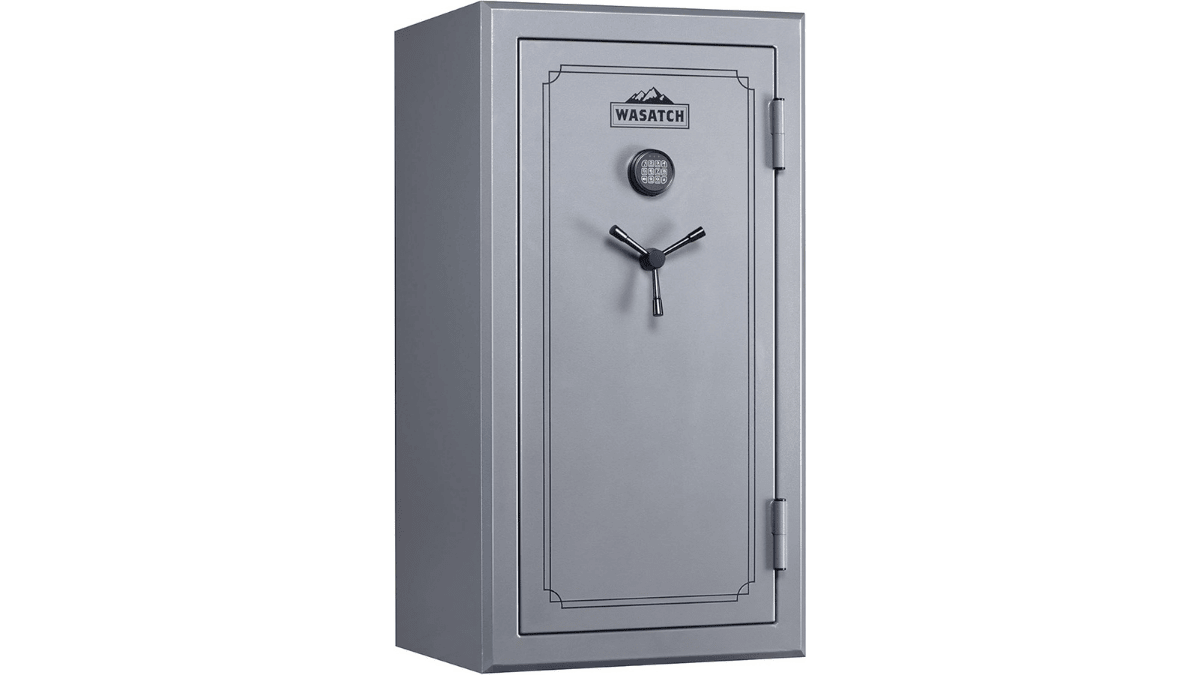
This Wasatch 40 gun safe review is all about the Wasatch 40EGW and whether it delivers real protection for the money, not just marketing. If you want a large safe that claims fire and flood resistance without jumping into premium-priced vault territory, this model is exactly what most users end up shortlisting.
Who it fits, who it doesn’t
The Wasatch 40 gun safe is best for someone who wants big interior space, a basic electronic lock, and fire plus water claims in a size that works for long guns and valuables. It is also heavy enough that you will respect the delivery day.
However, you need to be wary of this: real capacity is closer to the mid 20s once scopes and accessories enter the chat.

Product details at a glance
Here’s the quick spec picture.
| Spec | What you’ll see for the Wasatch 40 |
|---|---|
| Fire rating | 45 minutes at 1400°F |
| Water claim | 72 hours in 2 feet of standing water |
| Steel | 14-gauge |
| Bolts | 3 active 1.5-inch bolts plus 2 dead bolts |
| Door swing | External hinges, full 180-degree opening |
| Lock | Electronic lock, Alarm-U function, backup key |
| Door storage | Factory installed door storage |
If you want the “bigger and heavier, higher-tier” direction instead, look into our Steelwater 39 review. It’s pretty much ideal for those who are already sizing up large long-gun safes.
“40 guns” is not your real capacity
With the Wasatch 40 gun safe, capacity is where reality hits.
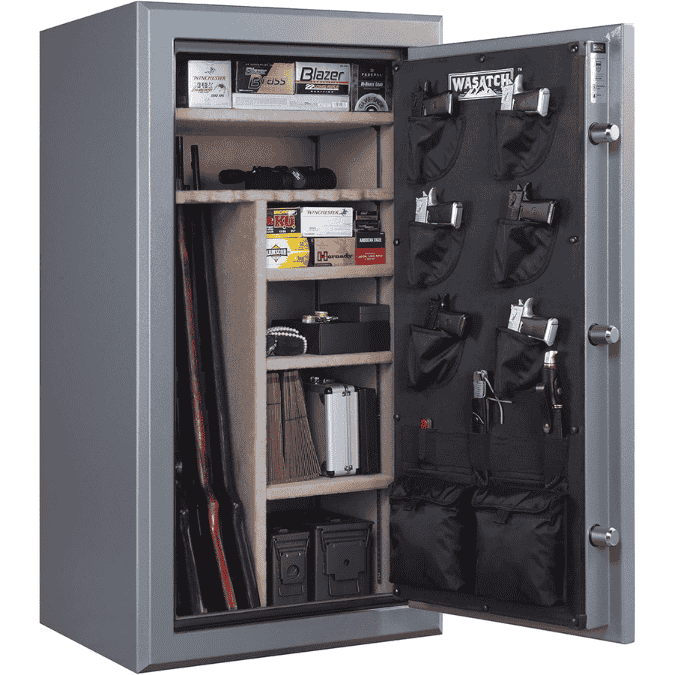
The label “40 gun” is usually measured with slim, unscoped rifles packed tight. In the real world, once you have optics, slings, extended mags, pistol grips, bipods, or thicker stocks, spacing becomes the limiter.
Another consistent takeaway is that the Wasatch 40 feels more like about 25 long guns if you want it to stay usable, plus room for several pistols on the door. That lines up with what’s reported in practice, and it is the number you would plan around if you care about quick access and not scratching everything up.
Build, door design, the “heavy-duty value”
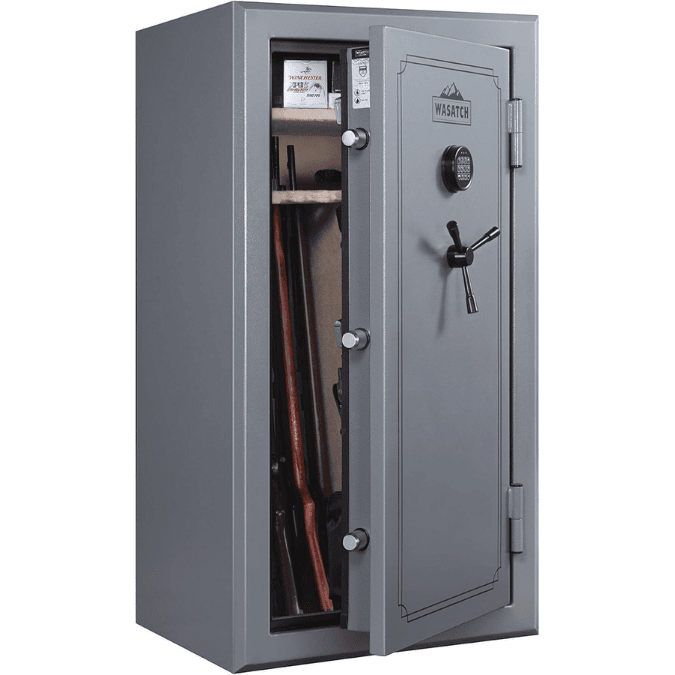
Wasatch positions this safe as a value-for-size play, and the design cues match that. You get external hinges for a full open door, and you also get recessed door geometry with tapered bolt design described as pry-resistance focused.
Steel thickness is set at 14-gauge. That is not “true safe” territory like higher-end American-built units, but it is a common gauge in the budget-to-mid range and it is still a serious upgrade over thin cabinets.
The boltwork is listed as 3 live action locking bolts plus 2 dead bolts. That is a simpler layout than some brands that advertise 10 or 12 total bolts, but bolt count alone is not the whole story. Door fit, hinge-side protection, and how the door locks into the frame all matter just as much.
The lock, the Alarm-U function, and the keypad issue
The Wasatch comes with an electronic lock that includes an Alarm-U function and a backup key. That is good for basic deterrence, and it also helps if you want a loud response to tampering rather than silent failure.
Now the practical part. The keypad is said to be backlit, yet according to one user review, it was not backlit in hand. That mismatch can happen across production runs, so it is smart to assume you may need a simple add-on light if night access matters to you.
Battery-wise, plan like a responsible owner. Replace the battery on a schedule, test the keypad monthly, and keep your override key stored responsibly. The goal is simple: no surprises when you actually need access.
Fire rating
This is a critical little trust checkpoint in our Wasatch 40 gun safe review.
It’s listed as 45 minutes at 1400°F (some sources also claim 30 minutes at 1400°F for the same model.) That is not a small difference, so you should treat it as something to confirm with your exact unit, not something to assume.
Also, remember what a fire rating is and is not. It is not a promise that every item inside will be untouched. It is more like a time window where the safe is designed to resist heat penetration long enough to protect contents in many common scenarios, especially when paired with smart placement in the home.
If you want extra confidence, check the safe label, check included paperwork, and screenshot the rating claim. That gives you a clean record if you ever need to use a warranty or dispute a mismatch.
Waterproof claim
Wasatch describes 72 hours in 2 feet of standing water. This is a big deal for two situations. One is a basement flood. The other is the mess after a fire where water ends up everywhere.
Still, you should not rely on any “waterproof” marketing as permission to ignore placement. Put the safe on a slightly raised base if you can. Use desiccants or a safe dehumidifier inside. Also, keep documents in sealed pouches because humidity is the quiet enemy, even when no flood happens.
Interior layout and door storage
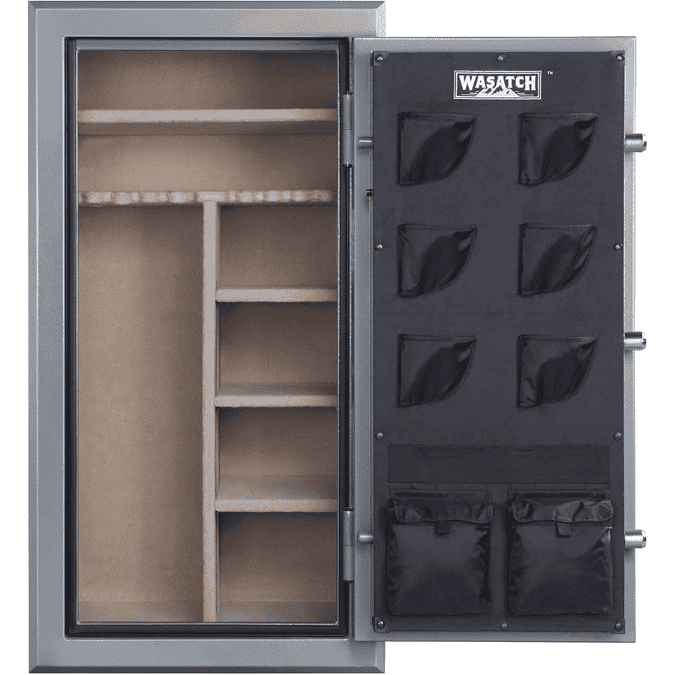
The interior design is one of the strongest reasons users develop interest in this safe. You get adjustable shelving, and you get factory installed door storage, which is actually useful in daily life.
Door storage is where pistols, mags, documents, and smaller valuables stop floating around on shelves. That organization also helps you keep long guns from turning into a tangled pile. If you already know you want a safe that supports a mixed loadout, this layout is a genuine win.
If you are shopping the opposite direction and want something compact, portable, and fast for travel or vehicles, our Vaultek Barikade Series 2 review is a better fit than any full-size long-gun safe.
Delivery, weight, and installation
Large safes are not fun when you treat them casually.
This model is listed as a heavy safe, so follow this theme: plan the route, plan the floor, and bring help.
You also want to anchor it. Weight slows thieves down, but it does not guarantee anything if the safe can be tipped or slid. Use the provided hardware if included, or use appropriate anchoring for your floor type, and do it as soon as you confirm placement.
One more practical point: check the packaging carefully. There can be a few issues, like a missing handle, or parts tucked into protective foam. So, inspect every corner of the packing before you throw anything away.
Pros and cons
Here is what stands out most often once people live with it.
| Pros | Cons |
|---|---|
| Big interior and good value for a large safe in this category | Some users report missing parts like a handle, so unboxing inspection matters |
| Realistic long-gun storage tends to land around the mid 20s with room for door pistols | Backlit keypad expectations are inconsistent (listing vs. real unit) |
| Fire and water protection claims are a major reason users opt for it | |
| Factory door storage adds daily convenience |
Quick comparison table
For context, Wasatch is a strong budget pick with decent fire and water claims, while Sports Afield, especially the 42-class and higher-end lines, generally steps up fire ratings, sometimes offers much longer waterproofing, and comes heavier and pricier depending on the model.
| Model | Fire rating claim | Water claim | Steel | Notes |
|---|---|---|---|---|
| Wasatch 40EGW | 45 min @ 1400°F | 72 hrs in 2 ft | 14-gauge | Great value-for-size |
| Sports Afield 42 class | 60 min @ 1400°F | Varies by model | 14-gauge on some models | Often a step up in fire time |
| Sports Afield brand line | 75 min @ 1400°F | Waterproof in 2 ft for 7 days | Varies | Heavier, typically pricier |
If you want a stronger “traditional heavy safe” vibe and you do not mind spending more, look at our Steelwater lineup reviews like Steelwater 20 and Steelwater 16 for a feel of what you get as you move up-market.
Buying guidance for the Wasatch 40
If you want the best experience with this safe, plan for your future collection, not just today. If you have 12 rifles now, you might think 40 is overkill. However, once you add optics, cases, and the “other valuables” category, the big interior becomes the point.
Also, decide what you value more between fire time and price. If you live where response times are slower, you may want to prioritize longer rated duration even if it costs more. On the other hand, if your main risk is theft deterrence plus basic fire and water resistance, the Wasatch 40EGW hits a strong value zone for many homes.
👉 If you are more focused on quick-access protection for a nightstand or travel, we recommend you check out our Vaultek LifePod review instead.
Bottom line
For most of you who land on this model, the answer is ‘Yes, go get it’, but with one condition. You just need to verify the fire rating minutes.
If you want a big, organized, long-gun safe with door storage and a solid set of baseline features, this safe is a practical pick. If you want premium steel thickness, top-tier support, and crystal-clear certifications, you should expect to pay more.
FAQs on the Wasatch 40
Is it really fireproof or “fire resistant”?
It’s fire-resistant, not “fireproof” in the literal sense. The Wasatch 40 is marketed with a 1400°F fire rating. Also, it’s normal in the safe world that “fireproof” is used loosely; even UL folks point out no safe is totally fireproof.
Is it truly waterproof for floods?
It’s rated waterproof for 72 hours in 2 feet of standing water (or “submerged under 2 feet”.) That’s strong for sprinkler run-off and shallow flooding, but it’s not a blank-check guarantee for deep, fast-moving, or long-duration floods.
How many long guns fit realistically with scopes?
Realistically, plan for about 20 to 25 long guns with scopes if you want it to stay usable (no scratched optics, no wrestling match every time you pull one out.)
“40-gun” ratings are typically based on slimmer, unscoped guns and ideal rack spacing, and optics and attachments cut.
Yes. It’s a battery-powered electronic keypad lock and the box lists a 9V battery included, plus a backup key for override. Keep a spare 9V outside the safe.
Can I bolt it down?
Yes. There’s a bolt-down kit mentioned, and it includes mounting hardware. Proper anchoring is still on you (concrete vs. wood anchors based on your floor.)
What should I do first after delivery?
Here’s what you should do: 1) start by checking for damage, 2) then confirm every part is included. 3) Test the lock before moving it. 4) Move it closed, 5) check the seal, 6) level it properly, 7) and plan anchoring before final placement.


