When it comes to the most revered magnum rifle cartridges in modern shooting and hunting, the 300 Winchester Magnum (300 Win Mag) and the 338 Winchester Magnum (338 Win Mag) stand out as potential options. Both options are popular for long-range performers. But they have differences related to energy delivery, recoil, trajectory, and optimal game use. These are potential factors that affect the precision and accuracy for hunters and shooters.
With this detailed guide, we will explain the origins, ballistic profiles, pros and cons, and best‑use scenarios of these options. It will help you choose the best options with confidence.
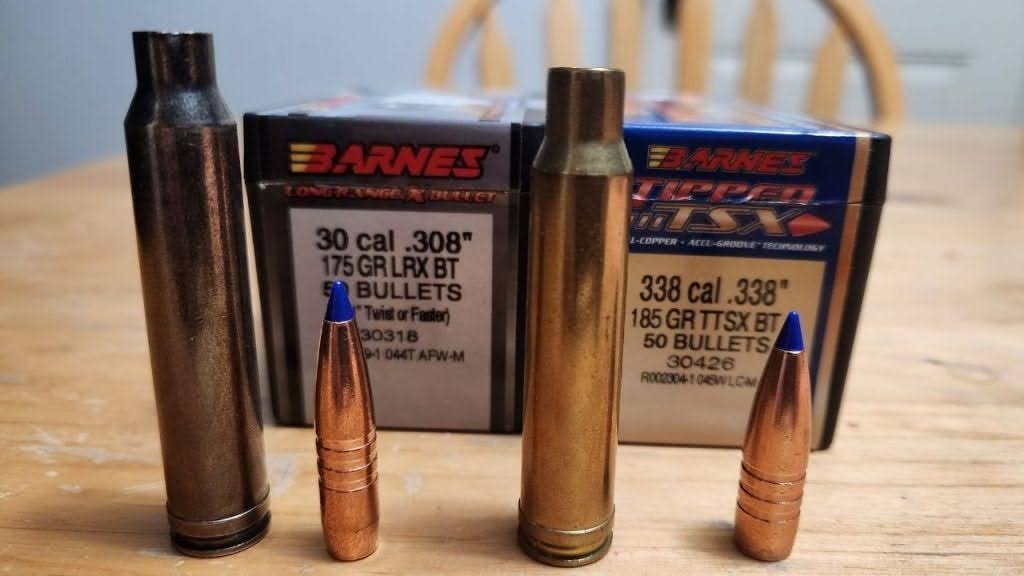
Cartridge Background & History
300 Win Mag
It was introduced by Winchester in the early 1960s. It quickly gained attention as a go-to option for long-range hunters and military/LE applications. It happened due to its flat trajectory and versatile features.
338 Win Mag
A few years after the introduction of the 300 Win Mag, the 338 Win Mag was introduced for heavier bullets and larger game. It proved to be a better option for situations where more energy on impact is required.
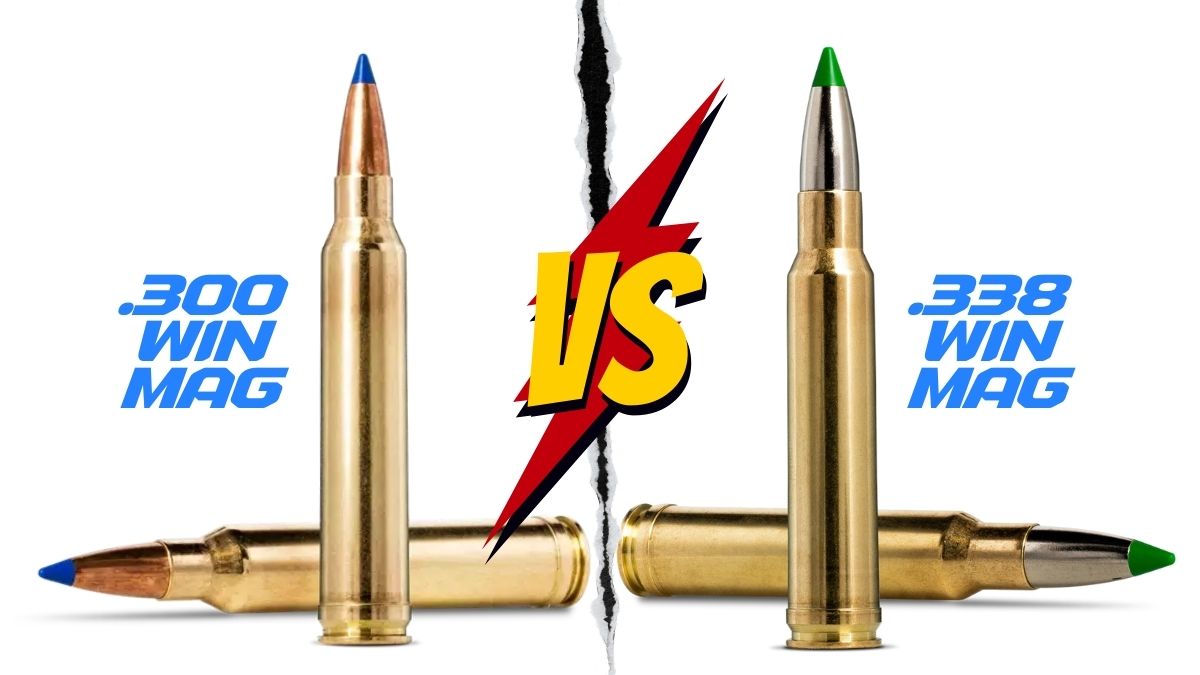
Quick Comparison Between .300 Win Mag vs .338 Win Mag
| Specification | .300 Winchester Magnum | .338 Winchester Magnum |
| Bullet Weight | 150-220 grains | 200-300 grains |
| Muzzle Velocity | 2,900-3,200 fps | 2,600-2,800 fps |
| Muzzle Energy | 3,500-4,000 ft-lbs | 4,000-4,500 ft-lbs |
| Recoil Energy | 20-25 ft-lbs | 30-35 ft-lbs |
| Effective Range | 800-1,000 yards | 600-800 yards |
| Case Capacity | 93.8 grains H2O | 86.0 grains H2O |
| Best For | Deer, long-range, target shooting | Elk, moose, bear, dangerous game |
| Ammo Cost (per box) | $35-$55 | $55-$85 |
| Recoil Level | Moderate | Heavy |
| Trajectory | Flatter | More arc |

Hunters and shooters have been interested in the considerations between .300 Win Mag vs .338 Win Mag for many years. Both cartridges are popular as heavy-hitting magnum rounds, but they still have unique purposes. The .300 Winchester Magnum offers incredible long-range accuracy with manageable recoil. In contrast, the .338 Winchester Magnum offers devastating stopping power for the largest North American game.
This comparison becomes interesting due to the fact that the .338 Win Mag has less case capacity than the .300. It still offers more raw energy through its larger bore diameter and heavier bullets. This precision makes the .338 a popular option among big-game hunters and professional guides.
When you consider the ballistics, recoil features, practicality, and prices, choosing the right magnum cartridge becomes simpler.
The Legacy of Two Winchester Magnum Cartridges
The .338 Winchester Magnum: Born for Big Game (1958)
The .338 Winchester Magnum was introduced in the market in 1958. It was specifically designed to cover the gap between normal deer cartridges and dangerous game calibers. Winchester Repeating Arms Company manufactured this cartridge to provide hunters with a powerful option for North American big game. It is without the severe recoil of African dangerous game rounds like the .375 H&H Magnum.
The .338 Win Mag was a popular option for its time. It offered hunters a cartridge that could clearly take elk, moose, and even brown bear from long distances. That’s why it became a go-to choice for Alaska and Canadian guides who required experienced stopping power for massive and potentially dangerous animals.
The .300 Winchester Magnum: Precision Meets Power (1963)
In 1963, after 5 years, Winchester introduced the .300 Winchester Magnum. It was a versatile and flat-shooting alternative for hunters interested in magnum performance without excessive recoil. It was primarily designed to compete with other popular .30-caliber magnums. It also provided better case capacity and velocity.
The .300 Win Mag offered instant success and is one of the most important magnum cartridges throughout the world. It combines flat trajectory, manageable recoil, and incredible long-range capabilities. These features made it a popular choice for Western hunters, long-range shooters, and even military snipers.
Now, both cartridges are still at the top in their specific categories. The .338 Win Mag stands out in the large-game hunting market. In contrast, the .300 Win Mag is popular for its versatility and long-range accuracy applications.
Ballistics & Performance Differences
.300 Winchester Magnum Ballistics
The .300 Win Mag is famous for its flat trajectory and intense velocity. It has a standard 180-grain bullet, which helps it achieve muzzle velocities around 3,000 feet per second (FPS). It also generates about 3,600 ft-lbs of muzzle energy.
Typical Load Performance:
- 150-grain bullets: 3,290 fps, 3,605 ft-lbs (ideal for deer and antelope).
- 180-grain bullets: 2,960 fps, 3,501 ft-lbs (most popular all-around load).
- 200-grain bullets: 2,825 fps, 3,545 ft-lbs (excellent for elk at extended range).
- 220-grain bullets: 2,680 fps, 3,508 ft-lbs (maximum penetration).
The .300 Win Mag has lighter and faster bullets, which help create an impressive flat trajectory. This makes range estimation less important, and hunters can take lethal shots at game more than 500 yards. But proper practice and equipment are necessary for such purposes.
.338 Winchester Magnum Ballistics
You can fire heavier bullets with the .338 Win Mag at a little lower velocity. But they offer significant downrange energy. A normal 250-grain bullet can achieve 2,800 fps at the muzzle, and generate about 4,350 ft-lbs of energy.
Typical Load Performance:
- 200-grain bullets: 3,000 fps, 4,000 ft-lbs (fast and flat for smaller game).
- 225-grain bullets: 2,800 fps, 3,918 ft-lbs (versatile all-around load).
- 250-grain bullets: 2,660 fps, 3,927 ft-lbs (most popular choice).
- 300-grain bullets: 2,450 fps, 4,001 ft-lbs (maximum penetration for dangerous game).
The heavy bullets can retain energy properly with the .338 Win Mag. They maintain nearly 2,000 ft-lbs of energy at 500 yards, unlike the .300 Win Mag’s 1,500 ft-lbs. The superior energy retention makes the .338 an efficient and effective option for large-bodied games at hunting distances.
Trajectory Comparison
The higher velocity of the .300 Win Mag ensures a flatter trajectory. It reduces the need for holdover or scope adjustments at different ranges. When narrowed at 200 yards with a 180-grain bullet, the .300 Win Mag drops approximately:
- 300 yards: -7.5 inches
- 400 yards: -22 inches
- 500 yards: -45 inches
The .338 Win Mag with a 250-grain bullet zeroed at 200 yards drops:
- 300 yards: -9 inches
- 400 yards: -26 inches
- 500 yards: -52 inches
Although the differences look minor in theory, the additional drop becomes massive while shooting at the game in the field. Range estimation errors are common in such spaces.
Recoil Comparison Between .300 Win Mag vs. .388 Win Mag
.300 Winchester Magnum Recoil
The .300 Win Mag generates approximately 20-25 ft-lbs of recoil energy in a typical 8-pound rifle. Most adult shooters can manage this level of recoil with proper technique and get time for instant follow-up shots.
Most hunters find the .300 Win Mag’s recoil as “stout but manageable.” It is noticeably more than a .308 Winchester but significantly less punishing than larger magnums. Shooters with a proper rifle fit and a high-quality recoil pad. They can usually fire 20-30 rounds in a practice session without flinching.
.338 Winchester Magnum Recoil
The .338 Win Mag kicks considerably harder, producing approximately 30-35 ft-lbs of recoil energy. It is roughly 50% more than the .300 Win Mag. Practically, it means the .338 offers a sharp and noticeable punch, which proves challenging for recoil-sensitive shooters.
If proper fundamentals are not maintained, hunters with extended practice sessions with the .338 Win Mag are physically taxing. The increasing recoil can lead to flinching. But for hunters who take one or two shots per season at large game, the recoil is totally manageable.
Recoil Management Tips for Both Cartridges
1. Proper Rifle Fit is Critical: The rifle should match your body proportions. The pull length must allow a comfortable cheek weld without straining your neck. The stock should also come to your shoulder naturally when you’re mounting the rifle.
2. Add a Quality Recoil Pad: Advanced recoil pads from manufacturers like Limbsaver, Pachmayr, and Sims help reduce felt recoil by 30-40%. The investment of $40-80 for a quality pad is worth every penny for magnum cartridges.
3. Consider a Muzzle Brake: Muzzle brakes are beneficial for decreasing felt recoil between 40-60%. But they massively increase muzzle blast and noise. They are essential for long-range precision shooting. But they are restricted in some hunting areas. Wearing hearing protection is a must.
4. Master Proper Shooting Technique:
- Pull the rifle firmly into your shoulder pocket.
- Lean slightly forward into the shot.
- Maintain consistent cheek weld.
- Follow through after the shot.
- Practice dry-firing to build muscle memory.
5. Start with Lighter Loads: When planning to learn the uses of .300 Win Mag or .338 Win Mag, start with decreased-power factory loads. You can also choose light bullet weights. It helps enhance confidence before you start using full-power hunting ammunition.
Effective Range Analysis: How Far Can You Shoot?
.300 Winchester Magnum Effective Range
The .300 Win Mag is famous for its large range and remains effective out to 1,000 yards. For precision shooting and 600-800 yards for ethical hunting. It proves one of the best options for open-country hunting due to its flat trajectory. Long shots are common in such areas.
Range Performance Breakdown:
- 0-300 yards: Minimal bullet drop, point-and-shoot simplicity.
- 300-600 yards: Requires range estimation and holdover, but the trajectory remains predictable.
- 600-1,000 yards: Demands precise range finding, wind reading, and ballistic compensation.
- Beyond 1,000 yards: Possible with match-grade ammunition and precision rifles, but generally beyond ethical hunting range.
The .300 Win Mag is a standout option among Western hunters interested in hunting mule deer, pronghorn, and elk across open sagebrush and mountain meadows. It’s also usable in long-range shooting competitions and has been preferred by military snipers due to its combined power and precision.
.338 Winchester Magnum Effective Range
The .338 Win Mag is highly effective between 600-800 yards for hunting applications. Rifle manuals usually list maximum effective ranges of 1,000-1,200 yards. But practical hunting effectiveness reduces beyond 600 yards due to increased trajectory arc and wind drift of heavier bullets.
Range Performance Breakdown:
- 0-300 yards: Devastating terminal performance, minimal concern for trajectory.
- 300-600 yards: Sweet spot for the .338, combining energy retention with manageable trajectory.
- 600-800 yards: Still effective but requires precise range finding and wind reading.
- Beyond 800 yards: Trajectory becomes increasingly challenging for field shooting conditions.
When maximum penetration and stopping powers are priority, the .338 Win Mag’s superior energy retention proves a better option. It proves ideal in dense cover where shots are shorter, and energy transfer proves more important than a flat trajectory.
Wind Drift Comparison
At 500 yards in a 10 mph crosswind:
- .300 Win Mag (180-gr): 16-18 inches of drift
- .338 Win Mag (250-gr): 18-21 inches of drift
The heavy .338 bullets drift a little because of their lower velocity. The difference is little, but still, both options require careful wind reading at extended ranges.
Hunting Applications: Choosing the Right Tool
Deer Hunting: .300 Win Mag vs .338 Win Mag
Winner: .300 Win Mag
The .300 Winchester Magnum is a better option for deer hunting, especially whitetail and mule deer. The flatter trajectory makes long-range shots manageable and offers more than enough energy for clean and ethical kills. It helps avoid excessive meat damage.

Why .300 Win Mag Excels:
- Flatter trajectory for a varied range of encounters.
- Less meat damage than the .338.
- More affordable practice ammunition.
- Lighter recoil allows better shot placement.
- Excellent ballistic coefficients for wind-bucking ability.

The .338 Win Mag can also prove vital in deer hunting, but it proves overkill for such medium-sized animals. The significant energy transfer leads to massive meat loss, especially with shoulder shots and closer-range shots. You can use the .338 for bigger and tougher animals, where its efficiency can prove vital.
Recommended .300 Win Mag Deer Loads:
- 150-165 grain bullets for whitetail.
- 165-180 grain bullets for mule deer.
- Premium bullets like Barnes TTSX, Nosler AccuBond, or Federal Trophy Copper.
Elk Hunting: The Great Debate
Winner: Depends on Range and Shooting Skill
That’s where most hunters feel confused. Both cartridges are beneficial as elk medicine, but their functionality differs.
Choose .300 Win Mag if:
- Hunting open country with shots beyond 400 yards.
- You’re recoil-sensitive but still want adequate power.
- You practice regularly and can place shots precisely.
- You want one rifle for both deer and elk.
Choose .338 Win Mag if:
- Hunting dark timber or brush where shots are under 400 yards.
- You need maximum energy transfer for quartering shots.
- You’re hunting mature bulls that require deep penetration.
- You want insurance against marginal shot placement.
Most professional elk guides choose the .338 Win Mag due to its massive safety margin on less-than-perfect shots. Elk are tough animals. But the .338’s superior penetration through heavy shoulder bones and into the vitals. It can make the difference between a quick, clean kill and a wounded animal.
Energy Comparison at Common Elk Hunting Ranges:
At 300 yards:
- .300 Win Mag (180-gr): ~2,450 ft-lbs
- .338 Win Mag (250-gr): ~2,900 ft-lbs
At 500 yards:
- .300 Win Mag (180-gr): ~1,500 ft-lbs
- .338 Win Mag (250-gr): ~2,000 ft-lbs
The .338 Win Mag maintains 33% more energy at 500 yards, leading to noticeably deeper penetration and larger wound channels.
Moose Hunting: Clear Winner for the .338
Winner: .338 Win Mag
.338 Winchester Magnum proves an ideal option for moose hunting. They are massive animals that weigh between 1,000 and 1,500 pounds with a heavy bone structure. They need deep-penetrating bullets for clean kills.
The .300 Win Mag with heavy 200-220 grain bullets can take moose. But the .338’s superior energy and larger bullet diameter provide a significant advantage. Moose hunts are usually expensive and remote affairs where you get one shot at a bull. Choosing the .338 provides the confidence that your bullet will penetrate completely, even on steep quartering angles.
Bear Hunting: Safety and Stopping Power
Winner: .338 Win Mag for Brown/Black Bears
Black Bear: Both cartridges are excellent for black bear hunting. The .300 Win Mag with 180-200 grain premium bullets is totally suitable. It offers benefits in accuracy and recoil for hunters who prefer longer shots over bait or in open country.
Grizzly and Brown Bear: The .338 Win Mag is strongly preferred for larger, more dangerous bears for hunting grizzlies or coastal brown bears. It especially happens in situations where a wounded bear might charge. The .338’s superior stopping power and penetration become critical safety factors.
Many Alaska and British Columbia guides won’t allow clients to hunt brown bears with anything smaller than .338 caliber. These bears can weigh 800-1,200 pounds, have thick hides and heavy bones. They require bullets that will penetrate deeply, even through dense muscle and heavy shoulder blades.
Long-Range Target Shooting
Winner: .300 Win Mag
The .300 Winchester Magnum proves a premium option for long-range shooting and precision rifle competitions. It is a primary choice for champions due to its flatter trajectory, a wide selection of high-BC match bullets, better barrel life, and lower recoil.
The .300 Win Mag is used extensively in:
- Precision Rifle Series (PRS) competitions.
- F-Class long-range competition.
- Benchrest shooting.
- Military and law enforcement sniper programs.
The .338 Win Mag is incredible for long-range shooting but is a less popular option for competitive shooting disciplines.
Cost & Ammunition Availability: Budget Considerations
.300 Winchester Magnum: Widely Available and More Affordable
Ammunition Cost:
- Budget factory loads: $35-$45 per 20 rounds.
- Premium hunting ammunition: $45-$65 per 20 rounds.
- Match-grade target ammo: $50-$75 per 20 rounds.
Availability: As one of the most popular rifle cartridges in North America, ammunition is constantly available at every sporting goods store, gun shop, and online retailer. You can also find 10-15 different load options from various manufacturers on any gun store shelf.
Reloading Components: The .300 Win Mag benefits from excellent component selection:
- Brass: $40-$60 per 50 cases (Lapua, Peterson, Norma available).
- Bullets: Widest selection of any magnum caliber (over 100 options).
- Powders: Multiple suitable options (IMR 4350, H4831, Retumbo, etc.).
Cost per Round (Reloading):
- Approximately $0.80-$1.20 per round for quality hunting loads.
- $0.60-$0.90 for practice ammunition.
.338 Winchester Magnum Pricing
Ammunition Cost:
- Budget factory loads: $55-$70 per 20 rounds.
- Premium hunting ammunition: $70-$95 per 20 rounds.
- Match-grade (limited availability): $80-$120 per 20 rounds.
Availability: The .338 Win Mag is less commonly stocked than the .300 Win Mag. Most gun shops have 3-5 load options, and you may need to order specific bullets or brands online. But know that all major ammunition makers produce .338 Win Mag ammunition. That’s why they are available, and proper planning is also essential.
Reloading Components:
- Brass: $55-$80 per 50 cases (more expensive but very durable).
- Bullets: Good selection but less variety than .300 Win Mag.
- Powders: Similar options to .300 Win Mag (IMR 4350, H4350, RL-19).
Cost per Round (Reloading):
- Approximately $1.10-$1.60 per round for quality hunting loads.
- Limited benefit in reloading practice ammunition due to component costs.
Total Cost of Ownership Comparison
Year One (100 rounds fired):
- .300 Win Mag: $4,000 rifle + $450 ammunition = $4,450
- .338 Win Mag: $4,000 rifle + $650 ammunition = $4,650
After Five Years (500 rounds):
- .300 Win Mag: $4,000 rifle + $2,250 ammunition = $6,250
- .338 Win Mag: $4,000 rifle + $3,250 ammunition = $7,250
The .338 Win Mag costs around $200 more per year for a hunter firing 100 rounds annually. For serious shooters practicing regularly, this difference compounds significantly over time.

Rifle and Barrel Considerations
Optimal Barrel Length
Both .300 Win Mag vs. .338 Win Mag benefits from longer barrels. This allows the entire powder burn and ensures maximum velocity.
.300 Win Mag:
- 24-inch barrel: Standard, very good performance.
- 26-inch barrel: Adds 50-75 fps, optimal for long-range.
- 22-inch barrel: Acceptable for mountain rifles, loses 75-100 FPS.
.338 Win Mag:
- 24-inch barrel: Minimum recommended length.
- 26-inch barrel: Optimal for maximum velocity and energy.
- 22-inch barrel: Significant velocity loss (100-150 FPS).
Shorter barrels increase muzzle blast and reduce velocity, which directly impacts downrange energy and trajectory. For hunting rifles, a 24-inch barrel provides the best balance of portability and performance for both cartridges.
Barrel Life Expectations
- .300 Win Mag: 1,500-2,500 rounds before accuracy degradation
- .338 Win Mag: 1,200-2,000 rounds before accuracy degradation
Both options are barrel burners because of large powder charges and high pressures. But most hunters will never shoot enough rounds to wear out a barrel in their lifetime. Competition shooters and serious long-range enthusiasts should budget for barrel replacements every 2-4 years.
Rifle Weight Considerations
Ideal Rifle Weights:
- .300 Win Mag hunting rifle: 8-9.5 pounds (scoped)
- .338 Win Mag hunting rifle: 9-10.5 pounds (scoped)
Heavy rifles decrease felt recoil and enhance shooting stability. However, they are harder to carry during long mountain hunts. The sweet spot for most hunters is a rifle that weighs 1 pound per foot-pound of recoil energy. It translates to:
- 8.5-9 pounds for the .300 Win Mag
- 10-10.5 pounds for the .338 Win Mag
Bullet Selection Guide to Maximize Performance
.300 Winchester Magnum Bullet Options
Lightweight Bullets (150-165 grains):
- Best for: Deer, antelope, mountain hunting, where shots may be long.
- Velocity: 3,100-3,300 fps.
- Advantages: Flattest trajectory, fastest time-of-flight, less wind drift.
- Popular choices: Barnes TTSX 150gr, Nosler Ballistic Tip 165gr, Hornady ELD-X 162gr.
Medium Weight Bullets (180-200 grains):
- Best for: All-around hunting, elk, mule deer, black bear.
- Velocity: 2,850-3,000 fps.
- Advantages: Best balance of velocity, energy, and penetration.
- Popular choices: Nosler AccuBond 180gr, Federal Trophy Bonded Tip 180gr, Swift Scirocco II 180gr, Hornady ELD-X 200gr.
Heavy Bullets (200-220 grains):
- Best for: Maximum penetration on elk, moose, and dangerous game.
- Velocity: 2,650-2,850 fps.
- Advantages: Deep penetration, high sectional density, superior energy retention.
- Popular choices: Nosler Partition 200gr, Swift A-Frame 200gr, Barnes TSX 200gr, Berger Hybrid 215gr.
.338 Winchester Magnum Bullet Options
Medium Bullets (200-225 grains):
- Best for: Deer, caribou, lighter elk.
- Velocity: 2,800-3,000 fps.
- Advantages: Flatter trajectory than heavier bullets, less recoil.
- Popular choices: Barnes TTSX 200gr, Hornady InterBond 225gr.
Standard Heavy Bullets (250 grains):
- Best for: Elk, moose, black bear (most popular weight).
- Velocity: 2,650-2,800 fps.
- Advantages: Excellent balance for North American big game.
- Popular choices: Nosler AccuBond 250gr, Swift A-Frame 250gr, Federal Trophy Bonded Bear Claw 250gr, Hornady InterLock 250gr.
Maximum Penetration (275-300 grains):
- Best for: Large bears, moose, and African plains game.
- Velocity: 2,450-2,600 fps.
- Advantages: Maximum penetration and bone-breaking capability.
- Popular choices: Swift A-Frame 275gr, Barnes TSX 285gr, Nosler Partition 300gr.
Premium Bullet Technology
Bonded Core Bullets (Federal Trophy Bonded, Swift Scirocco, and Hornady InterBond):
- The core bonded to the jacket prevents separation.
- Excellent weight retention (85-95%).
- Good choice for large game at all distances.
Monolithic Copper (Barnes TTSX/LRX, Hornady GMX):
- 100% weight retention.
- Deep, straight-line penetration.
- Required in some areas with lead bullet bans.
- Typically shoots best at higher velocities.
Polymer-Tipped (Nosler AccuBond, Hornady ELD-X, Sierra GameChanger):
- High ballistic coefficients for long range.
- Controlled expansion at varying velocities.
- Excellent accuracy in most rifles.
Partitioned Bullets (Nosler Partition, Swift A-Frame):
- Front half expands, rear half penetrates.
- Proven performance for 50+ years.
- Excellent for heavy-boned game.
Making Your Decision: .300 Win Mag vs .338 Win Mag
Choose the .300 Winchester Magnum If You:
- Hunt primarily deer, pronghorn, or similar medium game: The .300 Win Mag provides more than enough power without excessive meat damage.
- Take shots beyond 400 yards regularly: The flatter trajectory significantly simplifies range estimation and reduces holdover.
- You are recoil-sensitive or new to magnum cartridges: The 20-25 ft-lbs recoil is manageable for most shooters with proper technique.
- Want one versatile rifle for multiple species: From pronghorn to elk, the .300 Win Mag handles it all effectively.
- Value ammunition availability and affordability: Widely available at every gun shop with prices $15-25 per box, less than .338.
- Plan to practice frequently: Lower recoil and ammunition costs make regular practice more feasible.
- Participate in long-range shooting competitions: The .300 Win Mag is a proven competitor in precision rifle sports.
- Hunt in open country where flat trajectory matters: Western mountains, prairies, and open fields favor the .300’s trajectory.
Choose the .338 Winchester Magnum If You:
- Hunt large, heavy-bodied game like elk, moose, or brown bear: The .338’s energy advantage provides a significant safety margin on tough animals.
- Need maximum penetration and stopping power: Perfect for shots through heavy bone or at steep quartering angles.
- Most shots occur within 400 yards: Dense timber, thick brush, or mountainous terrain where distance is limited.
- You are comfortable with heavier recoil: If you can handle 30+ ft-lbs of recoil, the .338 delivers unmatched power.
- Hunt potentially dangerous game: Coastal brown bears and grizzlies require the .338’s authority.
- Want insurance against less-than-perfect shot placement: The .338’s massive energy transfer compensates for marginal hits better than any .30-caliber.
- Pursue once-in-a-lifetime hunts: When you’ve invested thousands in an Alaska moose hunt, the .338 provides confidence.
- Can accept higher ammunition costs: If budget isn’t a primary concern, the .338 delivers unmatched performance.
Expert Recommendations by Hunting Scenario
Mountain Elk Hunting (Open Country, 200-500 yards): .300 Win Mag with 180-200gr premium bullets.
Timber Elk Hunting (Close quarters, under 300 yards): .338 Win Mag with 250gr bonded or monolithic bullets.
Western Mule Deer (Mixed terrain, up to 600 yards): .300 Win Mag with 165-180gr bullets.
Moose in Alaska/Canada: .338 Win Mag with 250-275gr premium bullets.
Brown/Grizzly Bear: .338 Win Mag with 250gr Swift A-Frame or Barnes TSX (minimum).
Black Bear: Either cartridge works; .300 Win Mag with 180gr offers advantages.
Long-Range Target Shooting (600-1,200 yards): .300 Win Mag with high-BC match bullets.
African Plains Game (non-dangerous): .338 Win Mag with 250gr premium bullets.
Combination Deer/Elk Rifle: .300 Win Mag with 180gr as the best compromise.
Mountain Hunting (Weight-conscious, long carries): .300 Win Mag in a lighter rifle (7.5-8.5 lbs scoped).
Final Verdict: Which Magnum Wins?
The comparison between .300 Win Mag vs .338 Win Mag comes down to intended use rather than one being “better.”
The .300 Winchester Magnum is the superior all-around choice for most North American hunters. Its combination of flat trajectory, manageable recoil, wide ammunition availability, and effective power on game from deer to elk. This makes it one of the most versatile magnum cartridges ever designed. It excels in open country, long-range scenarios, and situations like precise shot placement at varying distances.
The .338 Winchester Magnum is the ultimate choice for hunters pursuing the largest, toughest game. In such games, maximum penetration and energy transfer are paramount. It provides a meaningful advantage on elk, moose, and bear, particularly at closer ranges, through heavy cover. Or when shot angles may be less than ideal. For dangerous game and once-in-a-lifetime hunts, the .338’s authority is unmatched by any .30-caliber cartridge.
Both cartridges are legendary for good reason. They’re accurate, reliable, and have proven their worth in the field over decades. You can’t make a wrong choice, only a choice that’s better suited to your specific hunting style and game pursuit.
Choose the .300 Win Mag for versatility, precision, and comfort. Choose the .338 Win Mag for power, penetration, and confidence on the biggest game. Either way, you’ll own one of the finest hunting cartridges ever created.
Frequently Asked Questions
The .338 Win Mag is more powerful. It delivers approximately 4,350 ft-lbs of muzzle energy with 250-grain bullets. Unlike the .300 Win Mag’s 3,600 ft-lbs with 180-grain bullets. But the power depends on the application.
The .338 Win Mag has significantly more recoil. It generates approximately 30-35 ft-lbs of recoil energy compared to the .300 Win Mag’s 20-25 ft-lbs, roughly 50% more. In practical terms, the .300 Win Mag delivers a manageable push that most shooters can handle comfortably. In contrast, the .338 Win Mag produces a sharp, heavy thump that can be challenging for recoil-sensitive shooters.
Yes, the .300 Win Mag is more than adequate for elk hunting. But pairing them with quality 180-200 grain bullets and ensuring a proper shot placement is vital. It has cleanly taken countless thousands of elk over six decades.
Yes, the .300 Win Mag is capable of cleanly taking moose and black bear with proper bullet selection. Use heavy, premium bullets in the 200-220 grain range with controlled expansion designs. They can involve options, like the Nosler Partition, Swift A-Frame, or Barnes TSX.
The .338 Win Mag’s recoil can be challenging for new shooters or those unaccustomed to magnum cartridges. At 30-35 ft-lbs of recoil energy, it’s noticeably more punishing than standard cartridges, causing flinching if proper fundamentals aren’t maintained. Beginners should start with lighter-recoiling cartridges to develop good shooting habits before stepping up to the .338 Win Mag.