This guide cuts through the noise for practical shooters and landowners who want the real story on varmint hunting, what it is, why it matters, and how to do it right. We keep things plain-spoken, skip the fancy talk, and include a few quick data points where they actually make sense.
What “varmint” means and why it matters
“Varmint” isn’t a biological category; it’s everyday language for animals that damage crops, property, or habitats. Depending on where we hunt, this can include ground squirrels, prairie dogs, marmots/woodchucks, jackrabbits, coyotes, foxes, feral hogs, and certain invasive or non-protected birds. Because the list changes by state or province, and public lands can have their own overlays, we always verify the local definition and the current rules before planning a trip. On U.S. National Wildlife Refuges, for example, general hunting rules plus unit-specific regulations are published annually in 50 CFR Part 32; refuges can be open or closed to particular methods or species, and those pages are the place to confirm the latest details.
Why varmint hunting exists (management, not mayhem)
Done legally and responsibly, varmint control is one tool among many for protecting working lands and native habitats. Burrowing species can undermine embankments and irrigation; overabundant populations can hammer crops and push out native wildlife. We frame the activity as purposeful pest management with a strong ethical center, clean shots, real backstops, and lawful methods, rather than as casual target practice on live animals. On public lands like refuges, method restrictions (e.g., night hunting, artificial light, electronic calls) and species lists are spelled out, read them, then build our plan around what’s explicitly allowed.
Law and access: the simple checklist we follow
We always confirm three layers. First, state rules (license or permit, seasons, species status, allowed methods). Second, unit-specific rules on public lands; in the U.S., refuge regulations live in Part 32 and on each refuge’s page. Third, private-land permission in writing, including dates, headcount, parking, and carcass handling. The exact links and PDFs change year to year, so we make a habit of checking the current pages before every trip.
Safety in open country
A varmint backdrop is often hardpan, rock, stubble, or water, surfaces that can throw a ricochet. Our rule is simple: no backstop, no shot. A steep dirt berm or hillside is ideal; if we can’t clearly see what’s in front of and beyond the animal, we don’t press the trigger. We keep muzzles managed around vehicles and fences, wear hearing and eye protection for sustained strings, and slow down when wind and mirage start to hide the real picture. These aren’t suggestions; they’re the same fundamentals taught in hunter-education standards nationwide.
Field hygiene and zoonoses
We carry nitrile gloves, cover cuts, and wash up after handling animals. We don’t touch sick or strangely tame wildlife, and we keep dogs vaccinated and away from carcasses. The public-health context is real: the CDC notes that around 4,000 animal rabies cases are reported in the U.S. each year, with over 90% occurring in wildlife like bats, raccoons, skunks, and foxes. Recent JAVMA surveillance reports 3,579 animal rabies cases in 2022 across 54 jurisdictions, a helpful benchmark when we think about precautions.
Choosing calibers that match real terrain
We size our cartridge to distance, wind, and target size, not to internet folklore. For shorter shots and quieter ranch work, rimfire can shine. For reach and wind, centerfire is the honest choice. Below is a compact, manufacturer-anchored snapshot to set expectations (muzzle velocities are typical factory specs; always confirm with our specific rifle and lot).
| Cartridge | Typical bullet weight | Typical factory MV | Where it shines |
|---|---|---|---|
| .17 HMR | 17 gr V-MAX | ~2,550 fps | Small rodents to ~150–200 yds in light wind; precise shot placement. |
| .22 WMR | 40 gr JHP/JSP | ~1,875–1,910 fps | Modest ranges where a bit more punch than .22 LR helps. |
| .223 Remington | 55 gr PSP/SP | ~3,240 fps | Versatile all-rounder for fox/coyote and windy days, with abundant ammo choices. |
| .22-250 Remington | 55 gr JSP/V-MAX | ~3,650–3,680 fps | Flat trajectories and decisive terminal effect on open prairie, with attention to barrel heat. |
We treat those numbers as starting points. Our rifle’s barrel length, altitude, temperature, and ammo lot will nudge real speeds and drops.
Bullet construction that actually helps
For small varmints, we prefer polymer-tipped varmint bullets (e.g., V-MAX/BT-style) because they’re designed for rapid expansion or fragmentation on impact. That yields quick, humane terminal performance on small targets and reduces ricochet risk compared with tougher, big-game bullets. Manufacturers are explicit about this design intent in their varmint lines; we stick with it for the use case it was built for.
Optics and stability
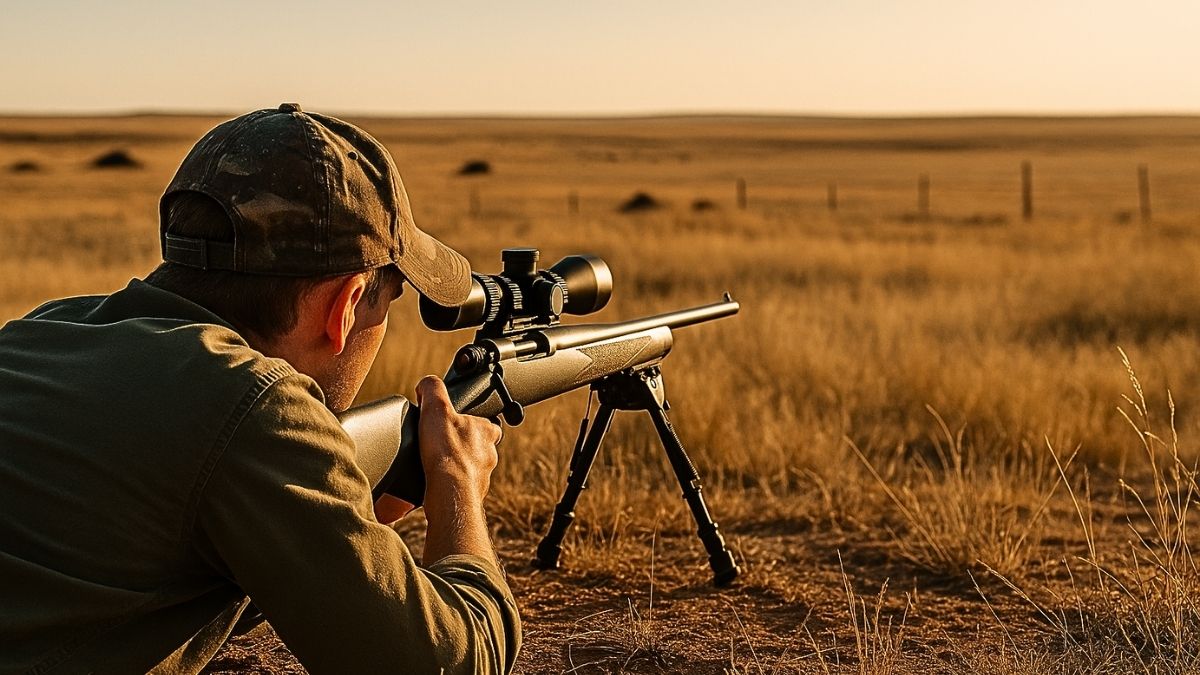
We prioritize a clear 3–9× or 4–12× scope with a simple MOA/MIL reticle and repeatable turrets. At the distances most of us shoot, stability matters more than magnification: a bipod plus a rear bag, a pack over a fencepost, or a tripod clamp when sitting will do more for clean hits than chasing 20× glass. We also log our dope on a card taped to the stock; even a perfect reticle can’t fix guesswork.
Day vs. night
Daytime varminting is about glassing, reading mirage, and managing the wind. Night predator control, if it’s legal where we hunt, is about lighting or thermal equipment and a tighter safety bubble, because depth perception changes in the dark. The method rules live in state regs and, for U.S. refuges, in the unit’s Part 32 page; we check those first and build from there.
Shot placement and follow-ups
On small rodents (prairie dogs, ground squirrels), center-mass shots with polymer-tipped varmint ammo are realistic and effective; precision head/neck shots demand rock-solid positions and perfect wind calls. On fox and coyote, we favor centerfire (.223/.22-250) and aim through the shoulder/boiler room for quick, humane outcomes. We stay in the scope through recoil to call our own hits and deliver an immediate follow-up if needed.
Range work that transfers to the field
Before any trip, we confirm a 100-yard zero and shoot multiple groups to verify both point-of-impact and consistency. We then build a small dope card: for centerfire, holds at 150/200/250/300 yards; for .17 HMR and .22 WMR, meaningful data from 50–200 yards, with wind notes in 5–10 mph increments. We also pay attention to cold-bore behavior and re-confirm if we change ammo lots.
Landowner etiquette that keeps access open
We call ahead with dates and headcount, park where asked, close every gate, avoid livestock, pick up brass where practical, and pack out trash. Afterward, we share results and ask whether a follow-up day would help. Access is a relationship; professionalism gets us invited back.
Ethics and public perception
We take high-percentage shots and pass on marginal wind or shaky positions. We stage photos thoughtfully and keep social posts respectful. Other land users will hear shots or meet us on a fenceline; being courteous and calm is part of the job.
Final Words
Varmint hunting isn’t casual plinking; it’s purposeful fieldwork with real conservation value when done right. We match our cartridge to our terrain, insist on safe backstops, keep shots inside our proven limits, and follow the letter of the law. Do that, and we protect habitat, help landowners, and come home better marksmen.
FAQs
Sometimes, but not everywhere. Some states set seasons or method limits even for unprotected pests. Public lands, including refuges, may have their own calendars and restrictions. We check current pages before every trip.
That depends on species, health, and local law. Some small game may be edible and legal to keep; others are typically left or used as legal bait. We follow the rules and any landowner instructions for carcass handling.
Often, a standard hunting license is required; certain methods (night hunting, thermal, electronic calls) can require additional permissions or may be prohibited. On U.S. refuges, the unit’s Part 32 page spells it out.