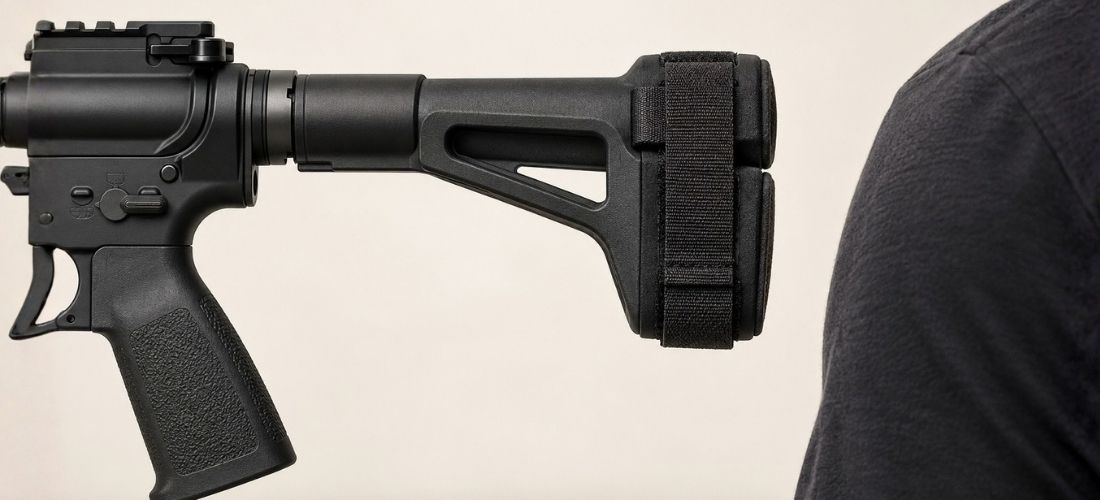
Can you shoulder a pistol brace and stay on the right side of federal law? As of September, 2026, generally yes, if the brace is still in its originally approved configuration and the shouldering is incidental rather than the firearm’s built-in purpose.
The 2023 rule that once said otherwise was vacated nationwide, but that vacatur didn’t declare every braced pistol legal to shoulder. The firearm’s actual design and configuration, and your own state’s laws, still decide the rest.
Can You Shoulder a Pistol Brace?
Under ATF’s April 2017 clarification, briefly shouldering a stabilizing brace that hasn’t been altered from its approved design doesn’t by itself redesign a pistol into a shoulder-fired rifle. That 2017 position is the federal starting point, and it survived the rise and fall of the 2023 factoring-criteria rule.
What changed in between is the regulation layered on top of it, not the underlying statute. The 2023 rule tried to reclassify large numbers of braced pistols as short barreled rifles (SBRs) using a factoring-point system. A federal court vacated that rule nationwide in 2024, and ATF’s proposed rule would formally strike the added language from its regulations. As of this writing, that proposal has not been finalized.
How the Pistol Brace Rule Got Here
The back-and-forth over braces spans nearly a decade of shifting agency guidance layered on a statute that hasn’t moved. Brace makers pushed ATF for a formal position after earlier, less consistent guidance left buyers unsure whether shouldering would count against them.
The table below lays out the key dates since.
| Date | Development |
|---|---|
| April 2017 | ATF issues a clarification letter: incidentally shouldering an approved stabilizing brace doesn’t redesign the pistol into a shoulder-fired weapon. |
| January 2023 | ATF finalizes a rule adding factoring criteria that reclassified many braced pistols as short barreled rifles unless registered. |
| June 2024 | A federal court vacates the 2023 rule nationwide, in the Northern District of Texas. |
| May 2026 | ATF proposes formally removing the 2023 rule’s added regulatory text; the proposal remains under review. |
| June 2026 | The making and transfer tax for SBRs and similar NFA items drops to $0, though registration still applies. |
Notice what isn’t on that timeline: A Supreme Court ruling, or any final rule stating that all braces are categorically legal. The vacatur removed one regulation. It didn’t rewrite the statute underneath it.
What Federal Law Actually Defines as a Rifle
Two separate questions decide whether a braced firearm counts as a rifle under federal law: what the statute itself says, and what ATF has said about shouldering. They come from different sources, they change on different timelines, and neither one cancels the other out. So if you’re wondering, “is it legal now?”, read on to find the answer.
The NFA’s Statutory Test
The National Firearms Act defines a rifle as a weapon designed or redesigned, made or remade, and intended to be fired from the shoulder, built to fire a single projectile through a rifled bore with each trigger pull.
A rifle with a barrel under 16 inches, or one modified to an overall length under 26 inches, falls into the short barreled rifle category and requires NFA registration.
That statutory language hasn’t changed at any point in this dispute. It’s the same test that separates a standard AR pistol from an SBR, no matter what ATF’s regulations say about braces in a given year.
The 2017 Clarification on Shouldering
In April 2017, ATF stated that incidentally shouldering a stabilizing brace, without altering the firearm’s approved configuration, doesn’t by itself redesign a pistol into a shoulder-fired rifle. That position is what most owners mean when they ask, can you shoulder a pistol brace without consequence.
ATF’s 2026 proposal leans back toward that 2017 standard, but it stops short of guaranteeing every brace on every firearm passes. ATF has been explicit that its proposal doesn’t create a categorical exemption. Classification of a specific firearm stays a factual question, evaluated case by case.
Configuration vs. Action
Shouldering is one variable. How the firearm is built is another.
The matrix below states general classification principles for three common setups. It isn’t a legal verdict for any specific brace, firearm, or manufacturer.
| Factor | Unmodified Approved Brace | Altered / Stock-Like Configuration | Registered SBR |
|---|---|---|---|
| Federal classification signal | Generally remains a pistol when used and configured as approved | May trigger the NFA’s redesign test for a rifle | Already classified as a short barreled rifle |
| Occasional shouldering | Not disqualifying under the 2017 clarification | Feeds into the redesign analysis, doesn’t decide it alone | Not a separate legal question; shouldering is expected |
| Registration required | No | Potentially, if reclassified | Yes, already completed through Form 1 or Form 4 |
None of these categories is self-certifying. A brace that looks unmodified but sits on a receiver already drilled or shaped for a stock raises a different question than the brace itself.
A Three-Part Test for Owners, Today
Tackling the question, can you shoulder a pistol brace, for a specific firearm means running through three separate checks. Each one stands on its own.

What the Vacatur Does, and Doesn’t, Change
The 2023 rule’s nationwide vacatur means ATF cannot enforce that rule’s factoring criteria and cannot use it to reclassify a braced pistol as an SBR. It doesn’t mean every brace configuration is now automatically legal, and it doesn’t erase the underlying NFA definition of a rifle. Those are two different legal instruments. Only one of them was struck down.
What Your Firearm’s Configuration May Still Trigger
A pistol changed from how it was originally sold, a brace swapped for a stock-like item, an added cheek weld, or a rear-heavy buffer tube modification, moves closer to the NFA’s redesign language regardless of what happens to any brace rule.
So does a pattern of use that looks less like incidental shouldering and more like the firearm is built and used as a shoulder-fired rifle. Neither factor decides the question by itself, but both feed into it.
What Your State Requires
Federal vacatur doesn’t touch state law. A number of states restrict braces, short barrels, or overall firearm length independently of whatever ATF does, and some require their own registration or apply outright bans in categories federal law otherwise permits. Checking state and local rules separately from the federal question is a necessary step, not an optional one.
The $0 Tax Doesn’t Mean No Paperwork
A separate change in 2026 lowered the making and transfer tax for short barreled rifles, short barreled shotguns, silencers, and other NFA-regulated items to $0, effective June 10, 2026. That’s a real change from the historical $200 stamp, and it matters for anyone planning to register a firearm as an SBR going forward.
It isn’t a shortcut around registration. Making or transferring an SBR still requires an approved Form 1 or Form 4, along with fingerprints, photographs, and ATF sign-off, before the firearm can lawfully exist in that configuration.
Owners who’d rather sidestep the SBR question entirely sometimes solve it at the barrel instead, using a pinned-and-welded muzzle device to keep overall length compliant without registering anything. Skipping registration because the tax is now $0 doesn’t remove the requirement, and an unregistered short barreled rifle carries the same federal exposure it did before.
Applying the Test: A Few Common Scenarios
The three-part test looks different depending on the actual firearm in front of you. A few common situations illustrate how.
- An unmodified brace, shouldered occasionally. This is the scenario the 2017 clarification was written for. It generally carries lower federal risk, though it’s still not a guarantee for every brace and receiver combination.
- A brace swapped for a stock, or a configuration ATF never approved. This looks like the redesign the NFA’s rifle definition targets, independent of whatever the brace-specific rule says at the time.
- A pistol already registered as an SBR through an approved Form 1. The shouldering question doesn’t apply here. The firearm is already lawfully a short barreled rifle, and it can be shouldered like any other rifle.
- Ownership in a state with its own brace or short-barrel restrictions. Federal status, vacated rule or not, doesn’t override a state law that’s more restrictive.
Where This Leaves Pistol Brace Owners
So the bottom line is: you gotta stay careful of these firearms-related laws, rules, and regulations, ALWAYS, AT ALL TIMES.
The 2017 clarification still stands for an unaltered, originally approved brace used as intended. The 2023 rule that briefly said otherwise is vacated and ATF has proposed formally removing it, but that proposal isn’t final, and it explicitly doesn’t hand out a blanket exemption.
The safest approach is the three-part test: know what the vacatur actually changed, know what your firearm’s real configuration and use pattern say about it, and know what your state separately requires.
Because ATF’s rulemaking is still open and could shift again before a final rule is issued, treat any brace-specific answer as current only as of the date it was checked, not as a permanent ruling. None of that is a substitute for reviewing your specific firearm against current ATF guidance, or with a qualified attorney if the answer matters to you.
FAQs
Can you shoulder a pistol brace without it becoming an SBR?
Under ATF’s 2017 clarification, occasionally shouldering a stabilizing brace that’s still in its originally approved configuration doesn’t by itself reclassify the pistol as a short barreled rifle. Altering that configuration, or using the firearm primarily as a shoulder-fired weapon, changes the analysis.
Did the 2023 ATF brace rule get overturned?
Yes. A federal court vacated the 2023 factoring-criteria rule nationwide in 2024, and ATF has since proposed formally removing the rule’s added regulatory language. That proposal was still pending as of this writing.
Is a pistol brace the same as a shoulder stock?
No. A brace is designed as a stabilizing aid rather than a shoulder-fire device, and that distinction is part of what keeps a braced firearm classified as a pistol. Swapping a brace for a stock-style attachment changes the firearm’s design in a way that federal law treats differently.
Does the $0 SBR tax mean I don’t need to register?
No. The making and transfer tax for SBRs dropped to $0 in 2026, but Form 1 or Form 4 approval, fingerprints, and ATF sign-off are still required before making or transferring one. Registration and the tax are separate requirements.
Do state laws still matter if the federal rule is vacated?
Yes. Vacating a federal regulation has no effect on state law. Several states impose their own restrictions on braces, barrel length, or overall firearm length that apply regardless of federal status, so state rules need to be checked separately.