The Mantis X10 vs X3 comparison comes down to training goals. Both provide reliable movement tracking, shot scoring, and corrective feedback during dry and live fire. The X3 is the better value for most pistol and rifle shooters, while the X10 Elite justifies its extra $80 with recoil measurement, holster-draw diagnostics, included adapters, and support for shotguns and bows.
Small mistakes during a trigger press are surprisingly difficult to recognize. The sights may dip for a fraction of a second, the support hand may relax, or the shooter may anticipate recoil without realizing it. Traditional practice reveals the result on the target, but it does not always explain what caused the miss. That is where the Mantis X10 vs X3 comparison becomes useful.
Both are compact motion sensors that attach to your equipment and turn barely visible movement into clear, shot-by-shot feedback. The X3 focuses on the fundamentals most pistol and rifle shooters need, while the X10 Elite expands the experience with advanced recoil, holster-draw, shotgun, and archery tools. The right choice depends less on which sensor is more capable and more on which features will genuinely improve your regular training.
Mantis X10 vs X3 at a Glance
| Feature | Mantis X3 | Mantis X10 Elite |
|---|---|---|
| Dry-fire training | Yes | Yes |
| Live-fire training | Yes | Yes |
| Recoil measurement | No | Yes |
| Holster-draw diagnostics | No | Yes |
| Shotgun support | No dedicated mode | Yes |
| Archery support | No | Yes |
| Pistol and rifle support | Yes | Yes |
| Included adapters | None beyond standard mount | BR7 barrel mount and Universal MagRail |
| App access | Core pistol/rifle functions | Pistol, rifle, shotgun, and archery functions |
| Best for | Fundamentals and general practice | Advanced, defensive, and multi-discipline training |
What Is the Mantis X3?
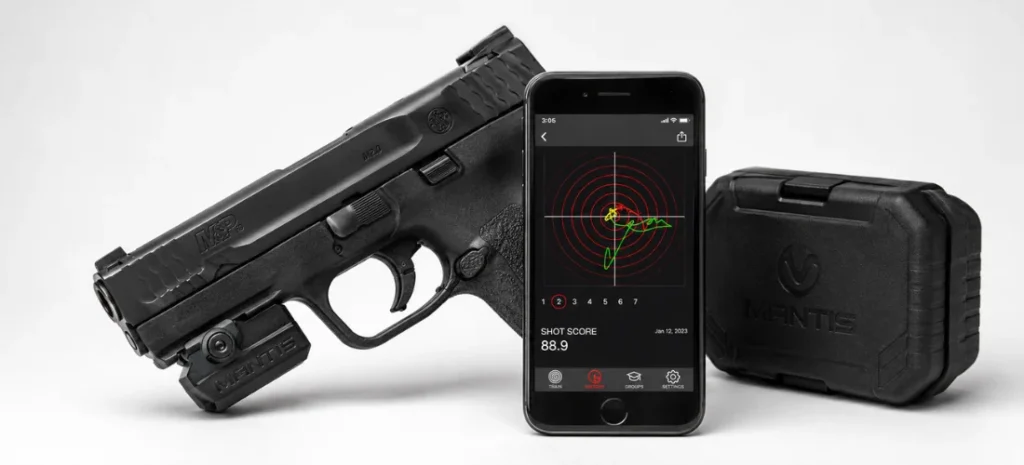
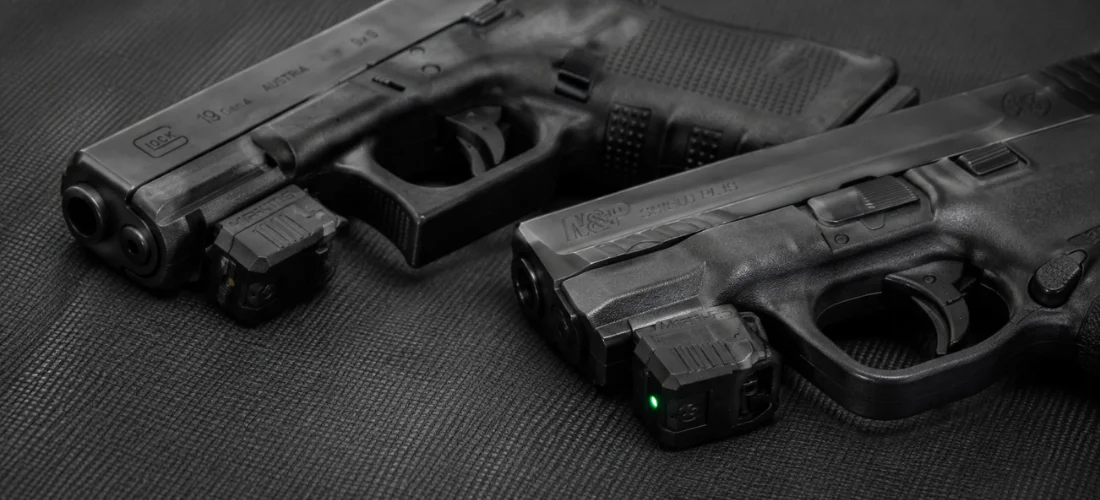
The Mantis X3 is a compact motion sensor that attaches to a pistol or rifle and records movement immediately before, during, and after the trigger press. It connects to a compatible phone or tablet through Bluetooth and supports practice at home as well as shooting at the range.
A Mantis X3 review should begin with what the unit actually measures. It does not use a camera to locate holes on a target. Instead, its internal sensors record the firearm’s orientation and movement, allowing the software to identify common handling errors.
As a motion sensor dry fire training tool, the X3 is especially useful for finding movement that is difficult to see with the naked eye. It can show whether the muzzle dipped, drifted, or moved sharply as the shot broke.
The sensor supports pistols, rifles, and airsoft or CO2 trainers. However, it does not provide the advanced draw, recoil, shotgun, or archery functions reserved for the X10 Elite.
The X3 is not dry fire only. Unlike the less expensive X2, it can detect and record shots during live range sessions.
What Is the Mantis X10 Elite?
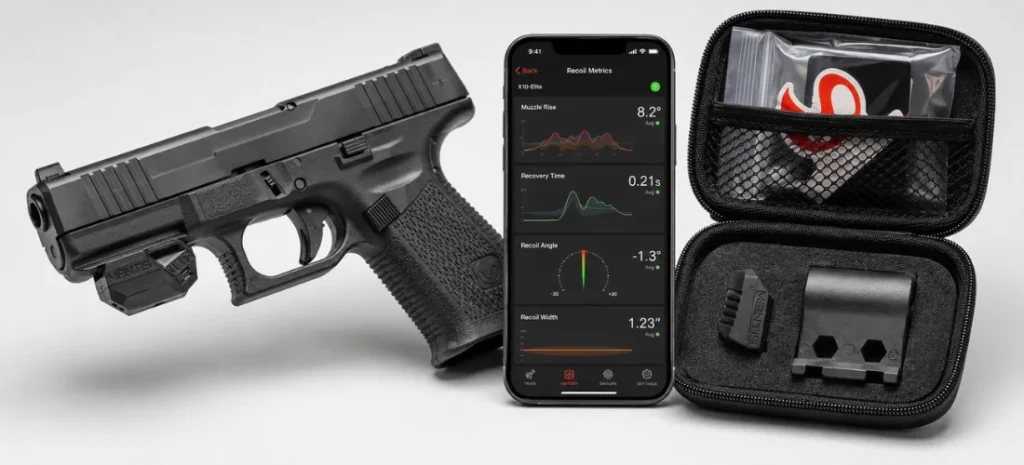
The Mantis X10 Elite is the flagship sensor in the standard MantisX lineup. It combines the core pistol and rifle functions of the X2 and X3 with advanced tools for analyzing defensive draws, firearm recovery, multi-target transitions, shotguns, and bows.
In our Mantis X10 Elite review, we loved its advantage: versatility rather than better basic shot scoring. For ordinary slow-fire pistol exercises, its fundamental feedback is similar to what the X3 provides. Its value appears when the shooter starts using the extra training modes.
As a complete shooting performance system, the X10 Elite suits users who move between several disciplines or need more information than a basic stability score can provide.
The bow/archery mode records movement through the draw, hold, release, and follow-through phases, expanding the sensor beyond firearms.
The package also includes mounting accessories that would otherwise have to be purchased separately. These additions make the higher price easier to justify for shooters whose equipment does not have a convenient accessory rail.
Key Differences Between the X10 Elite and X3
The central Mantis X10 Elite vs X3 difference is not basic accuracy training. Both units detect firearm movement, score the shot, identify likely mechanical errors, and preserve session data. The X10 adds specialized modes and broader equipment support.
Someone performing controlled presses with one pistol may see little practical benefit from upgrading. A defensive or multi-discipline shooter can use considerably more of the X10’s toolkit.
Recoil Analysis
The X10’s recoil analysis measures four useful components: muzzle rise, recovery time, recoil angle, and recoil width. These measurements help reveal how consistently the gun returns toward its original orientation after each shot.
The feature requires live ammunition because there is no actual recoil during an unloaded trigger press. It is most valuable when comparing grip techniques, ammunition loads, stance adjustments, or different firearms.
The X3 can record live fire tracking and score movement around the shot, but it does not provide the X10’s dedicated Recoilmeter breakdown.
Recoil data should not be treated as a contest to produce the lowest possible number. A better goal is repeatability. Look for a controlled return path and consistent recovery rather than trying to force the muzzle unnaturally downward.
Holster Draw Analysis
The X10 divides a draw into timed stages, helping the shooter identify where delays or unnecessary movement occur. It also overlays movement paths so inconsistent presentations become easier to recognize.
The dedicated holster draw analysis is particularly useful when a shooter cannot tell whether lost time occurs during the initial grip, removal from the holster, rotation, extension, sight confirmation, or trigger press.
The X3 includes timers and general exercises, but it does not produce the X10’s detailed draw-path diagnostics.
Safe practice remains essential. Begin with an unloaded firearm, remove ammunition from the room, use a suitable backstop, and confirm that the chosen holster can safely accommodate the mounted sensor. Speed should only increase after the movement is controlled.
Firearm and Equipment Compatibility
Both sensors work with most pistols and rifles when a suitable mounting point is available. They are caliber-independent because neither device enters the chamber or barrel.
The X10 has dedicated shotgun compatibility and includes a BR7 barrel-mounted rail that makes sensor placement easier on long guns without an accessory rail.
The X10 can also run the company’s archery application. Its included Universal MagRail can help with pistols whose forward rail is unavailable or whose holster will not accept a mounted sensor.
The X3 is the practical choice for a pistol, rifle, or airsoft user. Adapters remain available separately when the firearm lacks a suitable mounting slot.
Price Difference and What You Get for It
At current list prices, the X10 Elite costs exactly $80 more than the X3. That additional amount buys:
- Dedicated recoil measurements.
- Detailed draw-stage timing.
- Draw-path overlays.
- Shotgun training access.
- Archery application access.
- Multi-target and movement-oriented exercises.
- A BR7 barrel-mounted rail.
- A Universal MagRail adapter.
If you are asking whether Mantis X10 is worth the extra money, count the features you will genuinely use. One required adapter plus regular defensive-draw practice can narrow the effective price difference considerably. If those additions will stay in the case, the X3 provides better value.
The broader MantisX model comparison is simple: X2 handles unloaded pistol and rifle practice, X3 adds range use, and X10 Elite adds advanced analytics and multi-discipline support.
Setup and Mounting
Setting up either sensor normally takes only a few minutes:
- Charge the sensor.
- Install the free app on a compatible device.
- Mount the sensor securely.
- Switch it on and connect through the app.
- Select the firearm and practice type.
- Confirm the sensor’s mounting direction.
- Calibrate while holding the firearm still.
- Begin with slow, deliberate shots.
The sensor can be mounted forward, backward, or upside down. The selected orientation must match the application setting, or the resulting trace may be misleading.
Rail Mounting
The sensor clamps directly onto a slotted accessory rail. A Picatinny rail mount is usually the fastest arrangement on a full-size handgun or modern rifle.
Tighten the attachment enough to prevent movement, but do not force the screw. A sensor shifting between shots can create inconsistent readings that resemble a technique problem.
Forward mounting is convenient for stationary exercises, but it may stop the firearm from fitting its regular holster. Magazine-floorplate or model-specific adapters can move the sensor away from the dust cover when draw practice is required.
Using the Universal Adapter for Guns Without a Rail
A firearm without an accessory rail requires a model-specific mount or universal adapter. Mantis offers magazine-floorplate, barrel, shotgun, and other attachment solutions through its adapter finder.
The X10 package includes a Universal MagRail, although some firearms still require a separate model-specific accessory. The X3 does not include this adapter.
Verify fit before ordering. Compact magazines, unusual baseplates, revolvers, and low-capacity versions of otherwise common pistols may require different hardware.
App Experience and Data Tracking
Both sensors connect to the same MantisX app, so the basic interface is familiar regardless of which unit you buy. The application detects shots, assigns scores, draws movement patterns, suggests corrections, and offers drills and guided courses.
The visual muzzle trace is the most immediately useful screen. It separates the approach to the target, movement during the trigger press, and movement after the shot, allowing the shooter to see exactly when instability entered the sequence.
Its trigger control analysis associates movement patterns with possible problems such as tightening the fingers, pushing forward, breaking the wrist, or anticipating the shot. These suggestions are diagnostic clues rather than unquestionable conclusions.
The app’s coaching feedback becomes more helpful when users focus on one repeated issue instead of reacting to a different tip after every trigger press.
With historical performance tracking, sessions can be filtered by firearm and compared over time. This is more meaningful than chasing one unusually high score because it shows whether improvement is sustained across several practices.
The X10 unlocks its specialized draw and recoil screens and works with separate shotgun and archery applications. Core shooting exercises, courses, groups, daily challenges, and shot history are shared with the X3.
What Improves With Each Model
The X3 is designed to surface errors in grip stability, sight movement, and trigger control. The X10 Elite provides those same fundamentals, then adds information about recoil recovery and draw efficiency.
In practical Mantis X10 vs X3 training, neither device automatically makes a shooter more accurate. Improvement comes from using the trace to identify one repeatable error, adjusting the technique, and checking whether the movement becomes smaller and more consistent.
The X3 is excellent for:
- Smoothing a heavy or unfamiliar trigger press.
- Comparing support-hand pressure.
- Reducing anticipation.
- Building consistent pre-shot stability.
- Comparing unloaded and live sessions.
- Creating a measurable practice routine.
The X10 adds value for:
- Measuring draw-to-first-shot time.
- Identifying inefficient draw stages.
- Comparing recoil recovery between loads.
- Evaluating muzzle-return consistency.
- Training with shotguns.
- Recording bow movement.
Neither sensor shows the precise location of a real or simulated hit. It evaluates firearm movement, not point of impact. Shooters should still use a clearly defined target and confirm results during responsible range practice.
Mantis X10 Elite vs X3: Pros and Cons
Mantis X3 Pros and Cons
Pros
- Covers both unloaded and live range sessions.
- Provides the same core movement diagnostics as the X10.
- Works with pistols, rifles, airsoft, and CO2 trainers.
- Costs $80 less than the flagship model.
- Includes free application access without a required subscription.
- Compact enough to leave mounted during longer sessions.
Cons
- Does not measure recoil recovery.
- Lacks detailed draw-stage diagnostics.
Mantis X10 Elite Pros and Cons
Pros
- Includes every core X3 function.
- Measures muzzle rise and recovery during live fire.
- Breaks defensive draws into timed stages.
- Supports pistols, rifles, shotguns, and bows.
- Includes two useful mounting accessories.
- Better suited to advanced and multi-discipline practice.
Cons
- Costs more despite producing similar basic shot scores.
- Advanced screens can provide more data than beginners need.
Which Mantis Should You Buy?
Buy the X3 if you primarily train with a pistol or rifle, want both home and range data, and care most about grip, stability, and trigger-press improvement. It delivers the essential Mantis experience without charging for specialized modes you may never open.
Buy the X10 Elite if you practice defensive draws, want quantitative recoil data, use a shotgun or bow, need included mounting accessories, or expect your training routine to expand. The additional $80 is reasonable when two or more of these capabilities will be used regularly.
For a budget-conscious pistol owner, the X3 is the smarter purchase. For an instructor, competitive shooter, serious concealed carrier, or multi-discipline user, the X10 Elite is the more complete long-term choice.
Mantis X10 vs X3 vs Mantis Laser Academy
Mantis Laser Academy is a different kind of product. It uses a firing-pin-activated laser cartridge, printed target, and phone camera to record simulated hit location and shot timing. The X3 and X10 Elite attach externally and analyze movement without projecting a laser.
Choose Laser Academy when you mainly want to see where simulated shots land. Choose an X-series sensor when you want to understand what the firearm did before and during the trigger press.
Some shooters use both systems because they answer different questions. The motion sensor explains why the gun moved, while the camera-based system shows where the laser struck.
For a direct comparison between camera-tracked cartridge systems, head to our review of the Strikeman dry fire system.
Final Verdict
The Mantis X10 vs X3 comparison has a straightforward winner for each buyer. The X3 is the best value for most pistol and rifle owners because it preserves the core diagnostics and works during both home and range sessions. The X10 Elite is worth paying more for when recoil recovery, defensive-draw timing, included adapters, shotgun training, or archery support forms a real part of your routine. It is more capable, but it is not automatically more useful.
FAQs
The X10 Elite is worth the additional $80 if you will use its defensive-draw diagnostics, recoil measurements, shotgun application, archery application, or included adapters. For ordinary pistol and rifle fundamentals, the X3 supplies nearly the same core movement feedback at a lower price.
Yes. The X3 detects and records shots during both unloaded practice and live range sessions. This capability distinguishes it from the less expensive X2. Its range data focuses on firearm movement and trigger mechanics, however, rather than providing the X10 Elite’s dedicated recoil-recovery measurements.
Yes. The X10 Elite supports pistols, rifles, shotguns, airguns, and bows through the appropriate application and mounting arrangement. Its package includes a BR7 barrel-mounted rail for rifles or shotguns and a Universal MagRail that can support several other equipment configurations.
Yes. Both connect by Bluetooth to the main MantisX application and share its core scoring, traces, exercises, courses, coaching, and session-history functions. The X10 Elite additionally unlocks specialized recoil and draw tools and can connect with the company’s dedicated shotgun and archery applications.
No. The X10 Elite is an externally mounted movement sensor that diagnoses firearm handling during home and range sessions. Laser Academy uses a chamber cartridge and phone camera to record simulated hit locations during unloaded practice. They can complement each other, but they collect different information.