Quick verdict: The VNSH Belly Band Holster is a comfortable, belt-free way to carry many compact, subcompact, and full-size handguns, and it shines with clothing that can’t support a standard holster. The trade-off is its soft, universal pocket. It can’t match a firearm-specific Kydex holster for rigid trigger protection, retention, or concealment control, so every gun must be checked in it before carry.
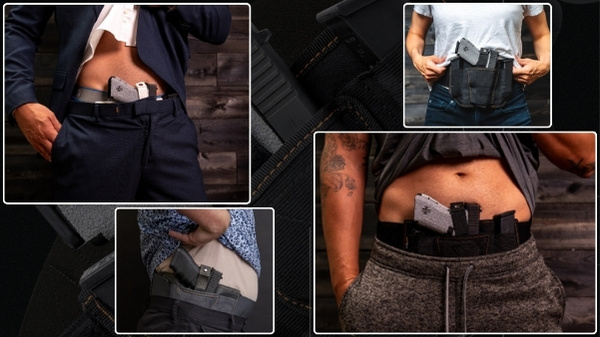
Most inside-the-waistband holsters depend on a stiff gun belt. They can also dig into your side when you sit, drive, or bend. The VNSH takes a different route: a wide, adjustable band wraps around the torso and holds the handgun without touching your belt or pants at all.
I’m Thomas Harvey, and I research, evaluate concealed-carry and everyday-carry gear. Rather than repeating the “fits 99% of handguns” claim, I judge the VNSH against the standards that matter for any carry holster: full trigger-guard coverage, secure retention, a clean draw, and safe reholstering.
Trigger coverage gets the most weight here, for good reason. Keeping your finger off the trigger until you’re ready to shoot is one of the core NSSF firearm safety rules. A holster has to do the same job for fabric, straps, and anything else that could reach the trigger. Sizing and configuration details in this review follow VNSH’s published specifications.
Below, you’ll find the full specs, how the band performs for comfort, concealment, retention, and draw, and who should skip it. If you’re still weighing materials or carry positions, our guides on Kydex vs leather holsters and AIWB vs IWB carry are useful companions.
What Is the VNSH Belly Band Holster?
The VNSH is a concealed-carry belly band designed to hold a handgun without requiring a separate gun belt. The adjustable band wraps around the waist or lower torso and closes using a hook-and-loop system.
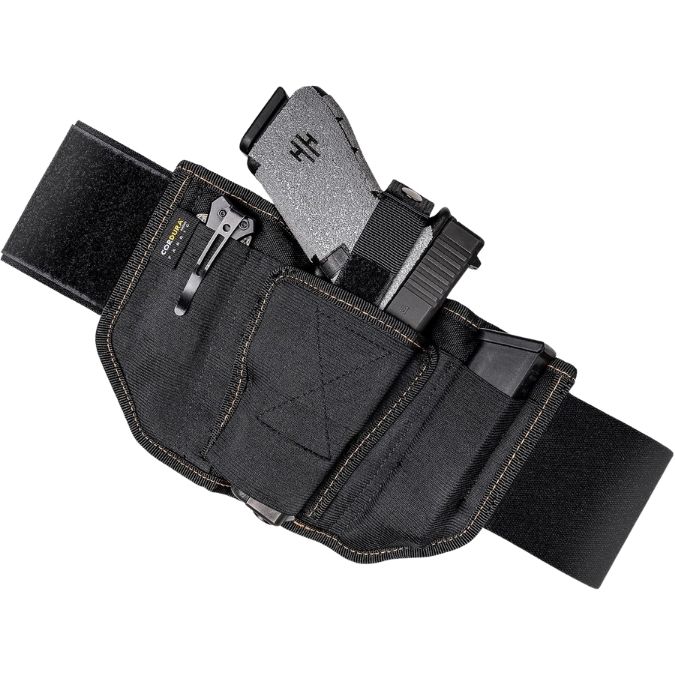
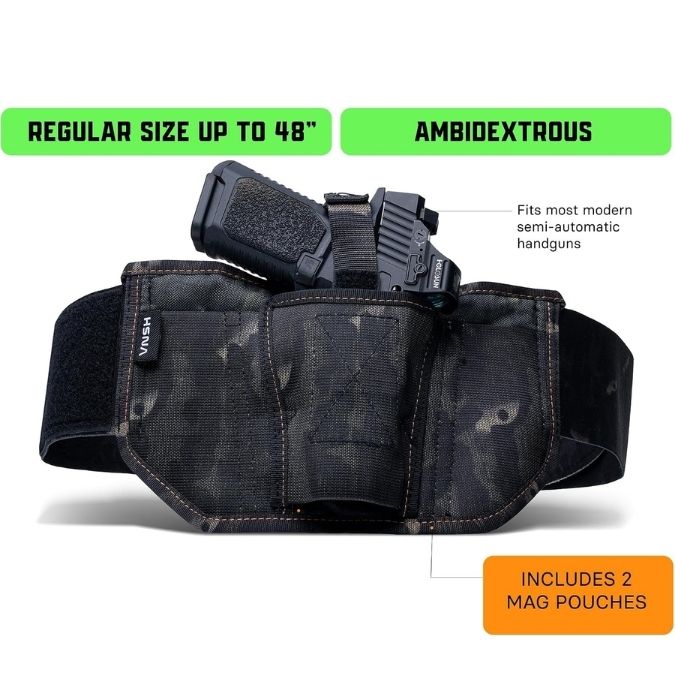
Its firearm compartment is sewn into a reinforced section of the band. An adjustable strap provides secondary retention over the handgun. Two integrated accessory pockets can hold spare magazines or similarly sized everyday-carry equipment.
These holsters fit approximately 99% of modern handguns. Its universal compartment can physically accommodate many popular pistols, but that does not mean every firearm will receive an equally secure fit.
A small subcompact pistol, for example, may sit too deeply in the compartment. A heavy full-size handgun might fit but produce more movement, sagging, or printing. Owners must evaluate their specific firearm instead of relying exclusively on the universal-fit claim.
Current VNSH options also include non-weapon-light and weapon-mounted-light configurations. The standard non-light model is generally ambidextrous, while the WML versions may require users to select a right- or left-draw configuration.
How Does the VNSH Holster Work?
The band wraps around the torso and attaches using a large hook-and-loop area. Because it does not connect to the pants, the wearer can position it above, below, or directly behind the waistband.
The holster can also be rotated around the body. This allows the handgun to be placed in the appendix, strong-side, or behind-the-hip position. The ideal position depends on body shape, firearm size, mobility, clothing, and the ability to establish a complete firing grip.
Once the firearm is inserted, the adjustable strap closes over it to provide active retention. The two neighboring pockets can hold spare magazines, provided their contents cannot interfere with the firearm or trigger area.
This arrangement is simple, but it lacks the detailed adjustments of many modern Kydex holsters. There is no dedicated cant hardware, concealment claw, wedge, or adjustable belt clip. Most fit changes are made by tightening, loosening, raising, lowering, or rotating the entire band.
Specs of the VNSH Belly Band Holster
| Specification | Details |
|---|---|
| Brand | VNSH |
| Holster type | Belly band concealed-carry holster |
| Material | Nylon with reinforced 1000D denier nylon |
| Color | Black |
| Closure system | Hook and loop |
| Product weight | Approximately 6 ounces |
| Regular size | Fits up to approximately 48 inches |
| XL size | Fits up to approximately 68 inches |
| Standard orientation | Ambidextrous on designated non-WML models |
| WML orientation | Dedicated right- or left-draw configurations |
| Retention system | Adjustable secondary retention strap |
| Accessory storage | Two integrated magazine pouches |
| Gun belt required | No |
| Carry positions | Appendix, strong side, or behind the hip |
| Weapon-light compatibility | Only on designated WML versions |
| Optic compatibility | Depends on the firearm, optic, and selected configuration |
| Intended use | Concealed everyday carry |
Features of the VNSH Holster
Comfort and Everyday Wear
Comfort is the strongest reason to consider the VNSH. The broad band distributes firearm weight over a larger area than a narrow belt clip. It also eliminates the hard edges that sometimes press into the abdomen or hip with a rigid inside-the-waistband holster.
This can make the VNSH comfortable while driving, working at a desk, completing household tasks, or wearing casual clothing. The weight of a larger handgun feels more manageable when distributed across the band.
Comfort still depends on correct sizing and placement. If the band is too loose, it may move with the firearm. If it is excessively tight, it may restrict movement or become uncomfortable when sitting.
Sweat is another consideration. A belly band covers more skin than a conventional holster and may retain heat during extended wear. The firearm should be inspected and cleaned regularly because prolonged moisture exposure can affect certain finishes and metal components.
Concealment Performance
The VNSH can conceal effectively, but results depend heavily on the wearer’s body shape, handgun, clothing, and carry position.
Loose shirts, sweatshirts, jackets, and structured fabrics are generally more forgiving. Thin or fitted garments can reveal the grip, retention strap, or thickness of the reinforced compartment.
The holster’s main concealment limitation is its lack of grip-rotation hardware. Modern appendix holsters often use a claw to rotate the grip toward the body. A wedge can also adjust the angle of the holster and reduce printing. The VNSH does not provide these features.
Wearers must instead experiment with vertical placement and positioning around the torso. Moving the firearm slightly away from the body’s widest point may help reduce printing, but it should never compromise access or trigger coverage.
Trigger Protection and Safety
A suitable concealed-carry holster should completely cover the trigger guard and prevent the trigger from being moved while the firearm is holstered.
The VNSH uses reinforced fabric rather than a fully rigid shell. The outer material is relatively substantial, but sections of the compartment remain flexible. That makes individual fit testing particularly important.
Before carrying, owners should use an unloaded firearm to confirm that:
- The entire trigger guard is covered.
- Firm pressure through the material cannot move the trigger.
- The firearm cannot rotate inside the compartment.
- The retention strap cannot enter the trigger guard.
- Clothing and drawstrings cannot enter the holster.
- Accessories in neighboring pockets cannot reach the firearm.
If the trigger can be moved through the material or accessed through an opening, the combination should not be used. Physical fit alone does not make a holster suitable for concealed carry.
Retention and Draw Performance
The VNSH uses an adjustable strap to help keep the firearm inside its compartment. This is necessary because a universal fabric pocket cannot create the molded friction fit provided by a firearm-specific Kydex shell.
The strap can improve retention during ordinary movement, but it complicates the draw. It must be intentionally released before the handgun can be removed.
If the strap is not cleared correctly, it may slow access or cause the band to rise as the user pulls the firearm upward. The entire process can feel less natural than drawing from an open-top Kydex holster.
Practice should begin with a verified unloaded firearm. The wearer must learn how to clear clothing, release the strap, establish a complete grip, and draw without pulling the band out of position.
The unloaded setup should also be tested while walking, sitting, bending, and crouching. If the handgun shifts significantly or begins leaving the pocket, the band is either incorrectly adjusted or unsuitable for that particular firearm.
Reholstering the VNSH Holster
Reholstering requires more care with a soft-sided holster. Unlike molded Kydex, the VNSH compartment may not remain completely open after the handgun is drawn.
The retention strap, shirt material, or waistband could move toward the opening. Any material entering the trigger guard while the handgun is inserted creates an unnecessary hazard.
Never force a handgun into a partially collapsed compartment. When possible, remove or clearly expose the holster, inspect the pocket, carefully insert the firearm, and then reposition the band.
Reholstering should always be slow and deliberate. There is rarely a practical reason to return a handgun to concealment quickly.
Pros and Cons
| Pros | Cons |
|---|---|
| Does not require a conventional belt | Flexible material offers less rigid trigger protection |
| Works with sweatpants, shorts, leggings, and similar clothing | Universal fit is less precise than firearm-specific molding |
| Accommodates a broad range of handgun sizes | |
| Regular and XL sizes cover many body types |
Who’s It For
Best For
The VNSH Belly Band Holster is best for owners who prioritize belt-free comfort and clothing versatility. Compact handguns will usually offer a better balance between concealment and stability than particularly heavy full-size models. Very small pistols, however, can sometimes sit too low to allow immediate grip access.
Skip If
Skip the VNSH if rigid trigger protection and firearm-specific retention are essential requirements. A firearm-specific Kydex holster will normally provide more consistent trigger coverage, grip access, draw geometry, and retention.
How to Choose a VNSH Belly Band Holster
Here’s what you should consider before buying the VNSH Belly Band holster.
Exact Firearm Compatibility
Confirm compatibility with the complete firearm setup, not merely its model name. A red-dot optic, suppressor-height sights, manual safety, laser, or weapon-mounted light can affect fit.
The firearm should sit securely while leaving enough grip exposed to establish a complete firing grip.
Trigger Coverage
Complete trigger protection should be non-negotiable. If the trigger guard remains exposed or the trigger can be pressed through the material, choose a different holster.
Regular or XL Size
The Regular model fits up to approximately 48 inches, while the XL extends to approximately 68 inches. Measure the location where the band will actually be worn instead of relying on pants size.
Carry Position
Test whether appendix, strong-side, or behind-the-hip positioning provides the best combination of comfort, concealment, stability, and access.
Clothing and Climate
Consider how the band will work with summer clothing, work uniforms, outerwear, and athletic apparel. Belly bands can feel warmer than traditional belt-mounted systems.
Retention Preference
Owners who dislike manual retention straps may find the VNSH draw unnecessarily complicated. A rigid open-top holster with properly tuned passive retention may be preferable.
What You Should Avoid
There are various factors that users should avoid before buying the VNSH belly band holster.
- Avoid purchasing solely because the holster is advertised to fit almost every modern handgun. Universal compatibility does not guarantee safe or dependable retention.
- Avoid using the wrong configuration with a weapon-mounted light. Select the designated WML version and correct the draw orientation.
- Avoid carrying the band loosely. Excessive movement can alter grip access and expose the firearm.
- Avoid overtightening the band to compensate for an unsuitable fit. It should remain stable without restricting normal breathing or movement.
- Avoid carrying keys, knives, loose ammunition, or unrelated objects inside the handgun compartment.
- Avoid allowing spare magazines or accessories to migrate toward the trigger area.
- Avoid practicing initial draws with a loaded handgun. Confirm fit and establish safe movements with an unloaded firearm first.
- Avoid assuming that comfort equals safety. If the holster does not protect the trigger, retain the firearm, and provide consistent access, its comfort is irrelevant.
Conclusion
The VNSH Belly Band Holster provides a practical answer to one specific problem: Carrying a handgun without relying on a traditional belt. Its flexible band works with casual and athletic clothing, distributes weight comfortably, accommodates numerous handgun sizes, and includes useful magazine storage.
Those benefits come with genuine compromises. Its universal fabric compartment cannot provide the same firearm-specific fit, rigid trigger protection, grip rotation, or consistent retention as a molded Kydex holster. The manual retention strap can also slow the draw, while the soft opening requires greater care during reholstering.
FAQs
VNSH advertises compatibility with approximately 99% of modern handguns, including many subcompact, compact, and full-size pistols. However, physical fitness does not guarantee proper trigger coverage, retention, concealment, or grip access. Every firearm and accessory configuration must be tested individually.
Yes. The VNSH wraps directly around the waist or lower torso and uses a hook-and-loop closure. It does not depend on a belt or belt loops, making it useful with sweatpants, athletic shorts, leggings, scrubs, and similar clothing.
It can only be considered suitable when the specific firearm’s trigger guard is completely covered, external pressure cannot move the trigger, and the gun remains securely retained. Its flexible construction does not provide the same rigid protection as a firearm-specific Kydex shell, so careful unloaded testing is essential.
Designated VNSH weapon-mounted-light models are available with right- and left-draw configurations. The standard version should not be assumed to support a light. Check compatibility with the exact firearm and light before purchasing.
The principal difference is band length. According to VNSH, the Regular model fits measurements up to approximately 48 inches, while the XL version fits up to approximately 68 inches. Measure the torso where the band will be worn rather than relying on your normal pants size.