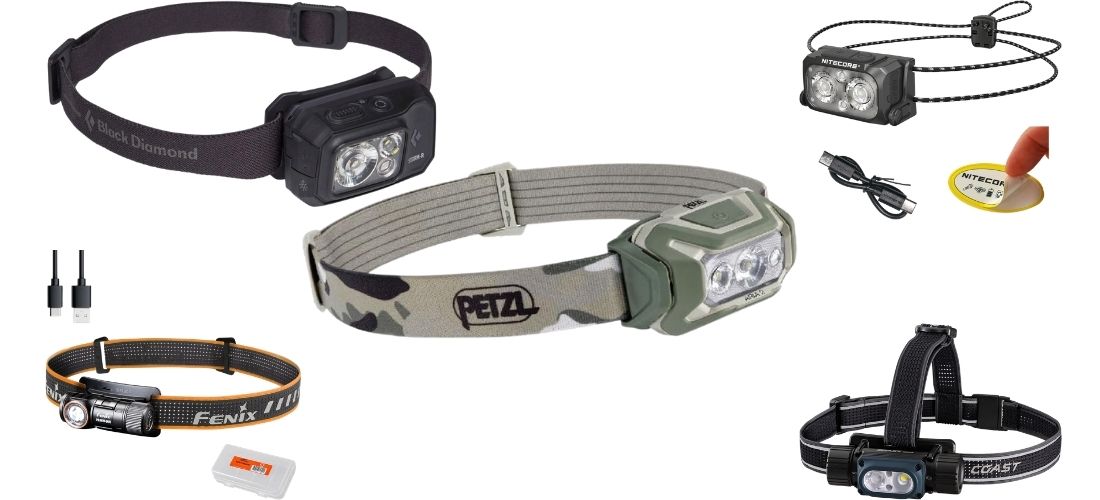
The best hunting headlamps fit the way you hunt. I’d choose the Petzl ARIA 2 RGB for AAA power and colored modes, the Nitecore NU25 MCT UL for a lighter pack, and the COAST WPH34R when output matters more than weight. Compare charging, controls, and drawbacks before choosing yours.
How I selected these hunting headlamps
I assessed these models through comprehensive product research. To compare the best hunting headlamps, I considered exact versions, published specifications, power arrangements, lighting options, fit concerns, and purchase-changing drawbacks. I wanted a few distinct choices rather than the top lamps competing on the same headline number.
Generation and package details matter, too. The lineup below keeps the legacy Petzl E070BA01 separate from newer versions, identifies the Nitecore MCT UL by its elastic-cord headband, and retains the selected Fenix organizer bundle. I also distinguish features from guarantees: an IP rating does not promise unlimited immersion, and a high lumen figure does not establish hours of constant brightness. The best headlamp for hunting is the one whose compromises fit your trip and equipment.
Compare the best hunting headlamps
These top lights solve different problems. Start with your power plan and how long you expect to wear the lamp, then compare its lighting options. Each product name takes you to its full review.
| Rank | Exact model | Best fit | Maximum white output | Power and charging | Main compromise | Price |
|---|---|---|---|---|---|---|
| #1 | Petzl ARIA 2 RGB, Camo, E070BA01 | AAA power and RGB flexibility | 450 lumens on AAA | Three AAA; optional CORE rechargeable battery | CORE costs extra; controls need practice | See price on Amazon |
| #2 | Black Diamond Storm 500-R, Black | Dimming and brightness memory | 500 lumens | Built-in rechargeable; Micro-USB | No quick battery swap | See price on Amazon |
| #3 | Nitecore NU25 MCT UL, Black, Elastic Cord | Low carry weight | 400 lumens | Built-in rechargeable; USB-C | Minimalist cord may feel uncomfortable | See price on Amazon |
| #4 | Fenix HM50R V2.0, LumenTac Organizer Bundle | Detachable task-light use | 700 lumens | Replaceable 16340 rechargeable; USB-C | Limited high-output endurance | See price on Amazon |
| #5 | COAST WPH34R, Blue/Black, Model 30833 | Higher-output camp tasks | 2,000 lumens | Rechargeable or three AAA; USB-C | Substantial front-loaded weight | See price on Amazon |
Note: Maximum output is not sustained output. The figures above also do not describe the brightness of red, green, or blue modes.
The best hunting headlamps I’d choose
Each light earns its place for a particular use. Here is where I’d choose it and where I would hesitate.
Petzl ARIA 2 RGB, Camo, E070BA01
Highlight: Flexible AAA power with white, red, green and blue lighting.
Key features: 450-lumen maximum on AAA batteries • Three white brightness levels • RGB lighting • Three AAA batteries or optional CORE battery • IP67 protection • 106 g with standard batteries
![Petzl ARIA 2 RGB Headlamp - Camouflage (450 Lumens) [Legacy] | best hunting headlamps](https://gunnersreview.com/storage/2026/10/Petzl-ARIA-2-RGB-Headlamp-Camouflage-450-Lumens-Legacy.jpg)
I’d choose the Petzl ARIA 2 RGB if you want a hunting headlamp that can run on spare AAA batteries when charging is inconvenient. This Camo E070BA01 is the legacy 450-lumen version, with a mixed white beam for walking and separate red, green and blue lighting. The appeal is flexibility: you can use white light when you need a clearer view of the trail, then switch to a colored mode for close-range tasks. I see it as a practical walking and camp light, rather than a dedicated long-distance search light. The colored modes are especially worth considering if you already know which ones you use.
What matters most to me is the choice of power source. You can start with three AAA batteries and add a compatible Petzl CORE rechargeable battery later. That gives you a route to rechargeable use without losing the ability to carry replacement cells. I would budget for the CORE separately, because this version does not include it. The three white brightness settings also provide a straightforward way to trade output for endurance. I’d use the lower settings whenever they give enough light for the task, keeping maximum output for shorter checks. The IP67 protection is another useful feature for wet-weather trips, provided the battery compartment is properly closed.
My main reservation is how much handling this design asks of you. Switching colors takes some familiarity, and I would practice the button sequence before relying on it in the dark. Battery access and the headband adjusters also deserve a careful check; I would make sure the cover sits flush and the strap holds its setting before heading out. I’m cautious about treating this as a guaranteed trouble-free choice for remote trips, particularly if you change batteries frequently. The housing is not my first choice for someone seeking the smallest possible lamp, either. For you, the strongest reason to choose it should be its replaceable power and RGB options, not an expectation of effortless controls or unlimited runtime.
Pros and Cons
| Pros | Cons |
|---|---|
| Runs on readily carried AAA batteries | CORE rechargeable battery costs extra |
| Compatible with an optional CORE battery | Color controls and battery access take familiarization |
| White plus red, green and blue lighting | |
| IP67 dust and water protection |
Best for: Hunters who want RGB lighting and the ability to replace AAA batteries in the field.
Skip if: You want a very small headlamp with immediately obvious color controls and a rechargeable battery included.
Black Diamond Storm 500-R, Black
Highlight: Adjustable lighting with brightness memory and RGB modes.
Key features: 500-lumen maximum • White and RGB lighting • Adjustable brightness • Brightness Memory • PowerTap control • Micro-USB charging
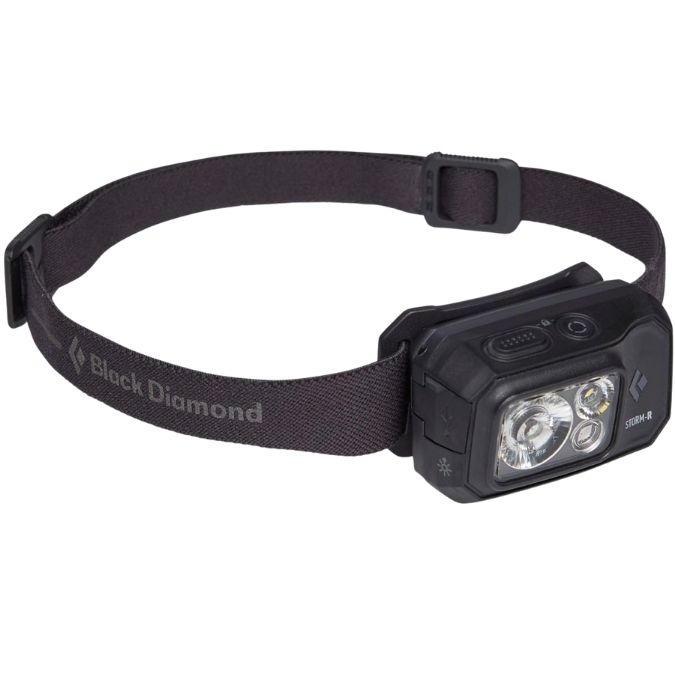
The Black Diamond Storm 500-R makes sense to me when you want more control over light output than a few fixed settings provide. You can adjust brightness, choose between white and colored lighting, and use Brightness Memory to return to your chosen output. I’d consider that especially useful when moving between a trail, camp and close-up equipment checks. You do not need the full 500-lumen maximum for every task, and avoiding unnecessary brightness is often more comfortable when working near another person. This is the Black rechargeable 500-R, with Micro-USB charging, so I would check that model designation carefully before comparing it with newer Storm versions.
I like the combination of dimming and a quick brightness change. PowerTap lets you move between full and dimmed output without repeatedly stepping through settings, while red, green and blue modes broaden the choices for low-light tasks. For you, that can mean keeping a comfortable working level and calling on more light when needed. The integrated rechargeable battery also removes routine disposable-battery changes from the equation. I would treat this as a convenient option for day hunts and trips with dependable charging access. Its IP67 protection adds useful resistance to dust and water, although it does not make careful handling of the charging-port cover unnecessary.
PowerTap is also my biggest control reservation: touching the side while adjusting the lamp can change the brightness when you did not intend to. I would not choose it if that sort of shortcut is likely to frustrate you. Micro-USB means carrying another cable if your other equipment uses USB-C, and the integrated battery prevents a quick field swap. My confidence in long-term charging and electrical reliability is also qualified; I would check charging, shutoff and every color mode before a trip, and avoid making this my only light on a remote hunt. The smaller mode button and headband adjustment deserve a trial with your usual gloves and hat. I recommend it most strongly for its lighting controls, with those ownership compromises understood.
Pros and Cons
| Pros | Cons |
|---|---|
| Brightness can be adjusted to the task | PowerTap can change brightness unintentionally |
| Brightness Memory retains the chosen output | Micro-USB charging and no quick battery swap |
| Red, green and blue lighting options | |
| IP67 dust and water protection |
Best for: Hunters who value adjustable brightness and RGB lighting and can recharge between outings.
Skip if: You require USB-C, field-swappable batteries or controls without a touch-sensitive shortcut.
Nitecore NU25 MCT UL, Black, Elastic Cord
Highlight: Minimal carry weight with selectable white-light color temperatures.
Key features: 400-lumen maximum • 47 g including bracket and headband • Three white-light color temperatures • Two red brightness options • USB-C charging • IP66 protection
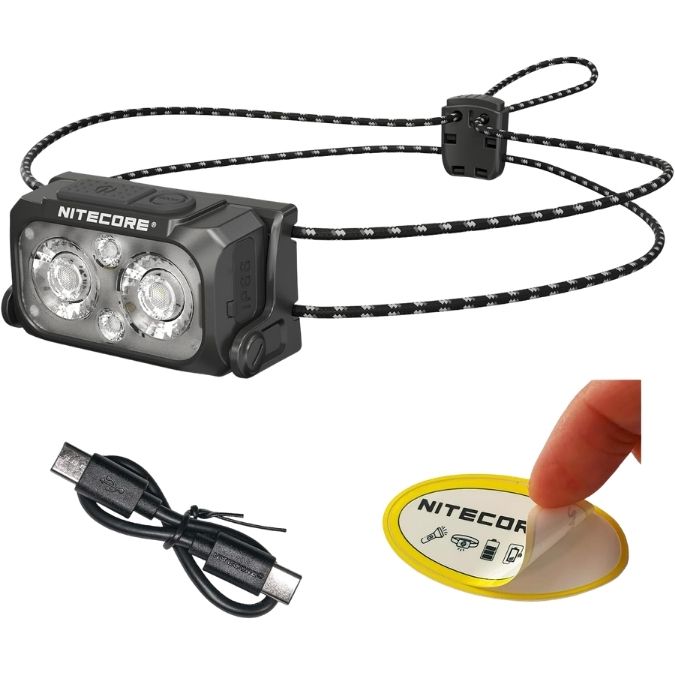
I’d put the Nitecore NU25 MCT UL high on your list if you carry everything into the hunting area on foot. At 47 g including its bracket and elastic-cord headband, it keeps the weight commitment small while retaining a 400-lumen maximum and red lighting. I see its strongest role as a compact trail and camp light for a carefully planned kit. The exact version matters here: this is the MCT UL with the elastic cord, rather than the older NU25 UL or a conventional-band model. I would choose it for the combination of low weight and useful lighting options, not because maximum lumens alone determine a good headlamp.
The feature I find most appealing is the choice of warm, neutral or cool white light. You can select 3,000K, 4,500K or 6,500K instead of accepting a single fixed tint. I prefer having that choice when a lamp must cover both walking and close-up camp tasks. Two red brightness options add another useful adjustment, and the included diffusing stuff sack gives the light a second role inside a tent. USB-C charging also fits neatly into a kit that already uses that cable. I would spend a few minutes practicing the two-button controls before a trip, because access to the different modes is less obvious than the lamp’s small size might suggest.
My main hesitation is the elastic-cord fit. The weight saving is attractive, but I would not assume the cord and small forehead contact area will suit you as well as a wider band. Pressure against bare skin and tangling in hair are worth checking with your usual hunting headwear. The built-in battery is the other important compromise: you cannot restore power by inserting a fresh cell. I would plan charging around the actual brightness you need, rather than expect maximum output throughout a long night. IP66 protection is useful for exposed outdoor use, but it is not an immersion rating. If you regularly wade, need prolonged high-output lighting or dislike minimalist headbands, I’d choose a different design.
Pros and Cons
| Pros | Cons |
|---|---|
| Very low complete headlamp weight | Elastic cord and forehead contact may feel uncomfortable |
| Warm, neutral and cool white-light choices | Built-in battery cannot be swapped in the field |
| Two red brightness options | |
| USB-C charging and an included diffuser sack |
Best for: Backpack hunters who prioritize a compact, lightweight light and have a workable charging plan.
Skip if: You need immersion protection, replaceable batteries or a broad conventional headband.
Fenix HM50R V2.0, LumenTac Organizer Bundle
Highlight: A compact headlamp that detaches for handheld or clipped use.
Key features: 700-lumen maximum • White and red lighting • Detachable right-angle light • Replaceable 16340 rechargeable battery • USB-C charging • IP68 protection
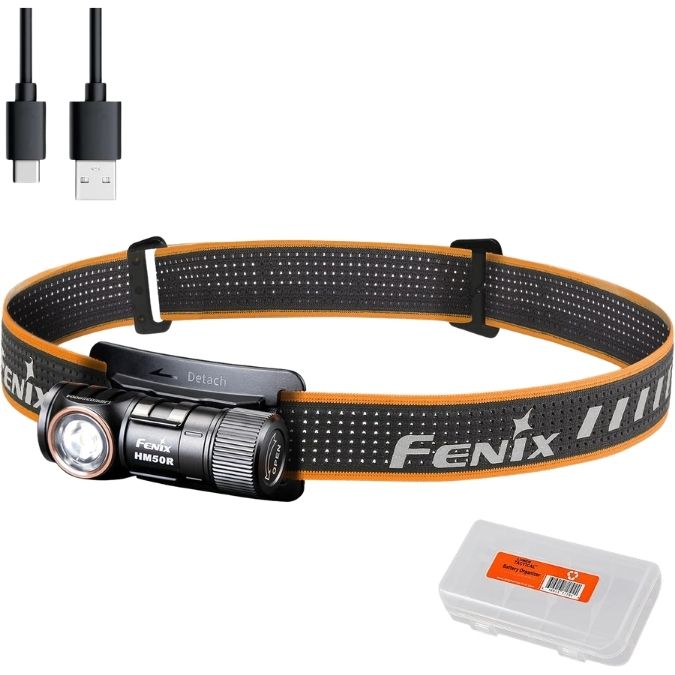
I’d choose the Fenix HM50R V2.0 if you want one small light that can move between your head, hand and clothing. Its detachable right-angle design is the main attraction for me. You can wear it while walking, remove it to inspect equipment, or use its clip when another mounting position is more convenient. That flexibility makes more sense to me than buying it simply for the 700-lumen headline. The selected package is the LumenTac Organizer bundle, which keeps the purchase distinct from other HM50R listings. Red lighting also gives you an alternative for close-range tasks when bright white light is unnecessary.
I particularly value the replaceable rechargeable battery. Carrying a charged, compatible spare gives you an option that a sealed-battery headlamp cannot offer, while USB-C allows charging through the lamp itself. For you, that is a useful balance between everyday convenience and field backup. The compact metal construction and IP68 protection also suit a light that may move between a headband and a pocket throughout a trip. I would still try the release and clip before heading out: a firm attachment is reassuring, but removal needs to feel manageable with your hands and gloves. I’d favor this design for directed tasks over a requirement to illuminate a broad area evenly.
My main caution is endurance at higher output. The small battery and compact housing impose real limits, and thermal protection can reduce brightness as the lamp heats up. I would not interpret a runtime figure as a promise of constant maximum output. For a long walk out, I’d select a lower useful level and carry a charged spare. I’m also cautious about long-term switch and charging reliability, so I would confirm the relevant seller’s support route before purchase. This is not a lamp I’d choose for uninterrupted high-output work over several hours. Its concentrated beam may also feel restrictive if you prefer broad flood lighting. For compact versatility, however, the detachable format gives you a clear reason to consider it.
Pros and Cons
| Pros | Cons |
|---|---|
| Detaches for handheld or clipped use | High output brings heat, step-downs and shorter endurance |
| Replaceable rechargeable battery | Concentrated beam is less suited to broad-area lighting |
| USB-C charging through the lamp | |
| Compact metal construction with IP68 protection |
Best for: Hunters who want a compact headlamp that doubles as a handheld or clipped task light.
Skip if: You need broad flood lighting or sustained high output for long stretches without battery changes.
COAST WPH34R, Blue/Black, Model 30833
Highlight: Higher-output spot and flood lighting with rechargeable and AAA power options.
Key features: 2,000-lumen maximum • Spot, flood and combined lighting • Red and green modes • Rechargeable battery or three AAA batteries • USB-C charging • IP68 protection
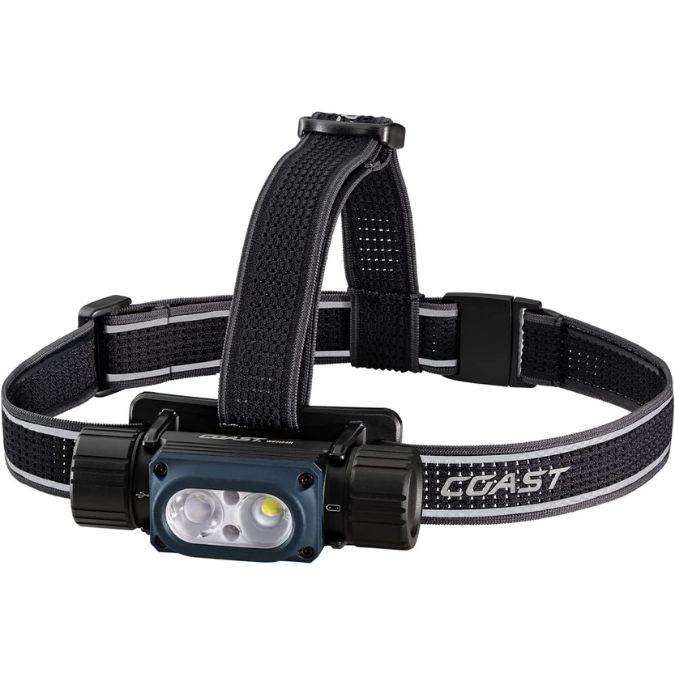
The COAST WPH34R is the headlamp I’d consider when output and power flexibility matter more to you than keeping weight low. Its spot, flood and combined settings give it several useful roles, from closer equipment work to illuminating more of the area ahead. The 2,000-lumen figure is a maximum, not a promise that every mode runs at that output. I see this as a deliberate choice for camp, vehicle-supported outings and tasks where a larger light earns its place. The Blue/Black model 30833 also includes red and green lighting, so you are not limited to using bright white light for everything.
What I like most is the backup power arrangement. You can use the rechargeable battery normally, then switch to three AAA batteries with the adapter when charging is inconvenient. I would view those as alternative power sources rather than assume identical output or endurance from both. USB-C charging and IP68 protection round out a practical feature set for outdoor work. The grippy headband and top strap are useful parts of the design, because a lamp this substantial needs more support than an ultralight model. I would set the fit and practice the color controls before taking it out, particularly if you often switch between close-range lighting and a brighter beam.
The weight is the deciding drawback for me. At roughly 8.36 ounces, this is a substantial load at the front of your head, and I would not make it my first choice for a long backpack hunt. A cap and careful strap adjustment may help, but they do not remove that weight. I also dislike the extra attention its single-button mode sequences require when you want a quick change. Heat at high output and the condition of the battery-cap seal deserve attention, too. I would check that the light is off before packing it, inspect the seal during battery changes and test charging before leaving. For you, the purchase makes sense when the beam options and backup power justify carrying and wearing a heavier lamp.
Pros and Cons
| Pros | Cons |
|---|---|
| Spot, flood and combined white-light options | Heavy, front-loaded design can compromise comfort |
| Rechargeable battery with AAA backup capability | Single-button mode sequences take practice |
| Red and green lighting for close-range tasks | |
| IP68 protection and USB-C charging |
Best for: Hunters who prioritize higher output and backup battery options for camp and vehicle-supported trips.
Skip if: You want a light headlamp for long walks or dislike a substantial housing on your forehead.
How to choose a hunting headlamp for your hunt
The best hunting headlamps balance useful light, manageable controls, and a workable power plan. Start with the trip you actually take.
Choose a beam for the task, not just a lumen number
A predawn trail, a camp table, and an open stretch ahead need different lighting. A broad flood makes nearby space easier to take in, while a more concentrated spot directs light farther ahead. Useful spill around the center helps you keep nearby obstacles in view.
I would choose adjustable output over a lamp that makes every task excessively bright. Turn the light down for close work and raise it when the terrain requires more visibility. A brighter reflection from a nearby surface can be distracting without improving your view beyond it.
For equipment checks and work with hunting knives, a downward-aimed beam keeps your hands free. Check that the lamp holds its angle and illuminates the working area without a sharply defined bright center obscuring the surroundings. A detachable format, such as the Fenix, gives you another positioning option.
Brightness and beam distance answer different questions. Lumens describe total light output; distance depends on how that light is directed. Neither number tells you whether a particular trail will be comfortably visible. I would start with beam shape, usable lower settings, and the ability to adjust quickly, then consider maximum output.
Plan power for the whole trip
When comparing headlamp battery life, choose a power arrangement before judging long runtime claims. A built-in rechargeable hunting headlamp can suit regular outings with charging between trips. For longer stretches away from power, replaceable batteries give you another way to keep going, provided you carry the correct spares.
| Power type | Lineup examples | Field recovery | Extra item and drawback |
|---|---|---|---|
| Built-in rechargeable | Storm 500-R; NU25 MCT UL | Recharge from an available source | Matching cable and power source; no quick cell swap |
| Removable rechargeable | HM50R V2.0 | Insert a charged, compatible spare | Protected spare cell; compatibility remains model-specific |
| AAA or hybrid | ARIA 2 RGB; WPH34R | Replace AAA batteries or use the compatible rechargeable option | Spare cells and any required adapter; output may differ by power source |
Also separate total burn time from constant brightness. Petzl explains how headlamp runtime is measured: the FL1 endpoint allows output to fall to 10% of its starting level. That is not a promise of full brightness throughout the stated period.
Heat can reduce output too. Fenix explains the HM50R V2.0’s automatic reduction as it heats up. Do not assume that every lamp follows the same output curve.
Among the best hunting headlamps here, the Storm needs a Micro-USB cable; Nitecore, Fenix, and COAST use USB-C. Pack for the brightness you need and the charging opportunities you actually have. No universal cold-weather runtime applies to these models.
Choose white and colored modes for useful visibility
A hunting headlamp with red light gives you another option for close tasks, but the color label is only part of the decision. How low does the mode go, how quickly can you reach it, and can you see the task clearly? Those questions matter more than collecting the largest number of modes.
I would practice moving between white and colored lighting before leaving home. A sequence that feels straightforward at a desk may be frustrating when you are wearing gloves or trying to avoid shining light toward a companion. Check whether switching on returns to the mode you expect.
Selectable white-light temperature is different from RGB lighting. Nitecore’s warm, neutral, and cool options change the appearance of its white beam; they are not substitutes for separate green or blue LEDs. Choose the white setting that makes your immediate task comfortable to see.
I would not choose a color on the assumption that it makes you invisible to deer or reliably highlights every blood trail. Avoid directing the beam at another person, and use enough light to see the walking surface clearly. A dim mode is only useful when it still lets you complete the task.
Check fit and controls with your hunting layers
A lightweight hunting headlamp can still feel uncomfortable if its housing presses on the wrong spot. Elastic cords save weight, while wider bands spread contact differently. Heavier lamps may need a top strap, and front-loaded weight becomes more noticeable when you tilt your head or walk for longer periods.
I would try the buttons with the gloves I actually wear. Our review of the best hunting gloves cover the trade-offs between fingertip access, bulk, and coverage. Check color selection, brightness adjustment, and shutoff without assuming that a large-looking button will be easy for you to operate.
When comparing the best hunting headlamps, fit the complete setup: hat, lamp, straps, and any hood. Look down, turn your head, and adjust the beam. The housing should stay where you set it without excessive strap tension. Finally, practice the model’s lockout or other manufacturer-approved transport precautions; an easy shortcut should not become an unwanted brightness change.
Match water protection to your exposure
Choose protection for the conditions you expect, including a dropped lamp as well as rain. IP66 addresses dust and water jets; it is not an immersion rating. IP67 and IP68 involve immersion protection under defined conditions, so check the exact model’s depth and duration rather than treating either label as unlimited waterproofing.
Water protection also depends on the lamp being correctly assembled. A charging-port cover left open or a damaged battery seal can undermine the intended protection. I would inspect those areas after battery changes and follow the manufacturer’s drying and cleaning instructions after wet use.
Impact resistance is a separate question. A water-protection rating alone does not show how a lamp will survive a fall or repeated knocks. Check the housing, tilt mechanism, and closure as part of your regular inspection. Finally, try the lamp with the hood of your hunting rain gear so fabric does not block the beam or make the controls difficult to reach.
Compare the cost of the complete setup
The best hunting headlamps can become less attractive once you price the missing pieces. Compare the lamp, rechargeable pack if needed, compatible spare cells, cable, and separate backup light. Avoid buying accessories you already own, but confirm compatibility before counting them as part of the setup.
The selected Petzl runs on AAA batteries and needs a separate CORE purchase for that rechargeable option. The Fenix link covers the LumenTac Organizer bundle, so compare its package with other offers carefully. A similar product photograph does not prove that the same accessories are included.
I would pay for the features that solve my actual trip requirements. Extra modes add little value if I cannot access them comfortably, and more output brings little benefit if the weight keeps the lamp in my pack. Use the exact product links to check current prices and seller terms rather than assume one model will always be cheapest.
Before you head out: a five-point light check
A short check at home is easier than troubleshooting at the trailhead obviously. I would run through these items with the same lamp, clothing, and power setup I plan to carry.
- Confirm power. Charge the lamp or install suitable fresh batteries. Check that your spare cells and charging cable match the exact model.
- Practice the modes. Find your working white level and colored mode, then turn the light off and back on to confirm what happens.
- Check the fit. Wear your normal hat and gloves. Adjust the strap and tilt, then walk around to check stability and pressure.
- Inspect and secure it. Close covers, inspect seals, and follow the manual’s precautions against accidental activation before packing.
- Carry a working backup. Spare batteries cannot replace a lost or damaged lamp. Compare tactical flashlights for low-light conditions if you want a separate handheld option, and choose one you will actually carry.
Which hunting headlamp would I choose?
I’d start with the Petzl ARIA 2 RGB when AAA backup and RGB options are priorities. The Storm 500-R makes sense for dimming and brightness memory if charging access is dependable. For a lighter kit, I’d favor the Nitecore NU25 MCT UL.
The Fenix HM50R V2.0 is my choice for detachable use and replaceable rechargeable power. I’d consider the COAST WPH34R when higher output justifies the weight. The best hunting headlamps solve different problems, so return to the comparison and choose the power arrangement and main compromise you can live with.
FAQs
How many lumens do I need for a hunting headlamp?
Choose adjustable output that clearly illuminates your terrain. Beam shape, useful lower settings, and runtime matter more than a universal lumen threshold.
Does red light keep deer from seeing me?
Do not treat red light as guaranteed concealment. Choose lighting that lets you see your surroundings clearly rather than relying on color alone.
Can I use one headlamp for hiking and hunting?
Yes, if its beam, power arrangement, fit, and controls suit both activities. A hunting label alone does not add capability.
Does a longer listed runtime mean longer full brightness?
No. Output may decline or step down during that period. Compare the selected mode and measurement method, not just the total hours.
Should I carry a second light if I have spare batteries?
Yes. Spare batteries address depleted power, while a separate working light also covers damage or loss of your primary lamp.