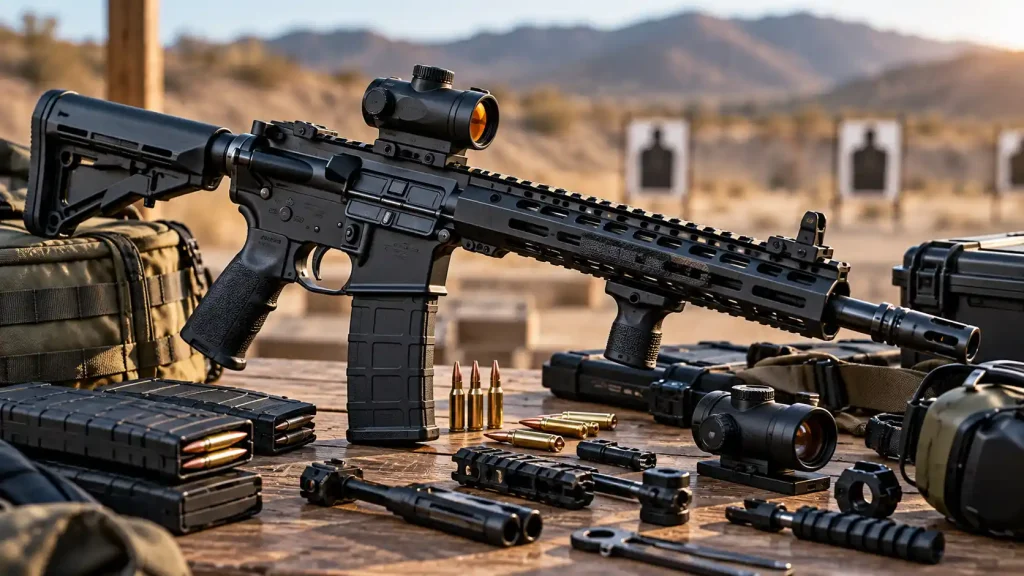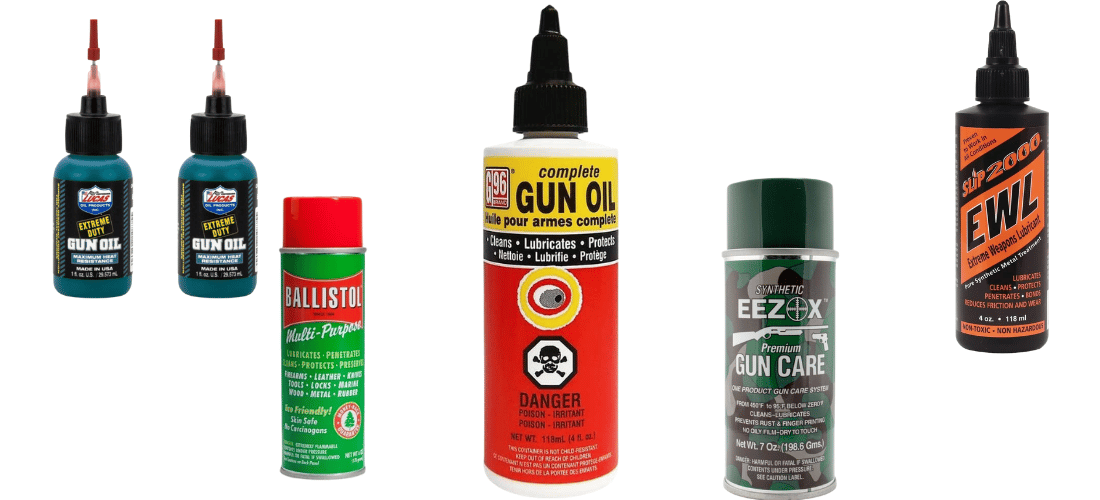
The best oil for firearms has to do three jobs at once; lubricates moving metal parts, break down carbon and lead fouling, and protect the finish from rust between range trips.
Most of you grab whatever bottle sat on the shelf at the last gun show you attended, and never think about it again. I wanted to know which products actually earn a permanent spot in a range bag, so I ran different oils across pistols, rifles, and a shotgun over a number of weeks.
Here is what separates a genuinely good gun oil from one that is just *marketed handsomely*, and which ones made my final list.
Top Picks Compared
Here’s how the best oil for firearms candidates I tested stack up:
| Product | Best For | Type | Key Strength | Price Tier |
|---|---|---|---|---|
| G96 1054 Gun Oil | Best Overall | CLP | Cold-weather performance, real cleaning power | Budget-friendly |
| Lucas 2 Extreme Duty Needle Oiler | Best for Precision Application | Lubricating oil | Needle-tip control, resists creep | Mid-range |
| SLIP 2000 EWL CLP | Best for Extreme Temperatures | CLP | Handles heat and cold, resists carbon buildup | Mid-range |
| Ballistol Multi-Purpose Oil | Best for Wood Stocks and Multi-Surface Care | CLP, multi-surface | Safe on wood, metal, and leather; strong rust removal | Mid-range |
| Eezox Premium Synthetic Gun Care | Best Long-Term Rust and Corrosion Protection | Dry-film protectant | Outstanding rust prevention, dries clean | Premium |
5 Best Oils for Firearms
Here are the best oils for firearms:
G96 1054 Gun Oil, 4-Ounce
Highlight: Best overall.
Key features: All-in-one CLP formula that cleans, lubricates, and protects • non-aerosol squeeze bottle • strong cold-weather performance • signature scent • 4oz bottle
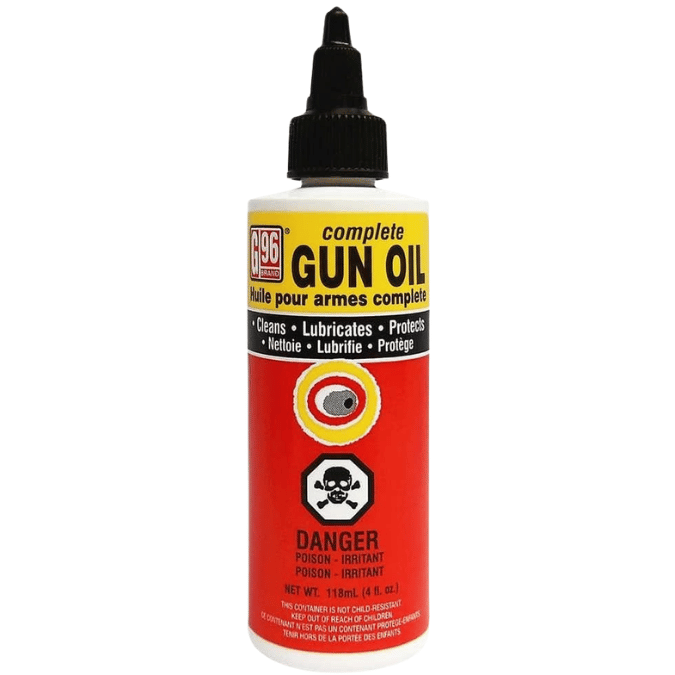
I grabbed this 4oz bottle mainly because I wanted a non-aerosol option I could toss in a range bag without worrying about pressure or overspray. G96 has been around for decades, and it shows in how dialed-in the formula feels. It’s marketed as a true CLP, and unlike some of the newer synthetic blends I’ve tried, it comes across as an old-school, no-nonsense oil that doesn’t try to reinvent anything.
The biggest surprise for me was cold-weather performance. I took a bolt gun out on a frigid morning and the action stayed smooth the whole time, no stiffness, no drag. It also does real cleaning work, not just lubrication. A light coat left on lead and powder residue for a minute, then wiped clean, pulls a surprising amount of grime off without needing a separate solvent first. On my BCG it made a noticeable difference in smoothness, and the scent, which most people either love or immediately recognize from higher-end rifle builds, made cleaning day feel a lot less like a chore.
Where I’d pump the brakes is long-term storage. The viscosity is on the thinner side, so if I coat a gun and put it away for months rather than weeks, I’ve noticed it migrate to the lowest point instead of staying evenly spread. I also learned the hard way that it doesn’t play nice with certain rubber grips. It softened and discolored a rubber wraparound panel on one of my pistols before I caught it, so now I keep it away from anything rubber or unknown synthetic material. For heavy carbon or copper fouling on a rifle that’s seen a lot of rounds, I still reach for a dedicated solvent first.
Pros and Cons
| Pros | Cons |
|---|---|
| Genuine all-in-one CLP that cleans, lubricates, and protects in one pass | Thinner viscosity means it can migrate off metal during long-term storage |
| Performs reliably in serious cold without stiffening up | Can react with rubber grips and some synthetic materials |
| Noticeably improves BCG and slide smoothness | |
| Compact non-aerosol bottle that’s easy to control and pack |
Best for: shooters who want a dependable, cold-weather-capable CLP for regular cleaning and lubrication between range trips.
Skip if: you’re storing a firearm untouched for months at a time, or your grips are rubber or an unknown synthetic.
Lucas 2 Extreme Duty Gun Oil 1oz Needle Oiler
Highlight: Best for precision application.
Key features: Precision needle-tip applicator • extreme duty formula built to resist creep • holds viscosity through extended range sessions • compact bottle sized for a range bag • sold as a two-bottle set
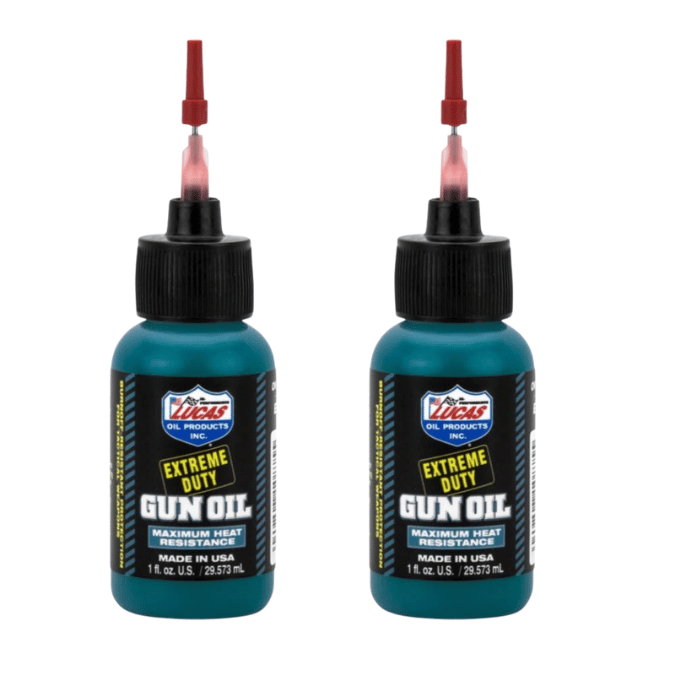
I picked this one up because I wanted something built for the actual metal-on-metal contact points on my carry pistol, not a generic spray can that coats everything and calls it done. It comes in a small needle-tip bottle, and Lucas clearly built the formula around slide rails, guide rods, and trigger groups rather than a quick wipe-down job. I keep one bottle on the cleaning bench and the second rides in my range bag, since it comes as a two-bottle set.
What sold me on it is the needle applicator itself. I can place a single drop exactly where I want it instead of guessing how much is coming out of an open-top bottle or a spray nozzle, and that control matters more than people expect since too much oil just attracts carbon and grit. On my AR the tip reaches the bolt carrier group and trigger pins with zero spillover, and on my pistols it gets into the rail grooves and barrel-to-slide contact points cleanly. The viscosity is thick enough to stay put instead of migrating off the metal, and I have put a few hundred rounds through a pistol on a single application without it drying out or turning gummy.
There’s slight concern with shipping. Your order might arrive with oil leaking inside the box because the bottles are not packed with much real padding, and the cap and plunger do not feel like the sturdiest part of the build. I have not had a bottle fail on me in actual use, but I would not toss one loose in a bag without a zip-top pouch as backup. It is also not the cheapest option per ounce, so if you are stocking a full cleaning bench rather than a carry gun and a range bag, the cost adds up.
Pros and Cons
| Pros | Cons |
|---|---|
| Needle tip gives precise, mess-free application | Bottles frequently arrive leaking from thin packaging |
| Viscosity resists creep and holds up over hundreds of rounds | Cap and plunger feel cheap and can be stiff to remove |
| Works across pistols, rifles, and shotguns without turning gummy | |
| Compact two-bottle set fits a range bag and a cleaning bench |
Best for: shooters who want precise, targeted lubrication on rails, triggers, and bolt carrier groups without over-oiling.
Skip if: you want one large bulk bottle for a full cleaning bench, or you’re wary of packaging issues during shipping.
SLIP 2000 EWL CLP Gun Lube
Highlight: Best for extreme temperatures.
Key features: Synthetic CLP formula that cleans, lubricates, and protects in one product • non-toxic with low odor • rated for extreme cold and heat • resists dust and carbon buildup • 4oz squeeze bottle
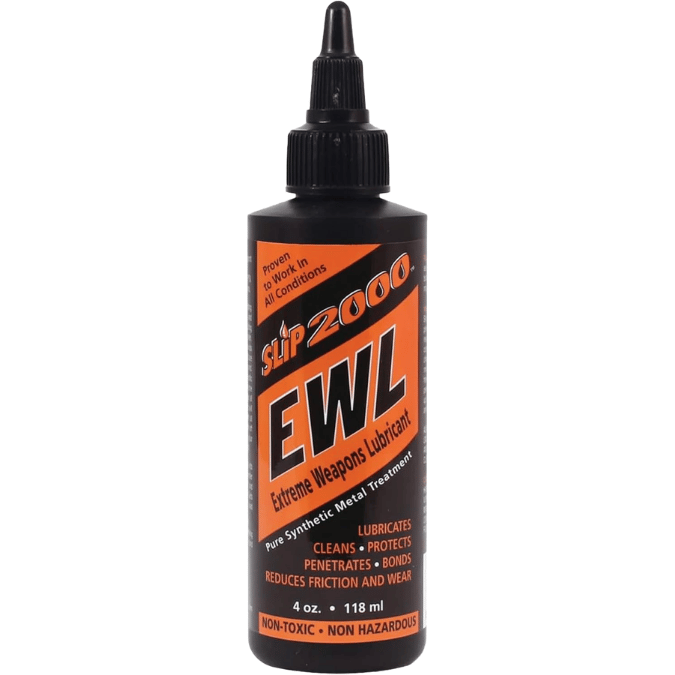
I switched to this after getting tired of juggling a separate cleaner, oil, and protectant every time I broke down a rifle. SLIP 2000 markets EWL as a true CLP, one bottle for the whole process, and after running it through cleaning day after cleaning day, I get why so much of the military and law enforcement crowd leans on it. It comes in a 4oz squeeze bottle rather than a needle applicator, which changes how I use it. This is not a spot-treatment oil for one or two contact points, it’s a working lube meant to go on generously, soak in, then get wiped down.
The part that actually changed my routine is how it handles temperature and carbon. I run a gas-impingement AR and used to deal with a gummy bolt carrier group anytime I let a lube sit too long between cleanings. With this one, carbon wipes off almost effortlessly instead of caking on, and I have taken guns out in genuinely cold weather without the sluggish action I get from some other oils. It also does not attract the layer of dust and grit that some CLPs pick up sitting in a range bag or a trunk, which matters more than people expect once a gun sits between uses.
My one real gripe is the bottle itself. The tip opening is wider than I would like, so getting a small, controlled drop takes more care than it should, and if I squeeze too hard it drains down the threads and makes a mess on the bench. It also runs thinner than I expected going in. I wanted something closer to a grease for rail contact points, and this leans closer to a light oil, so I still keep a separate grease on hand for pure metal-on-metal wear points. If you go longer than a few months between cleanings, plan on reapplying rather than treating one coat as a set-it-and-forget fix.
Pros and Cons
| Pros | Cons |
|---|---|
| True all-in-one CLP that cleans and lubricates in one pass | Squeeze-bottle tip is imprecise and prone to leaking down the sides |
| Handles extreme cold and heat without gumming up or freezing | Runs thinner than expected, so it’s not a substitute for a dedicated rail grease |
| Resists dust and carbon buildup better than most oils I have used | |
| Non-toxic formula that’s safe to handle without gloves |
Best for: shooters who want one product to clean, lubricate, and protect in a single pass, especially in guns exposed to extreme heat or cold.
Skip if: you want a precision needle applicator or a thicker, grease-like lube for rail contact points.
F W Klever GmbH Ballistol Multi-Purpose Aerosol
Highlight: Best for wood stocks and multi-surface care.
Key features: Multi-surface CLP formula safe on metal, wood, and plastic • non-toxic and skin-safe • strong rust and corrosion protection • non-CFC aerosol spray can • 6oz size
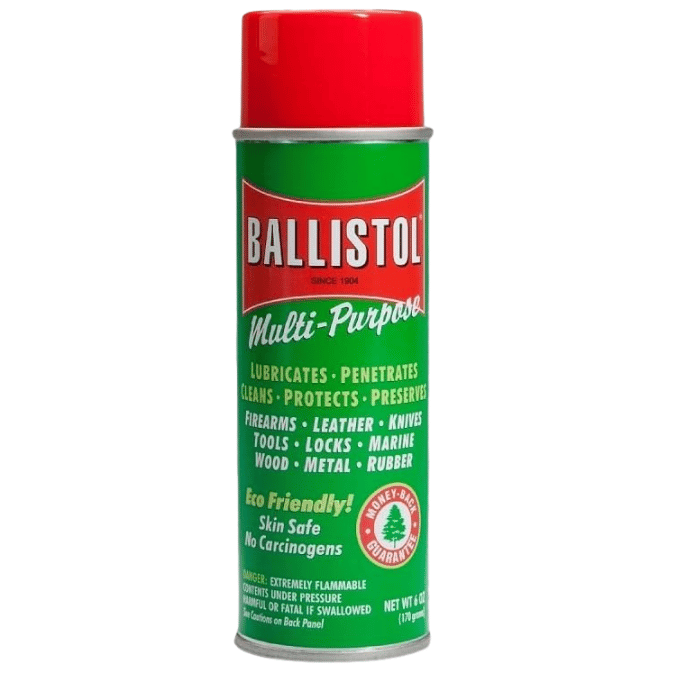
I picked this up mostly out of curiosity after hearing it referenced so often as the old-world alternative to modern CLPs, and it earned a permanent spot in my cleaning kit right away. Ballistol has been around since before most gun oils on the market existed, and the formula hasn’t changed much because it doesn’t need to. It comes as a non-CFC aerosol spray, so I end up using it on more than just firearms. It goes on locks, hinges, and a few tools around the shop, and it hasn’t let me down on any surface I’ve sprayed it on, wood, blued steel, plastic, even leather.
Where it really earns its reputation is rust and corrosion. I have a couple of older firearms with wood stocks and blued finishes, plus one bolt gun that had picked up light surface rust before I started using this. A light coat, a short soak, and a wipe-down took the rust off cleanly without touching the finish underneath, and the metal came out with a healthy, protected sheen. It’s also really useful for corrosive-ammo cleanup. I ran it through an older military surplus rifle after shooting some corrosive-primer ammo and it neutralized the residue completely, which isn’t something I can say for every cleaner in my cabinet.
The two things I’d flag are the smell and how it performs under heavy cycling. The scent is polarizing, somewhere between licorice and something more medicinal, and I keep a window open when I’m using much of it. It’s not harmful, just noticeable. As for lubrication, I wouldn’t trust it as the sole lube on a high-round-count AR running hot and dirty for hundreds of rounds in a row. It leaves a nice protective film, but it’s not built to hold up the way a dedicated high-heat CLP does under that kind of stress. I treat it as my go-to for cleaning, storage protection, and general maintenance rather than the primary lube on guns I shoot hard and often.
Pros and Cons
| Pros | Cons |
|---|---|
| Works safely across metal, wood, plastic, and leather without damaging finishes | Strong, divisive smell that some find unpleasant or irritating |
| Excellent at neutralizing rust and corrosive-ammo residue | Not aggressive enough as a standalone lubricant for high-heat, high-round-count actions |
| Non-toxic and skin-safe, with genuine household and multi-tool uses beyond firearms | |
| Long shelf life and a little goes a long way per can |
Best for: cleaning, rust prevention, and protecting stored firearms, including wood stocks and older or surplus guns.
Skip if: you want a single dedicated high-heat lubricant for a rifle you run hard at the range, or you’re sensitive to strong odors.
Premium Synthetic Gun Care 7oz Spray Can
Highlight: Best long-term rust and corrosion protection.
Key features: Synthetic dry-film CLP • long-term rust and corrosion protection • dries to a clean, non-greasy finish • effective against carbon and lead fouling • 7oz spray can
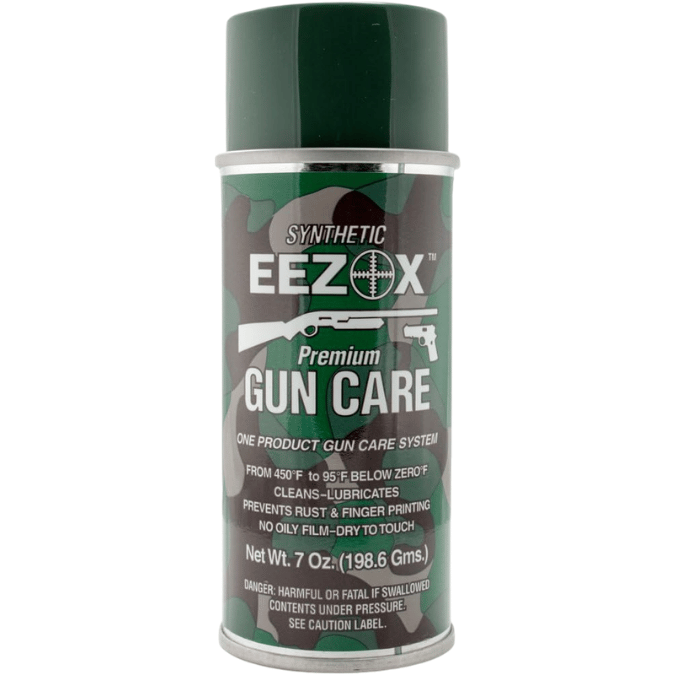
I went into this one skeptical, mostly because I’ve tried a handful of products that claim to clean, lubricate, and protect in one step and usually end up doing one of those jobs well and the other two just okay. This one changed my mind. It comes as a 7oz spray, and the first thing I noticed is that it dries down to a clean, almost dry-to-the-touch finish instead of leaving an oily film sitting on top of the metal.
The rust protection is where this really separates itself. I’ve carried a pistol daily through hot, sweaty months and it stayed rust-free with only occasional reapplication, and I’ve used it on a shotgun that sees salt air without any corrosion showing up. It’s also a legitimately good cleaner. I sprayed down a couple of revolvers I would have sworn were already spotless and pulled visible carbon and grime off both of them. For hard-to-reach spots on older or oddly shaped actions, spraying it in, letting it drain, and swabbing out the rest works better than trying to reach in with a rag.
The drawbacks are cost and technique. It runs noticeably more per ounce than a basic gun oil, and it took me a couple of applications to dial in how much to spray and how long to let it sit before wiping, since too much left behind more residue than I wanted. The smell is on the stronger side too, not unpleasant to me, but strong enough that I use it with a window open or outside. And while it protects and cleans exceptionally well, I still keep a separate lubricant on hand for parts that need heavier, ongoing lubrication rather than a protective dry film.
Pros and Cons
| Pros | Cons |
|---|---|
| Outstanding rust and corrosion protection, even in humid or salt-exposed conditions | Pricier per ounce than most gun oils and CLPs |
| Genuinely cleans carbon and lead fouling, not just protects | Takes a couple of uses to learn the right amount and dry time for best results |
| Dries to a clean, non-greasy finish instead of sitting wet on the metal | |
| Versatile enough for knives, tools, and other metal gear beyond firearms |
Best for: shooters who want strong, long-term rust and corrosion protection along with real cleaning power, especially for carry guns or firearms exposed to humidity or salt air.
Skip if: you want a straightforward wet lubricant for heavy metal-on-metal wear points, or you’re not willing to pay a premium per ounce.
How I Tested These Gun Oils
I did not rank these off the specifications alone. Each oil went onto firearms I actually own and shoot regularly, including a couple of semi-auto pistols, an AR-15, and a pump shotgun.
For every product, I looked at how well it lubricated after firing, how much residue it pulled during cleanup, and how it held up against rust over weeks of storage. A good cleaning mat underneath kept the whole process contained, especially with the thicker CLPs that tend to run. I also made sure my workspace stayed well ventilated throughout, since handling solvents and lead residue during cleaning is worth taking seriously.
Price factored in as well, because a strong performer that costs a fortune per ounce might not be practical for all of us.
Types of Gun Oil: Oil vs. CLP vs. Grease
Gun oil isn’t one single category.
Some products are pure lubricants, built to cut friction between moving parts and nothing else, relying on the same friction-reducing principle used across industries far beyond firearms.
Others are CLPs, short for clean, lubricate, and protect, meant to handle all three jobs from one bottle.
A smaller group behaves more like a light grease or dry-film protectant, designed to sit in place rather than soak into the metal. If cleaning is your main concern, look specifically for the best oil for cleaning firearms rather than a straight lubricant, since not every gun oil is built to break down carbon and lead. Knowing which category a product falls into matters more than whatever claim is printed on the label.
Pros and Cons of Using a Dedicated Gun Oil
| Pros | Cons |
|---|---|
| Reduces wear between metal parts and keeps actions cycling smoothly | Needs regular reapplication, especially after heavy use or long storage |
| Helps prevent rust and corrosion during storage or humid conditions | Quality gun oils cost more per ounce than generic household alternatives |
| Makes cleaning carbon and powder residue noticeably easier | |
| Formulated specifically for firearms, so it’s generally safer on metal finishes, wood, and polymer than random household oils |
What Is the Best Oil for Firearms?
The best oil for firearms overall, based on my testing, is the G96 1054 Gun Oil. It cleans, lubricates, and protects in a single application, performs reliably in cold weather, and costs less per ounce than most premium options.
That said, the right pick still depends on what you need most. If pinpoint application matters more, Lucas 2 Extreme Duty is the better fit. If long-term rust protection is the priority, Eezox pulls ahead instead.
What Oil to Use on a Gun
Stick to oil made specifically for firearms whenever you can. Dedicated gun oils are formulated to handle the heat, friction, and carbon buildup that firearms produce, and most are safer on wood stocks, polymer frames, and blued or stainless finishes.
As for what oil can you use on guns in a pinch, synthetic motor oil or WD-40 will technically work short term. Motor oil lubricates reasonably well but attracts carbon and offers little rust protection. WD-40 displaces moisture briefly, but it isn’t built for long-term lubrication and can leave a gummy residue over time.
For anything beyond a one-time emergency fix, a purpose-built oil is worth the extra few dollars.
How to Choose the Right Gun Oil
Once you know what you’re solving for, finding the best oil for guns you actually own gets a lot simpler. These factors will make your decision easier:
- Purpose: decide whether you need daily lubrication, deep cleaning, or long-term rust protection, since few products handle all three equally well
- Climate: cold climates call for oils that won’t thicken or freeze, while humid or coastal areas call for stronger corrosion protection
- Application method: needle-tip bottles give the most control and work well as a penetrating oil for tight tolerances, squeeze bottles cover ground faster, and aerosols reach hard-to-access spots
- Firearm material: wood stocks and leather need oils labeled safe for those surfaces, not just metal, and that same caution applies if you’re carrying in a leather holster rather than Kydex
- Storage length: a firearm going into a safe for months needs a heavier protective film than one used weekly, so it helps to know what actually separates a good gun safe from a decent-looking box before you decide how heavy to go
What’s the Best Oil for Gun Stocks?
For wood, the best oil for gun stocks is one built to condition the wood without stripping its finish or attracting grime. Ballistol stands out here, since it safely penetrates wood, leather, and blued metal without damaging what’s underneath.
Avoid plain mineral oil or furniture polish on stocks that see regular handling. Neither offers real protection against moisture or long-term wear.
Final Verdict
After weeks of testing, G96 earned my overall recommendation for its balance of cleaning power, cold-weather performance, and price. It’s also the one I would hand a new gun owner without hesitation.
Still, the other four aren’t runners-up so much as specialists. Lucas 2 rewards precision, SLIP 2000 handles extreme temperature swings, Ballistol covers wood and multi-surface care, and Eezox protects a carry gun better than anything else I tested, which matters even more if you’re carrying daily in a holster that traps in sweat and moisture.
Whichever you land on, the best gun oil for firearms is the one that matches how you actually use and store your guns.
FAQs
No. Gun oil is usually a pure lubricant, while CLP stands for clean, lubricate, and protect, meaning it handles all three jobs in one product. Some gun oils double as light CLPs, but not every lubricant cleans or protects as well as a dedicated CLP does.
For a firearm in regular use, a light coat after each cleaning session is usually enough. Firearms in long-term storage need a heavier coat and a check every few months, especially in humid climates.
Yes, in a pinch, though neither is ideal. WD-40 displaces moisture short term without offering real lubrication, and motor oil attracts carbon buildup faster than oils made specifically for firearms.
Most gun oils have a long shelf life, often several years, as long as they’re stored sealed and away from extreme heat. Separation or a strong change in smell usually signals it’s time to replace the bottle.
Not always. Some oils can soften or discolor rubber grips over time. Checking the label first, or testing on a small hidden spot, is the safer approach before coating the whole firearm.