Our G-Sight laser training system review’s verdict is that the ELMS Plus is worth considering if you want measurable dry-fire feedback while practicing with your own handgun. The cartridge is easy to install, its replaceable strike pads address a common wear point, and the mobile app can record hits without requiring an expensive electronic target. Its main weaknesses are manual firearm resets, sensitivity to lighting, and an app experience that depends heavily on phone placement.
Dry firing becomes far more useful when you can see where every simulated shot lands. To ensure a better shooting routine, investing in a dry firing system is worth the shot. In this G-Sight laser training system review, we examine the ELMS Plus cartridge, app performance, shot-tracking accuracy, setup, durability, and overall value. The ELMS Plus combines a caliber-specific laser cartridge with phone-camera tracking.
You practice with your own firearm, so the grip, sights, controls, and trigger remain familiar. The app watches a paper target and records each laser pulse as a shot. That makes the system more informative than pointing at a blank wall, but less advanced than a recoil-enabled simulator. It is best viewed as an affordable bridge between ordinary dry firing and more expensive interactive training equipment. Investing in this system can help improve your overall dry firing practice.
What Is the G-Sight Laser Training System?
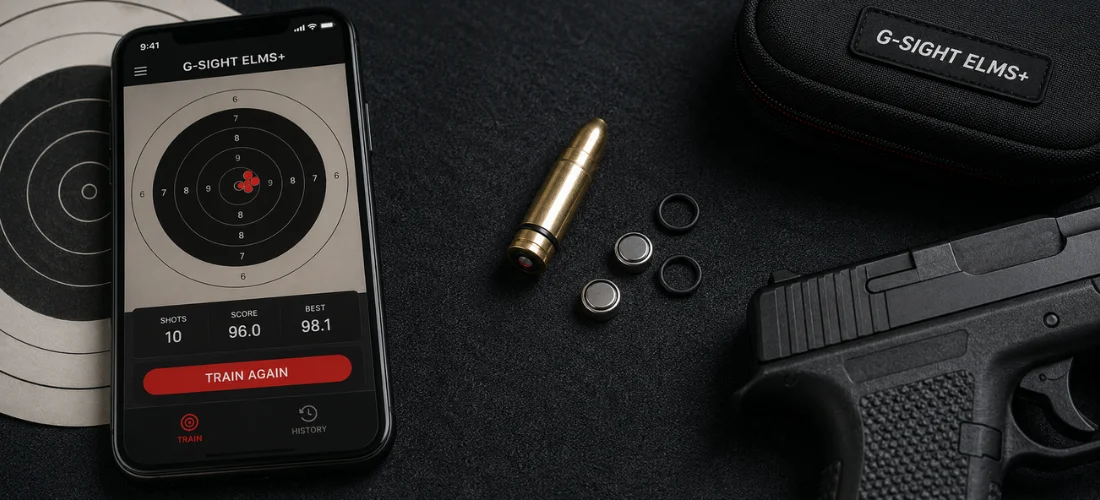
G-Sight is a home firearm-training platform built around the ELMS Plus cartridge and a mobile application that detects laser hits. The cartridge sits inside the firearm’s chamber and produces a brief red pulse when struck by the firing pin. A phone positioned near the target records those pulses, displays shot locations, and saves training results.
The G-Sight dry fire training system is designed to work with the firearm you already own. It does not replace the gun with a replica, which is important for shooters who want to retain their normal grip angle, sight height, and trigger reach.
The ELMS Plus is an updated design with replaceable rubber strike pads. Previous cartridges could become unreliable once repeated firing-pin strikes permanently damaged the rear pad. With the current model, the worn pad can be removed without replacing the complete cartridge.
How the G-Sight ELMS Plus Works
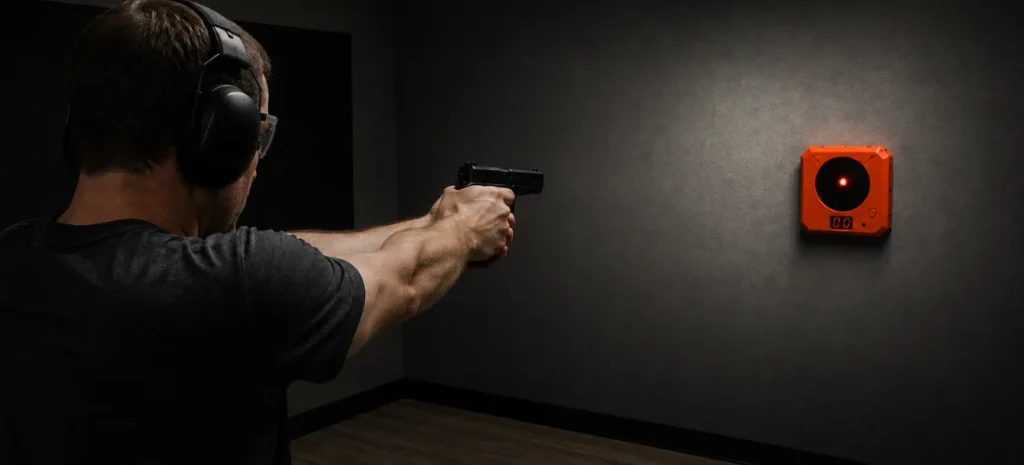
The system has three essential parts: the cartridge, a target, and a phone running G-Sight’s software. When the trigger is pressed, the firing pin contacts the cartridge’s rubber pad. The cartridge projects a short pulse, and the phone camera identifies the flash on the target.
This produces immediate information about sight alignment and where the muzzle was pointing when the shot broke. It does not recreate recoil, cycling, or recovery between shots.
The Laser Training Cartridge
The laser training cartridge is built to match the dimensions of a specific handgun caliber. It is inserted directly into the chamber after the firearm has been unloaded, cleared, and separated from all live ammunition.
An ELMS cartridge uses small rubber O-rings to hold it securely and keep the unit aligned with the bore. The ELMS Plus uses a three-O-ring design and replaceable firing-pin pads to improve fit and service life.
This chamber-fit cartridge arrangement is generally more convenient than a muzzle-mounted trainer. Nothing projects from the front of the barrel, and the firearm can still be presented from a compatible holster. When the rear pad begins developing a deep indentation, the shooter can install a new one rather than discarding the entire unit.
It has broad caliber compatibility (9mm, .380, .40, .45, 10mm, .223), although some sizes and rifle products belong to different cartridge families. The ELMS Plus also includes .357 SIG through the shared .40 S&W, .357 SIG, and 10mm configuration. Always verify the exact chambering before ordering.
The Laser Training Pro App
The original Laser Training Pro app uses the phone’s camera to recognize each red pulse and place it on a digital record of the target. It supports ordinary paper targets, automatic calibration, session review, and training periods of up to five minutes.
In this G-Sight app review, the basic tracking concept remains useful, but the older application is no longer the strongest part of the ecosystem. It is free with in-app purchases, while its rating is considerably lower than G-Sight’s newer SFL application.
The newer SFL app adds guided sessions, target recognition, automatic scoring, games, session history, and additional missions. G-Sight says it supports its ELMS, ELMS Plus, Quantum XG, and Gen 2 products, along with most red training cartridges.
The software effectively turns a phone into a compact shooting simulator app, although it still depends on physical targets and favorable lighting. It should not be confused with a full-screen projected simulator.
Setup: Tripod, Phone Holder, and Target
The phone should face the target from within approximately one yard, according to the app’s official guidance. Its camera needs an unobstructed view of the full target without being placed in the shooter’s path.
The ProPack kit includes a cartridge, professional tripod and phone holder, replacement O-rings, spare batteries, additional strike pads, instructions, and a carrying case. Some larger packages add printed smart targets.
Setup is straightforward:
- Remove all live ammunition from the training area.
- Unload the firearm and inspect the chamber, magazine well, and breech face.
- Install the batteries and correct the rear strike pad.
- Place the cartridge in the empty chamber.
- Mount the target flat against a nonreflective surface.
- Position the phone close enough to capture the entire target.
- Open the application and complete its calibration process.
- Test one shot before beginning a full session.
- Adjust the phone angle or room lighting if hits are missed.
- Remove the cartridge and clear the firearm again after training.
A stable mount makes a substantial difference. If the phone shifts during a session, the calibrated target boundaries may no longer correspond with the camera image.
G-Sight Laser Training System Specifications
| Specification | Details |
|---|---|
| Available handgun calibers | 9mm, .380 ACP, .40 S&W, .357 SIG, .45 ACP and 10mm Auto |
| Rifle availability | Separate products available for selected rifle chamberings |
| Laser classification | Class IIIa, less than 5mW |
| Laser color | Visible red |
| Typical wavelength | Approximately 650nm |
| Battery type | Three AG4/LR626 1.5V cells on applicable models |
| Rear contact | Replaceable rubber strike pad |
| Alignment | Three-O-ring retention system |
| Cartridge service life | Not stated as a fixed shot count; pads and batteries are replaceable |
| Standalone cartridge | Regularly listed around $69.99 during review |
| ProPack | Approximately $89 sale price; regular listing around $129.99 |
| ProPack X | Approximately $129 sale price; regular listing around $189.99 |
| ProPack XL | Approximately $229.99 sale price; regular listing around $279.99 |
| App support | iOS and Android; requirements vary by application |
| Target requirement | Paper or compatible printed smart target |
G-Sight identifies its Gen 2 cartridge as using a Class IIIA laser with output below 5mW. Its visible red output is commonly described as a 650nm laser, although specifications should always be confirmed for the individual model.
The manufacturer does not provide a universal cartridge shot-life figure. That is reasonable because battery quality, firing-pin force, pad condition, storage, and session length can change longevity considerably. G-Sight instead focuses on replaceable wear components.
Hands-On Testing: Accuracy and Shot Tracking
The ELMS Plus is sufficiently consistent for short-range indoor training when the cartridge is seated correctly, and the phone has a stable, evenly lit view of the target. Its strongest performance comes from grouping analysis rather than treating the laser as a perfect substitute for live-fire point of impact.
Laser Consistency Across Shots
A properly installed cartridge should place repeated pulses in a consistent area when the firearm is supported and the sights remain motionless. A stable cluster matters more than whether the dot perfectly overlaps the sights at every distance.
The laser originates from the bore while the sight line sits above it. Because those lines are offset, some vertical difference is normal at close range. The system is most useful for watching how the dot moves during the trigger press.
That movement provides practical feedback on trigger control. If the pulse repeatedly shifts low and left or low and right as the shot breaks, the shooter can inspect grip pressure and finger placement rather than merely counting hits.
Dirt, damaged O-rings, or an improperly tightened cartridge body can create a changing point of impact. Reseating the unit should be the first troubleshooting step when previously consistent shots begin wandering.
App Shot-Tracking Accuracy
The app performs best with a matte target, even illumination, and a fixed phone. Bright sunlight, reflective tape, glossy paper, deep creases, and moving shadows can all interfere with detection.
When the conditions are controlled, shot placement tracking makes each session easier to evaluate. Instead of walking forward after every group, the shooter can review hit locations and compare results from repeated attempts.
The app is less dependable when the target occupies a small portion of the phone screen. Moving the phone closer is usually more effective than increasing the brightness of the laser.
Camera quality also matters. Older phones may process frames too slowly, miss brief pulses, or struggle in dim rooms. A newer phone with a clean lens and stable focus provides a noticeably easier setup.
Trigger Pull and Reset Feel
Because ELMS Plus sits inside the shooter’s real firearm, the trigger press feels authentic until the action needs to be reset. Grip size, trigger reach, take-up, wall, and break remain the same as the firearm used at the range.
That realism helps build consistent muscle memory, particularly for presentation, grip establishment, and the first accurate shot.
The limitation is trigger reset. Many striker-fired handguns must have the slide cycled after every press. That interrupts follow-up-shot timing and makes the system less suitable for realistic rapid strings.
Double-action firearms may permit consecutive presses without manual cycling. Users should still follow their firearm manufacturer’s dry-fire guidance.
G-Sight Pros and Cons
What We Liked
- Uses the shooter’s actual firearm and sights.
- Replaceable rear strike pads reduce long-term waste.
- Three O-rings provide adjustable chamber retention.
- Compatible with free and paid mobile applications.
- Works with basic paper targets.
- Available in several common handgun chamberings.
The system gives dry fire practice more structure without requiring a dedicated training pistol. It is particularly useful for short dry fire drills that emphasize presentation, grip, sight stability, and the first controlled press. Users can also work on careful concealed carry practice, provided the training area is secured and all live ammunition has been removed.
For regular home shooting practice, the phone-based arrangement is more measurable than aiming at an unrecorded wall target. The absence of ammunition makes it an accessible form of ammo-free training, but normal firearm-safety rules still apply.
What We Didn’t Like
- Most striker-fired pistols require cycling after every press.
- Camera tracking is sensitive to lighting and reflections.
- Initial target calibration takes more effort than a standalone reactive target.
A cartridge cannot reproduce recoil management. It shows where the muzzle was aligned at the instant of activation, but it cannot reveal how the shooter would recover for a second live round.
G-Sight vs. Competitors
| System | Typical Price | Laser Tracking | Recoil Simulation | Caliber Options | Best For |
|---|---|---|---|---|---|
| G-Sight ELMS Plus | $70–$230 | Phone-camera tracking | No | Broad handgun selection | Using your own firearm |
| Mantis Laser Academy | $50–$160+ | Advanced app and smart targets | No | Multiple cartridge choices | Structured app-based drills |
| SIRT training pistol | $239–$514 | Visible laser; app options vary | No | Replica-specific, not caliber-specific | High-volume repetitions |
| iTarget | $50–$100+ | Phone-camera tracking | No | Common handgun calibers | Simple target practice |
| Strikeman | $80–$200+ | Phone-camera tracking | No | Common pistol and rifle calibers | Packaged app-based training |
G-Sight and Mantis Laser Academy
The G-Sight vs Mantis Laser Academy choice largely depends on software expectations. G-Sight offers a serviceable cartridge with replaceable strike pads and flexible target use. Mantis provides a more polished drill library and a stronger smart-target ecosystem.
Choose G-Sight when cartridge construction, multiple chamberings, and replaceable impact surfaces matter most. Choose Mantis when guided exercises, standardized targets, and a refined app are the priority.
G-Sight and SIRT Training Pistol
A G-Sight vs SIRT pistol comparison involves two different training philosophies. G-Sight converts your actual handgun into a laser trainer, while SIRT provides a separate inert replica with an automatically resetting trigger.
G-Sight better reproduces the dimensions and controls of the gun you carry. SIRT is more efficient for high-volume presses because there is no need to cycle the action. SIRT also keeps the real firearm out of the training session, which some instructors prefer.
G-Sight and iTarget or Strikeman Cartridges
iTarget and Strikeman follow the same general phone-camera concept. Their value depends on bundle price, application design, cartridge fit, and replacement-part availability.
G-Sight’s replaceable strike pads are a meaningful advantage for frequent use. Strikeman often appeals to buyers wanting an all-in-one retail package, while iTarget remains relatively simple.
Who Should Buy the G-Sight Laser Training System?
The ideal buyer owns one primary handgun, wants to practice with that exact firearm, and prefers measurable target feedback without paying for a dedicated electronic simulator. It is especially useful for new shooters, carry-gun owners, and experienced users who want short, structured practice sessions between range visits.
G-Sight is a good fit if you want to work on:
- First-shot accuracy.
- Presentation from a ready position.
- Grip consistency.
- Sight stability.
- Slow and deliberate presses.
- Target transitions.
- Timed single-shot exercises.
- Group-size improvement.
It is less suitable for shooters primarily interested in recoil control, natural rapid-fire cadence, or uninterrupted follow-up presses. So, is G-Sight worth it for a frequent shooter? Yes, particularly when one avoided range trip or several boxes of ammunition can offset the purchase price.
Common Problems and Fixes
The Firing-Pin Pad Is Deeply Indented
Repeated impacts eventually create a visible depression in the rubber. If activations become inconsistent, perform a snap cap replacement by installing one of the spare strike pads supplied with the cartridge.
Do not wait until the pad tears or becomes permanently compressed. G-Sight recommends changing it when dimpling or wear begins affecting performance.
The Cartridge Feels Too Tight or Too Loose
An incorrect O-ring size can make insertion difficult or allow the unit to shift inside the chamber. Confirm that the rings match your cartridge model and inspect them for cuts, flattening, or twisting.
A very light coating of manufacturer-approved lubricant may help, but excessive oil can migrate into the battery compartment or collect dirt. Never force the cartridge into the chamber.
The App Misses Shots
Start by reducing direct sunlight and reflections. Flatten the target, remove glossy tape, clean the phone camera, and place the phone within approximately one yard of the target.
Run the setup test again after changing the lighting. If the camera still misses pulses, try a lighter matte target or move the phone closer.
The Cartridge Stops Working
Replace all batteries as a set and check their orientation. Clean the contacts carefully and test the rear pad manually according to G-Sight’s instructions.
If the laser activates manually but not when installed, inspect pad wear, firing-pin contact, and cartridge depth. If it does not activate manually with fresh batteries, contact the manufacturer rather than disassembling the laser module.
Final Verdict
Yes, G-Sight ELMS Plus is a worthy option for shooters, but with conditions. It’s for shooters who want to use their own handgun and measure first-shot accuracy at home. The replaceable strike pads, broad cartridge selection, and phone-based scoring make it more useful than an untracked dry-fire routine. The cartridge is practical and serviceable, but the application requires careful lighting and phone placement. Buy the standard ProPack if you need a complete setup. Skip it if rapid trigger repetitions or realistic recoil are your main priorities.
FAQs
G-Sight does not publish one guaranteed activation count for every ELMS Plus model. Cartridge life depends on battery quality, firing-pin force, session frequency, and rear-pad condition. Replaceable pads, batteries, and O-rings allow the unit to remain usable after its normal wear components have deteriorated.
G-Sight offers free application access, but some exercises, unlimited sessions, memberships, or advanced functions may involve in-app purchases. The newer SFL application includes additional scoring, missions, target options, and session records. Check the current Apple App Store or Google Play listing before selecting a package.
The ELMS Plus includes a rubber rear surface that absorbs firing-pin contact, so an additional dummy round is generally unnecessary while the cartridge is installed. You should still confirm that your firearm manufacturer permits dry firing and replace the rear pad when it becomes deeply indented or damaged.
G-Sight states that approximately 20 to 25 yards should be workable under most conditions, although longer distances require darker lighting. For typical indoor use, shorter ranges provide easier camera detection and a more visible pulse. Mechanical sight-to-bore offset should also be considered when interpreting the dot’s location.
G-Sight’s newer SFL application says it can recognize most red training cartridges, including products outside the G-Sight range. Compatibility is not guaranteed with every laser brightness, pulse duration, or dot size. The older application is primarily optimized for G-Sight-branded products and may be less reliable with alternatives.