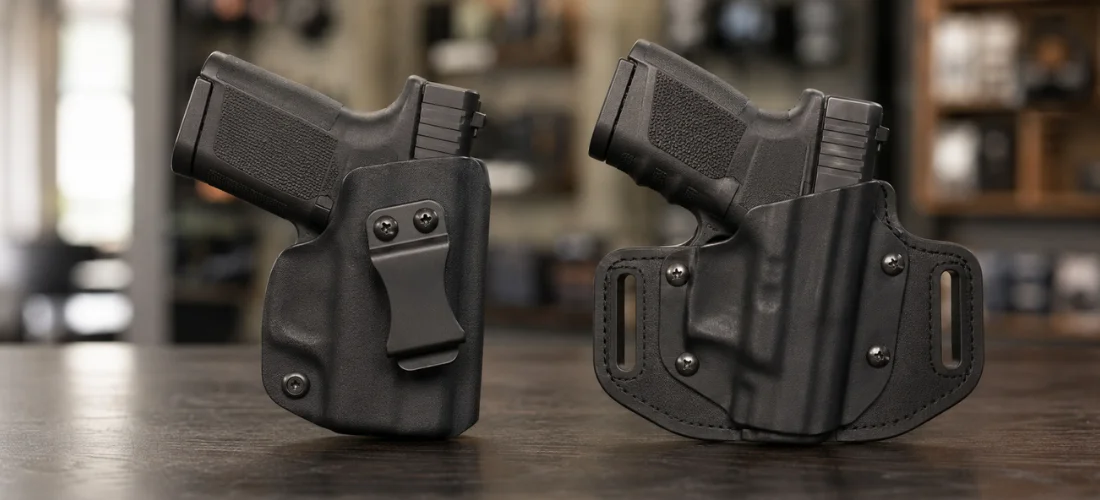
An IWB holster is generally better for maximum concealment and discreet everyday carry because most of the firearm remains inside the pants. An OWB holster usually provides greater comfort, easier access, and better support for larger handguns. The right choice depends on clothing, body type, firearm size, local laws, and intended use.
Choosing a carry method involves more than deciding where a handgun sits on the belt. The IWB vs OWB holster decision affects concealability, comfort, accessibility, clothing choices, and the types of firearms that can be carried practically. Inside-the-waistband models keep the handgun close to the body and hidden beneath relatively light clothing. Outside-the-waistband models place it beyond the pants, reducing pressure against the wearer and creating a more accessible grip.
Neither design is automatically right for every situation. A person who carries discreetly throughout the day may value minimal visibility, while someone training at a range may prefer easier access and less restriction. Understanding how each design performs during walking, sitting, driving, bending, and extended wear makes it easier to choose a secure setup that fits daily life.
What Is an IWB Holster?
An IWB holster sits between the wearer’s body and the inside of the pants. The handgun is positioned below the beltline, although the grip remains above the waistband so it can be accessed.
Most inside-the-waistband holsters attach to a belt using one or two clips, soft loops, pull-the-dot loops, or rigid belt attachments. The belt helps carry the handgun’s weight, while the waistband keeps the holster close to the body. Some clip designs can also work with reinforced clothing, but a proper gun belt usually provides better stability.
Tuckable IWB holsters leave a channel between the holster body and attachment clip. A shirt can be tucked into that space, allowing only the clip to remain visible. This arrangement improves concealment for business or formal clothing, although clearing a tucked shirt generally requires more practice.
IWB holsters can be worn in several positions, including appendix, strong-side hip, and behind the hip. The best position depends on body shape, handgun dimensions, daily movement, and time spent sitting.
What Is an OWB Holster?
An OWB holster carries the handgun on the exterior of the pants. It normally attaches to the belt through fixed loops, a paddle, wings, slots, or another mounting system.
Because the handgun does not occupy space inside the waistband, outside-the-waistband carry usually feels less restrictive. It also makes room for thicker or longer firearms that might be uncomfortable inside the pants. This is why the style is common for range use, duty applications, competitions, hunting, and lawful open carry.
An OWB handgun is normally visible with a fitted T-shirt or an open-front garment. Concealment is still possible, but it generally requires a jacket, overshirt, vest, or sufficiently long and loose top. A high-riding pancake design normally conceals more effectively than a paddle or duty-style model positioned farther from the body.
Comparing IWB vs. OWB
| Factor | IWB holster | OWB holster |
|---|---|---|
| Concealment level | High because most of the handgun sits below the beltline | Moderate to low unless covered by a long, loose garment |
| Comfort | Can create pressure against the body and waistband | Usually more comfortable because it remains outside the pants |
| Draw speed | Cover garment must be cleared before establishing a grip | Generally faster and less obstructed |
| Gun size compatibility | Best suited to subcompact and compact handguns | Better suited to compact, full-size, and duty-size handguns |
| Clothing requirements | Requires enough waistband space and may need larger pants | Requires a sturdy belt and longer cover garment for concealment |
| Climate suitability | Easier to conceal under light clothing but can trap heat and sweat | More comfortable in heat, although harder to conceal without layers |
| Legal considerations | Usually treated as concealed when properly covered | May qualify as concealed or open carry depending on visibility and local law |
| Beginner-friendliness | Requires adjustment and more practice clearing clothing | Usually easier to put on, access, and use during supervised training |
Detailed Comparison Between IWB vs OWB
An effective inside waistband vs outside waistband decision should consider the full carry system rather than the holster alone. Firearm dimensions, belt stiffness, clothing, retention, ride height, body shape, and training all influence the result.
Concealment
IWB is normally the stronger option when keeping the handgun out of ordinary view is the priority. The pants hide the slide and barrel, leaving the grip as the primary area that must be covered.
A basic concealment level comparison favors IWB with light everyday clothing. However, an appropriately selected OWB model can remain discreet under a jacket or untucked overshirt.
Printing Risk
Printing occurs when the outline of the firearm becomes noticeable through clothing. The grip is usually the most likely part to print, particularly when the wearer bends forward, reaches overhead, or twists.
Handgun grip length, holster cant, ride height, belt tension, and clothing material all influence visibility. A compact handgun in a well-fitted IWB model generally prints less than a full-size handgun in an OWB paddle holster.
A proper printing risk assessment should be completed with an unloaded firearm in a safe location. Check the setup while standing, sitting, reaching, and bending. A mirror view from only one angle may fail to reveal problems visible during movement.
Cover Garment Requirements
IWB can often be concealed beneath an untucked T-shirt, polo, or casual button-down shirt. The garment should be long enough to remain below the grip when the arms are raised.
OWB usually needs more coverage. Jackets and overshirts work well, but fitted or short tops may expose the lower edge of the holster. Wind and routine movement must also be considered because an open garment can shift unexpectedly.
These clothing requirements vary with torso length, firearm size, carry position, and the holster’s ride height. Simply buying oversized clothing is not always necessary. A slightly longer cut and fabric that does not cling may be enough.
Appendix Carry for Deep Concealment
Appendix inside-the-waistband carry, usually called AIWB, positions the handgun near the front of the body. It can offer deep concealment because the wearer can monitor the firearm and the front of the torso often supports a close, stable position.
A holster claw may rotate the grip inward, while a wedge can adjust the angle against the body. These accessories should improve fit without compromising trigger coverage or stability.
AIWB comfort varies considerably. Barrel length, grip length, ride height, body proportions, and seated posture all matter. Any appendix setup should use a rigid, firearm-specific holster that completely protects the trigger guard and remains open when the firearm is removed.
Comfort
OWB generally wins on immediate comfort. It does not reduce space inside the pants or press the firearm directly into the body. IWB can still become comfortable when the handgun, belt, clothing size, and position are properly matched.
The real test is comfort for all-day carry, not how a holster feels during a five-minute fitting. A setup should be evaluated while walking, sitting, driving, and completing normal daily activities.
Skin Contact and Sweat
An IWB holster may place the material or firearm close to bare skin. Sweat guards can reduce direct contact with the slide, but they do not eliminate heat or moisture. An undershirt may improve comfort and help protect the firearm’s finish.
Kydex does not absorb moisture, while leather and fabric-backed hybrid models may retain some perspiration. Regardless of material, the handgun and holster should be inspected regularly for moisture, debris, damaged hardware, or corrosion.
OWB creates more airflow and usually keeps the firearm away from the skin. That advantage becomes noticeable during long periods outdoors or in humid environments.
Waistband Pressure
IWB requires extra space inside the pants. Wearing normal tightly fitted trousers may create pressure even with a slim handgun. Moving up slightly in waist size or choosing stretch fabric can help.
A supportive belt should hold the handgun without requiring excessive tightness. Over-tightening can create pressure points, force the grip outward, and make sitting uncomfortable.
OWB avoids most internal waistband pressure, but a heavy firearm can still pull the belt downward. Wider mounting points usually distribute that weight more effectively.
Body Type and All-Day Wear
No universal position works for every body shape. Appendix carry may suit one person but become uncomfortable for another while seated. Strong-side carry may feel natural when standing but press against a chair or vehicle seat.
A useful holster position guide should therefore be treated as a starting point. Body proportions, mobility, dominant hand, occupation, driving time, and firearm dimensions determine the final position.
Draw Speed and Accessibility
OWB usually offers more direct access because the firearm sits outside the pants and may have less clothing over it. This explains much of the typical draw speed difference between the two styles.
Speed should never replace safe handling. A consistent grip, trigger-finger discipline, muzzle awareness, and controlled reholstering matter more than achieving the fastest possible movement.
Why Is OWB Usually Faster?
With an uncovered OWB setup, the wearer can establish a full firing grip without first lifting a shirt. The handgun also sits farther from the body, giving the hand more room.
Concealed OWB carry still requires the cover garment to be cleared. Its advantage may therefore become smaller when compared with a well-practised IWB setup.
IWB Draw Mechanics
Accessing an IWB handgun begins by safely clearing the cover garment and establishing a complete grip before the firearm leaves the holster. A tucked shirt or multiple clothing layers add steps.
Repeated practice should begin with an unloaded firearm or inert training tool under qualified supervision. Live-fire practice must follow the range’s rules and should not be rushed.
Training Considerations
Practice should reflect the clothing and holster position actually used. Range drills performed with an exposed OWB handgun do not automatically prepare someone to access a concealed IWB handgun beneath everyday clothing.
Reholstering deserves particular care. Clothing, drawstrings, and other objects must remain clear of the holster opening. There is rarely a reason to reholster quickly. Stop and correct the setup if the holster collapses, shifts, or fails to retain its shape.
Gun Size Compatibility
Firearm size affects concealability, leverage, weight distribution, and seated comfort. Holster quality cannot completely overcome a handgun that is poorly matched to the intended position.
Subcompact and Compact Handguns
Subcompact and compact pistols are usually easier to carry IWB because their shorter grips reduce visibility. Their lower weight also places less strain on the waistband.
Very short barrels are not automatically more comfortable. In some positions, a slightly longer holster can distribute pressure better and reduce the tendency for the grip to tip away from the body.
Compact pistols can work well in either style. IWB favors discretion, while OWB provides easier handling during range sessions and extended outdoor use.
Full-Size and Duty Handguns
OWB is generally more practical for full-size pistols, weapon-mounted lights, and duty configurations. The external position provides room for a longer slide and greater weight without using internal waistband space.
Carrying a full-size pistol IWB is possible, but it demands more attention to body shape, belt strength, cover garments, and holster position. A long grip may remain difficult to conceal even when most of the firearm is below the beltline.
OWB Holster Types
OWB is a category rather than a single design. The attachment method affects concealment, stability, convenience, and compatibility with different belts.
Pancake Holsters
A pancake holster uses widely spaced belt slots or loops on each side of the firearm. This pulls the handgun close to the body and spreads its weight across a larger area.
It is usually the best OWB option for concealment under a jacket or overshirt. The tradeoff is that installation may require removing or partially unthreading the belt.
Paddle Holsters
A paddle holster uses a broad attachment that slides inside the waistband while the holster remains outside. It is convenient to put on and remove without taking off the belt.
Paddle models may sit farther away from the body than pancake designs. They can therefore be easier to access but more difficult to conceal. A secure paddle should resist accidental removal and remain stable during movement.
Belt-Slide Holsters
A belt-slide design is compact and threads directly onto the belt. Some models cover less of the slide or muzzle, reducing bulk.
The small footprint can be convenient, but firearm protection and weight distribution vary by design. Users should ensure the trigger guard is fully protected and the handgun cannot be pushed upward or dislodged during normal movement.
For every design, the belt type needed depends on the combined weight of the handgun, holster, ammunition, and accessories. A purpose-built belt normally resists twisting and sagging better than a soft fashion belt.
Climate and Seasonal Carry
Hot weather creates a difficult choice. IWB conceals well beneath a lightweight untucked shirt, but it also increases skin contact, heat, and perspiration. OWB allows more airflow and may feel better, although concealing it can require a longer shirt or light overshirt.
A hot-climate setup should prioritize corrosion checks, washable or moisture-resistant materials, and clothing that provides coverage without excessive bulk. A smaller handgun may also be easier to manage during summer.
Winter changes the balance. IWB becomes easier to conceal under sweaters and coats, but heavy layers can obstruct access. OWB also hides easily beneath a coat, though removing that coat indoors may expose the handgun. Whichever method is used, training should account for the actual seasonal clothing worn.
Legal Considerations
The legal distinction is generally based on whether the firearm is visible or concealed, not simply whether the holster is inside or outside the pants. An OWB handgun completely covered by a jacket may be considered concealed. An IWB handgun with a plainly visible grip could raise different legal questions depending on the jurisdiction.
Laws vary across states and can change. Permit rules, age limits, prohibited locations, signage, vehicle carry, duty-to-inform requirements, and definitions of concealment are not uniform. Always verify the applicable statutes and official state guidance before carrying.
Therefore, the answer to IWB or OWB for concealed carry must include both practical concealment and legal compliance. OWB does not automatically mean open carry, and IWB does not guarantee that a handgun is legally concealed.
Which Holster Should You Choose?
The best choice depends on where, why, and how the handgun will be carried.
- Daily concealed carry: Choose IWB when discretion under ordinary clothing is the priority. A compact handgun, stable clip system, and rigid trigger coverage create a practical starting point.
- Range and training: Choose OWB for straightforward access, easier supervision, and greater comfort during repeated practice. Confirm that the range allows the selected holster and draw exercises.
- Duty or lawful open carry: OWB is usually more suitable for full-size handguns and active use. A retention system appropriate to the environment may be necessary.
- Hot-climate everyday carry: IWB usually conceals better beneath light clothing, but OWB may feel cooler. The decision depends on whether a reliable cover garment can be worn comfortably.
- First-time gun owner: OWB is often easier to fit and use during supervised training. Someone planning routine concealed carry should still train with the IWB system they intend to wear.
Regardless of style, choose a firearm-specific holster that securely retains the handgun, completely covers the trigger guard, stays attached during access, and does not collapse when empty.
Final Verdict
To conclude, when it comes to the IWB vs OWB Holster debate, IWB is generally the better choice for discreet everyday carry because it keeps most of the handgun below the beltline. Its disadvantages are added waistband pressure, greater contact with the body, and a more complicated path past the cover garment. OWB is normally more comfortable, accommodates larger firearms, and provides less restricted access. Its main limitation is concealment, particularly with short or fitted clothing. For many handgun owners, the practical solution is not forcing one design to handle every activity. An IWB model can serve daily discreet carry, while a separate OWB model can provide better comfort and access for training, outdoor activities, or professional use.
FAQs
OWB is generally more comfortable because the handgun remains outside the pants and does not press directly against the body. A correctly fitted IWB setup can still be comfortable, especially with a compact handgun, supportive belt, appropriate pants size, and suitable carry position.
Yes. An OWB handgun can be concealed beneath a sufficiently long jacket, overshirt, vest, or loose top. High-riding pancake holsters usually conceal better than paddle or duty models. Local law determines whether the resulting setup qualifies as concealed.
Subcompact and compact handguns are usually the easiest to carry IWB. Their shorter grips and lower weight improve concealability and reduce waistband strain. Full-size handguns can also be carried this way when the holster, belt, clothing, and body position support them properly.
Neither position is automatically safer. Safety depends on using a secure, firearm-specific holster that completely covers the trigger, following proper handling rules, and keeping clothing and foreign objects away from the holster opening. Qualified instruction is strongly recommended before carrying in either position.
A rigid gun belt is recommended. OWB places the handgun’s weight outside the pants, which can cause an ordinary fashion belt to twist or sag. The belt must also fit the holster’s loops or attachment system securely.