Quick Summary: A red dot is the better choice for many of us because it is lighter, less expensive, available for more firearms, and can run for years on one battery. A holographic sight makes more sense when you want a large circle-dot reticle, a fine center dot, a generous viewing window, and useful performance with a magnifier or a partly obstructed window.
Neither is automatically more accurate. Your choice depends on the firearm, distance, battery routine, eyesight, size, and weight.
If you are comparing more than these two categories, our review of the best AR-15 optics also covers prism sights and LPVOs.
Red Dot vs. Holographic
| Feature | Red dot sight | Holographic sight |
|---|---|---|
| Reticle technology | LED reflected from a coated lens | Laser illuminates a recorded holographic reticle |
| Typical format | Open reflex, enclosed micro, or tube | Full-size rectangular housing |
| Best fit | Handguns, rifles, PCCs, and shotguns | Primarily rifles, carbines, PCCs, and shotguns |
| Representative battery life | 50,000 hours for Aimpoint Micro T-2 | 1,000 hours for EOTech EXPS3; 1,500 for Vortex UH-1 Gen II |
| Representative weight | Aimpoint Micro T-2: 4.6 oz with standard mount | EOTech EXPS3: 11.2 oz |
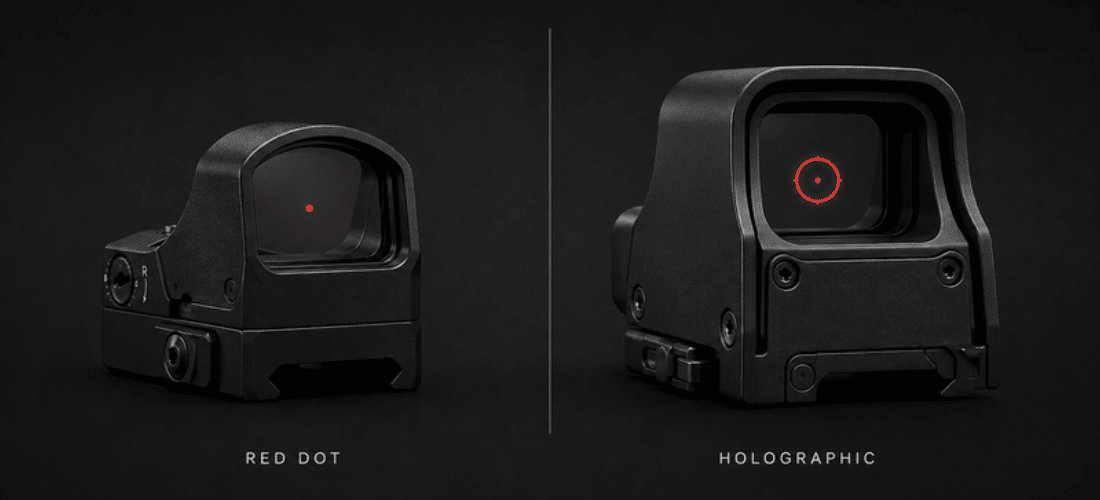
| Common aiming point | Often a 2 to 6 MOA dot; circle-dot options exist | Often a 1 MOA center dot inside a large ring |
| Magnifier compatible | Yes | Yes |
| Eye relief | Unlimited | Unlimited |
| Night vision | Model-dependent | Model-dependent |
| Main advantage | Low weight and exceptional battery efficiency | Fine, information-rich reticle and large window |
| Main drawback | Dot may distort for some eyes | Higher price, bulk, and power consumption |
These are representative figures. Runtime varies with brightness, battery, and temperature.
The Aimpoint Micro T-2 lists 50,000 hours at daylight setting 8 and 4.6 ounces with its standard mount. EOTech’s EXPS3 lists 1,000 hours at setting 12, 11.2 ounces, a 68 MOA ring, and a 1 MOA center dot.
How Does a Red Dot Sight Work?
A red dot is a reflex or reflector sight. A low-power LED shines toward a coated, curved lens, which reflects the aiming point to the shooter’s eye while the target remains visible.
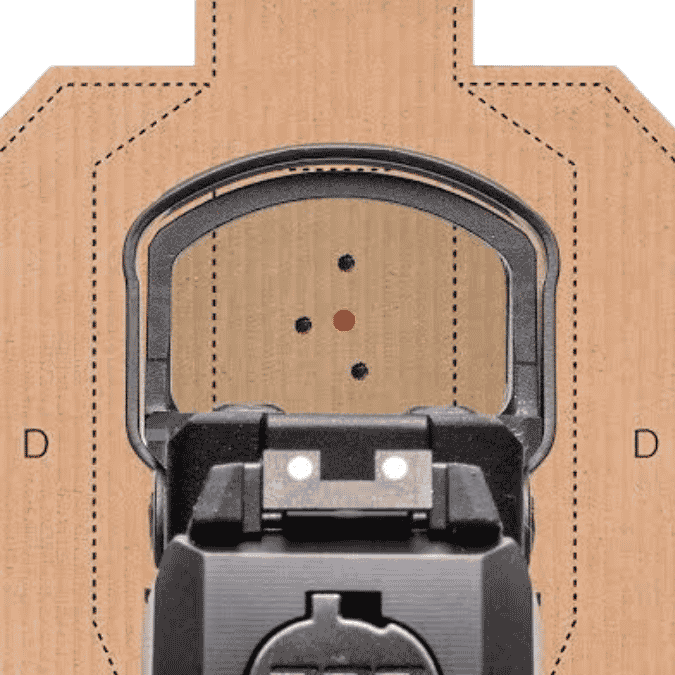
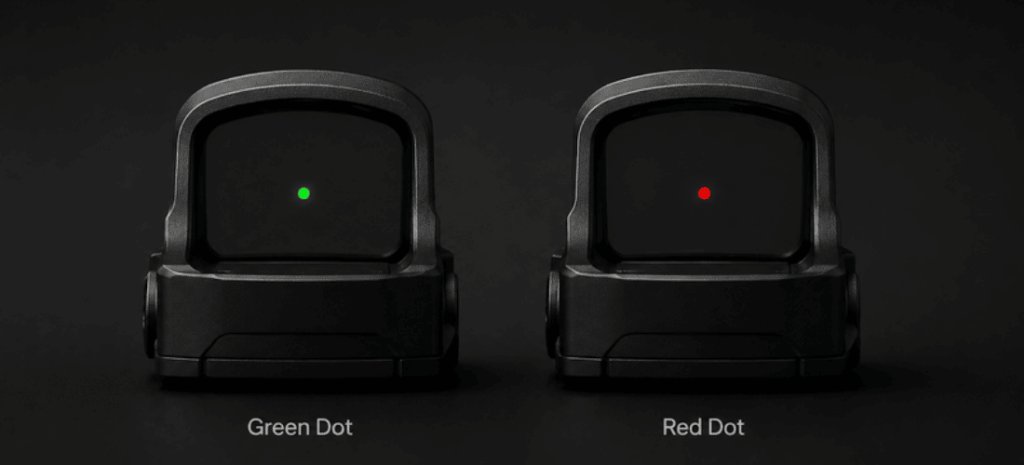
“Red dot” describes the sight family, not necessarily its color or shape. It can use a green emitter or display a circle-dot. This simple optical path allows tiny pistol optics, sealed rifle dots, and exceptional battery life.
How Does a Holographic Sight Work?
A true holographic weapon sight uses a laser diode to illuminate a reticle recorded in holographic film. It reconstructs a virtual image at distance instead of reflecting a basic LED dot from the objective lens.
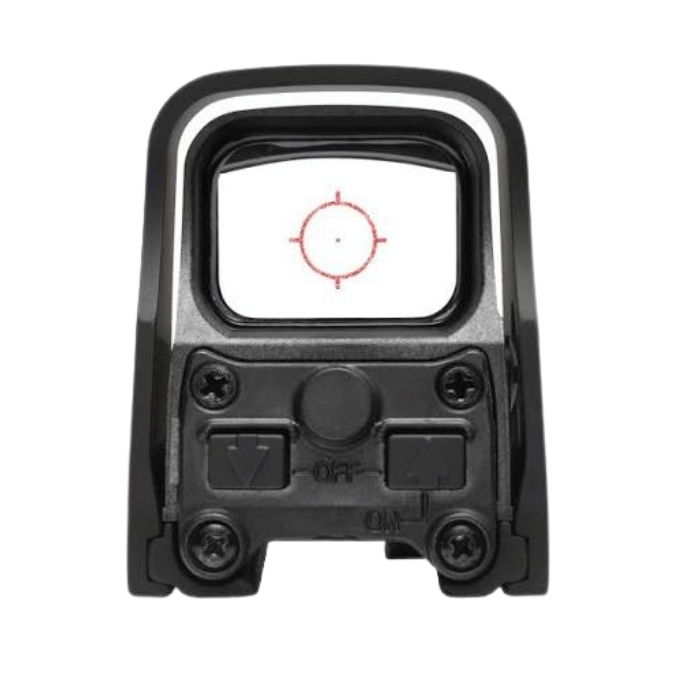
The system supports fine center points and detailed reticles but needs more space and power. EOTech and Vortex are the best-known current makers.
A Rectangle and Circle-Dot Do Not Make a Sight Holographic
Housing shape is not technology. The Holosun HS510C resembles a holographic sight and offers a 2 MOA dot with a 65 MOA circle, but it is an open LED reflex sight. Our Holosun 507C review covers another multi-reticle reflex sight sometimes called a “holo.”
Check the operating principle. “LED,” “reflex,” or “open emitter” indicates red-dot technology. A true holographic weapon sight uses a laser-illuminated hologram.
The Differences That Matter in Real Use
Here are the main differences you need to consider:
Size, Weight, and Firearm Compatibility
Red dots win here. Micro models fit pistol slides, work as offset optics, and keep light carbines balanced. Enclosed emitters protect the LED from rain, lint, and debris without becoming holographic. See our Aimpoint Acro P-2 review for one example.
Holographic sights need room for a laser, mirrors, electronics, and housing. They belong on long guns with adequate rail space. Weight adds up quickly with a riser, magnifier, and backup sights.
Battery Life and Ready-State Management
This is the clearest red-dot advantage. A quality LED sight may run continuously for years, reducing the chance of finding a dark optic when it is needed.
Holographic runtime is usually measured in hundreds or low thousands of hours. Owners need a battery schedule, must understand auto-shutoff behavior, and should check brightness and function regularly.
Reticle, Speed, and Precision
A 2 MOA dot is clean and uncluttered. One MOA subtends about 1.047 inches at 100 yards, so a 2 MOA dot covers roughly 2.1 inches there and half as much at 50 yards. Excess brightness can make it bloom.
A common holographic reticle combines a 68 MOA ring with a 1 MOA center dot. It does not improve mechanical accuracy, but it combines a bold visual reference with a fine aiming point.
Some shooters process a plain dot faster; others find a large ring more consistently. Try both against bright and dark backgrounds.
Magnification: Ignore the *2 MOA Becomes 6 MOA* Myth
Both sight types work with flip-to-side magnifiers. A 3x magnifier makes an LED dot look three times larger, but it also enlarges the target image three times. A 2 MOA dot therefore does not suddenly cover 6 MOA of the magnified target.
EOTech states that its holographic 1 MOA center dot remains 1 MOA under magnification. So from purchasing point of view: a fine, well-resolved aiming point covers less target than a coarse one.
Optical quality, reticle bloom, alignment, eye relief, and eyesight carry the most value. Confirm point of impact after installation. Our review of the best red dot magnifiers for AR builds explains the mounting and weight drawbacks.
Parallax and Head Position
“Parallax-free” is an operational description, not zero error at every distance and eye position. Off-axis viewing can still move the apparent point of aim.
An off-axis view near the outer edge may produce up to 4 ± 3 MOA of error at 71°F, while centering the reticle gives the least error. The lesson is not that holographic sights are inaccurate. It is that consistent presentation and a confirmed zero still matter with every electronic sight.
Astigmatism and Reticle Clarity
Astigmatism can make a dot look smeared, doubled, or starburst-shaped. Holographic reticles look cleaner to some shooters but grainy to others, especially when they focus on the reticle instead of the target.
Test with your corrective lenses, focus on the target, and avoid excessive brightness. A phone photo can help distinguish eye-related distortion from a defective emitter. If both look poor, try an etched prism reticle.
Durability and a Damaged Window
Premium examples in both categories withstand recoil, weather, and hard use. Housing, seals, electronics, mount quality, and testing matter more than category.
A holographic reticle may remain visible through an undamaged part of a cracked or obstructed window. Severe impact can still shift zero or disable the unit. An enclosed red dot protects its emitter from debris better than an open reflex sight.
Cost and Selection
Red dots cover nearly every budget and footprint, including products unsuitable for centerfire recoil. Still, it’s always best to get your own research in when purchasing.
True holographic sights occupy a smaller premium market. Include batteries and a magnifier in the total cost. If most shots require magnification or target identification, compare the setup with the best AR-15 LPVO scopes.
Which One Should You Choose?
Choose a red dot if:
- You want the lightest practical setup.
- Multi-year battery life and constant-on readiness matter most.
- The optic must fit a handgun or serve as an offset sight.
- You want more choices across budget, footprint, reticle, and color.
- A simple dot gives you a clean sight picture.
Choose a holographic sight if:
- The optic will live on a rifle, PCC, or shotgun with enough rail space.
- You prefer a large viewing window and circle-dot reticle.
- A 1 MOA center point and magnifier use are priorities.
- Partial-window obstruction is a meaningful concern.
- You accept shorter battery life, more weight, and a premium price.
For most civilian range, hunting, and home-defense setups, a quality red dot is the practical default. A holographic sight earns its extra weight and cost when its particular reticle, window, and magnifier performance solve a problem you actually have.
Final Verdict
The red dot vs holographic decision is not about choosing the more “tactical” optic. It is about matching the sight to the firearm and its real job.
Get a red dot for efficiency, compactness, platform flexibility, and easier ready-state management.
Get a holographic sight for its fine center aiming point, bold reticle, generous window, and resilience when part of the window is blocked.
Once picked, test the reticle with your own eyes, verify the mount and zero, and replace batteries on a written schedule.
FAQs
Not for everyone. Holographic sights offer a fine center dot, large reticle, and useful partial-window performance. Red dots are lighter, more affordable, more widely available, and far more battery-efficient.
A reliable red dot is the best default for most home-defense firearms because it can remain on for years and adds little weight. Choose holographic when you strongly prefer its reticle and follow a disciplined battery-check routine.
It can be, but results vary. Some shooters see a cleaner holographic reticle; others see grain or distortion. Test both with corrected vision. An etched prism is worth trying if neither looks clear.
Yes. Red dots and holographic sights can work with compatible magnifiers. Match optical height, check eye relief and mount clearance, then confirm zero and point of impact at the range.
No. The HS510C is an open reflex red dot that uses an LED, despite its rectangular window and selectable circle-dot reticle. Housing shape and reticle pattern do not determine the sight technology.