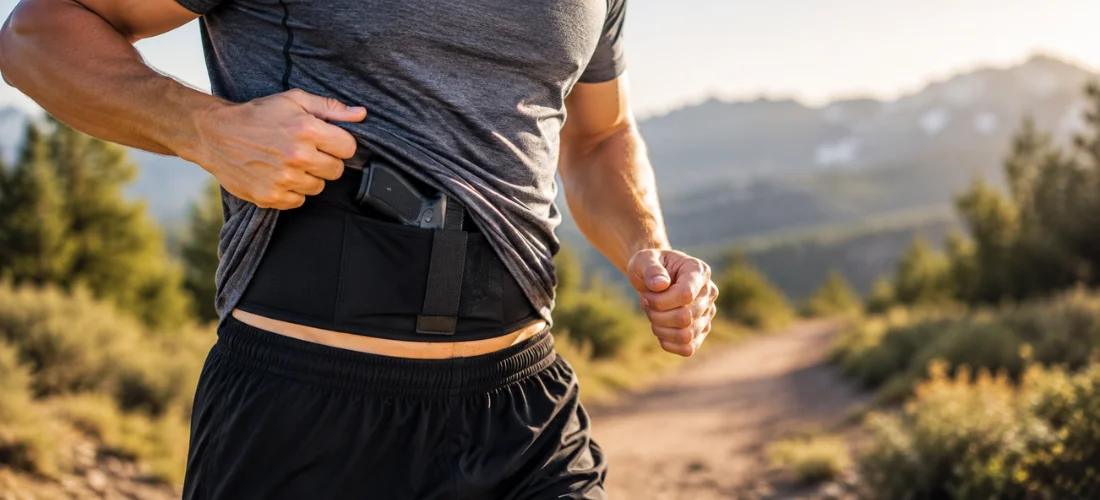
The ComfortTac Belly Band Holster is the best overall holster for running in 2026. Its 44″–54″ neoprene band sits directly against the skin and moves with your torso instead of against it, which keeps the gun from bouncing on every stride. The neoprene also breathes better than nylon-and-Velcro designs, so it doesn’t turn into a sweat sponge on a hot run. Because it rides flat under a shirt with no hard clips or metal snaps printing through the fabric, it stays concealed even at a full sprint. If you want a hard-shell alternative with true retention, the Clip & Carry STRAPT-TAC is the runner-up for anyone who already owns a Kydex IWB holster.
Runners who carry concealed have one problem nobody else in the holster world has to solve: constant vertical motion. Every footstrike sends a small shockwave up through the hips and torso, and a holster for running has to absorb that without letting the gun shift, flop, or print through a sweat-soaked shirt. Traditional inside-the-waistband (IWB) holsters, built for someone standing still behind a counter or sitting in a car, tend to fail runners in three predictable ways: they rely on a belt that isn’t there in running shorts, they trap heat against the skin, and they let the gun’s grip wander with every stride.
This guide breaks down the best holsters built specifically for that kind of movement, compares the major carry styles (belly band, chest rig, and appendix IWB), and tells you exactly which one fits your build, climate, and gun size.
Top Picks for Running
Running holsters fall into a few clear categories, and the right pick depends less on brand reputation and more on how you’re built and what you’re carrying. A subcompact single-stack behaves very differently strapped to a 44″ neoprene band than it does riding in a hard Kydex shell on your thigh, and a hot-climate runner has completely different priorities than someone who just needs to get through a 20-minute jog without a bounce.
The five holsters below were chosen because each one solves the running-specific problem of bounce, sweat, or printing, in a genuinely different way, not because they’re simply popular IWB holsters repurposed for the gym.
| Product | Type | Price Range | Best For |
|---|---|---|---|
| ComfortTac Belly Band Holster | Belly band (neoprene) | ~$25–$30 | Budget-conscious runners wanting all-day comfort |
| Clip & Carry STRAPT-TAC | Belly band + your own IWB Kydex | ~$35 | Runners who already own a quality Kydex holster |
| Vertx SOCP Tactical Fanny Pack | Off-body waist pack | ~$130–$150 | Runners who want a dedicated bag, not a belt |
| Nehostertfy Drop Leg Holster | Thigh/drop-leg rig | ~$20 | Trail runners or those who can’t carry at the waist |
| Galco Fastrax Pac Compact Waistpack | Off-body waist pack | ~$118 | Runners who want premium materials and a fast draw |
ComfortTac Belly Band Holster
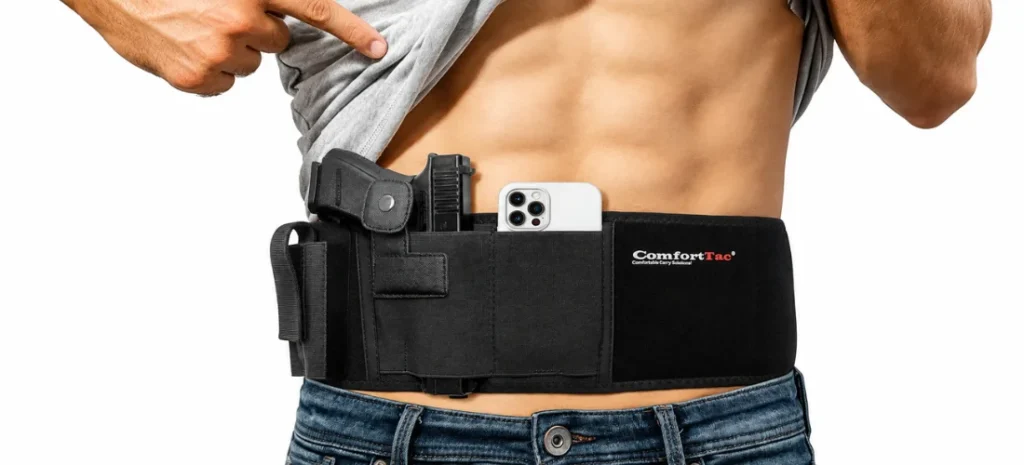
The band is made of surgical-grade elastic neoprene that stretches to fit up to a 44″ belly in the Large size (54″ in XL), and it’s soft enough to wear directly against skin without a shirt layer underneath. It includes a hard plastic trigger guard and a metal snap retention strap, and because the holster pocket can be repositioned anywhere on the band, it works for appendix, hip, or small-of-back carry depending on how your gait feels best.
Best for: Runners on a budget who want a genuinely comfortable, all-position band.
Skip if: You carry a full-size duty pistol. The elastic pocket isn’t built for heavier steel-frame guns.
Clip & Carry STRAPT-TAC Belly Band Holster
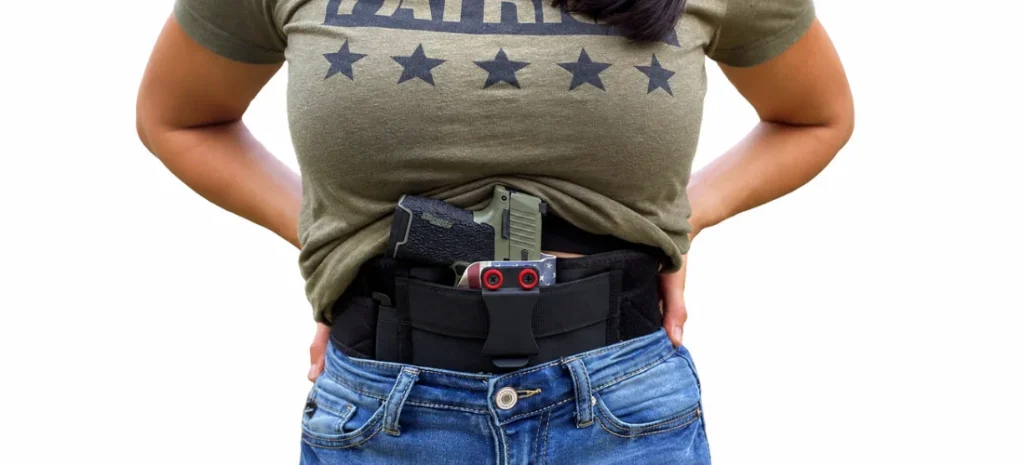
Instead of holding the gun in an elastic pocket, this band has a built-in track that your existing Kydex IWB holster clips into, so you get actual trigger-guard retention rather than pure friction fit. It’s made from a breathable “aeroprene” material and comes in three size ranges from a 23″ to a 48″ waist, with a rotating design that works for strong-side or appendix carry.
Best for: Runners who already own a well-fitted Kydex holster and want real retention on the move.
Skip if: You don’t own a compatible IWB holster. This product doesn’t include one.
Vertx SOCP Tactical Fanny Pack

This is a purpose-built off-body carry pack rather than a band, with a loop-lined CCW compartment, a holster retainer strap, and lockable ambidextrous zipper pulls so you can draw from either side in low light. A padded, adjustable waist strap and a separate front compartment for a phone and other EDC items keep the gun compartment dedicated to just the firearm and spare mag.
Best for: Runners who dislike anything touching bare skin and prefer a dedicated bag-style carry.
Skip if: You want the slimmest possible profile. A fanny pack is bulkier than a band under a fitted shirt.
Nehostertfy Drop Leg Holster
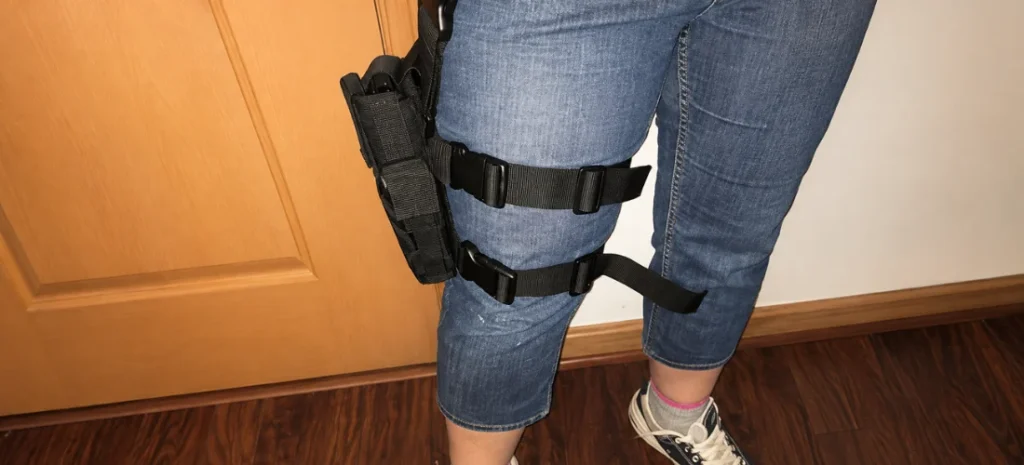
A thigh-mounted rig with fully adjustable straps that fit a 19″–27″ thigh circumference, plus a magazine pouch and a quick-release buckle system. Moving the gun off the waistband eliminates bounce from the torso, which some runners find far more stable than any belly band.
Best for: Trail runners, hikers, or anyone who can’t or doesn’t want anything cinched around the belly.
Skip if: Concealment under regular running shorts is a priority.
Galco Fastrax Pac Compact Waistpack
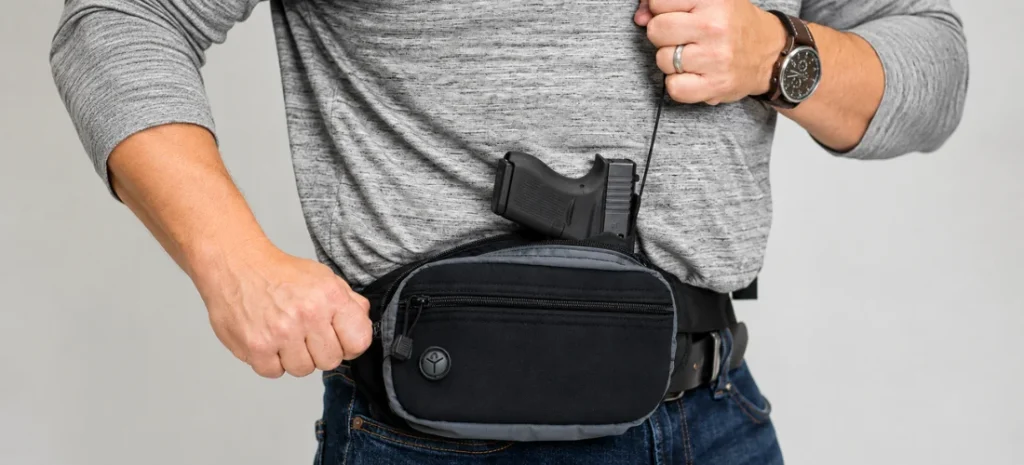
Built with a 400-denier nylon packcloth body and a neoprene front face, this waistpack uses a pivoting holster component and an external activation cord so you can draw much faster than digging through a normal fanny pack. Galco’s “Comfort Cloth” back panel adds moisture-wicking padding, and the elasticized waist strap adjusts up to 50″.
Best for: Runners who want a premium off-body option with a genuinely fast draw stroke.
Skip if: Budget is the main concern. This is the most expensive pick on the list.
What Makes a Holster Good for Running?
Bounce and Shift Control
A holster that’s fine for walking can fail at a running cadence, because the vertical G-forces of each footstrike are far higher than anything experienced standing still. The best running holsters either hug the body tightly enough that the gun moves with the torso as one unit (belly bands) or move the weapon off the waist entirely so torso motion doesn’t affect it at all (drop-leg and off-body packs).
Breathability and Sweat Handling
Neoprene is the material of choice for most running-specific belly bands because it wicks and dries faster than plain elastic or nylon webbing, and it doesn’t chafe the way a stiff nylon Velcro band can after a few miles. Materials matter more here than in everyday carry, since a holster that’s comfortable for an eight-hour desk shift can become unbearable after 30 minutes of sweat.
Concealment and Printing at Speed
A gun that’s perfectly concealed standing still can print badly the moment your gait causes fabric to move and cling. Flat, low-profile bands generally conceal better while running than rigid OWB-style holsters, because there’s no hard edge for a sweaty shirt to catch on and outline.
Retention and Trigger Guard Safety while Moving
Because running involves so much more movement than everyday carry, retention isn’t optional. A loose-fitting holster is far more likely to let a gun shift toward the trigger guard or fall out entirely. Look for a hard trigger-guard cover (plastic or Kydex) rather than a pure fabric pocket, especially if you’re carrying without a shirt tucked in to help hold things in place.
Types of Holsters for Running, Compared
Belly Band Holsters
Belly bands remain the most popular running holster style because they don’t require a belt, which most running shorts and joggers don’t have anyway, and because the wide elastic band distributes the gun’s weight across a larger area of the torso instead of concentrating it on one hip.
The trade-off is heat: a 4″-wide band worn directly against the skin under running clothes traps warmth, so material choice (neoprene vs. plain elastic) makes a bigger comfort difference here than in almost any other holster category.
| Product | Width/Sizing | Material |
|---|---|---|
| Galco Underwraps Belly Band | 4″ wide, S–XL (30″–52″ waist) | Elastic nylon band with two leather holster pockets |
| Blackhawk Stache Belly Band | 4″ tall, five sizes | Double-ply elastic with a 1.5″ scuba-webbing mounting section |
Galco Underwraps Belly Band uses two leather holster pockets that can be positioned anywhere along the 4″-wide elastic band, so you can carry one or two guns simultaneously, plus accessories like a spare magazine or a phone, and switch between strongside, cross-draw, or small-of-back carry without buying a second band. The leather pockets stabilize the gun’s position and angle far better than a plain elastic pocket, at the cost of being slightly less breathable than a full-neoprene design.
Best for: Runners who want to carry a spare mag or second item alongside the gun.
Skip if: You want the coolest, most breathable option.
Blackhawk Stache Belly Band takes a different approach: rather than an elastic pocket, it has a double-layered 1.5″ scuba-webbing section built into the center of the band, and your existing Stache IWB (or similarly sized) Kydex holster clips directly onto that webbing. That means you get real Kydex retention with the beltless convenience of a band, plus four storage pockets for a phone, spare mag, or tourniquet.
Best for: Runners who already own a Stache or similarly compatible Kydex IWB holster.
Skip if: You don’t own a compatible clip-on holster.
Chest Rig / Chest Bag Holsters
Chest packs solve the bounce problem in a completely different way from belly bands: rather than cinching tight to the torso, they distribute the gun’s weight across the upper chest and shoulders, which some runners find more stable than anything worn at the waist, especially for longer distances.
The obvious trade-off is concealment. A chest pack is far more visible under clothing than a belly band, so this style leans toward open or semi-concealed carry rather than deep concealment.
| Product | Mount Style | Material |
|---|---|---|
| Lemubeane Sports Chest Pack | Adjustable shoulder + chest strap | Water-resistant nylon |
| RXW Chest Bag | Adjustable 3D air-mesh strap (10.8″–16.7″) | Nylon with MOLLE webbing |
Lemubeane Sports Chest Pack includes a detachable hook-and-loop holster inside the main pocket that adjusts to fit different pistol sizes, plus eight reflective strips and a rear reflective panel for visibility on early morning or evening runs. Both the upper shoulder strap and lower chest strap are independently adjustable, and the elastic lower strap keeps the pack from bouncing during a run.
Best for: Runners who train in low light and want built-in visibility features.
Skip if: Deep concealment is required.
RXW Chest Bag uses a 3D air-mesh strap that adjusts from 10.8″ to 16.7″ for a snug, non-bouncing fit, and it splits its front pockets between a MOLLE-webbing panel and a hook-and-loop panel with seven elastic loops, which keeps the dedicated CCW storage separate from your phone and keys. It’s built for a low-profile, print-resistant look specifically for discreet urban carry rather than an overtly tactical appearance.
Best for: Runners who want organized, separated storage for the gun versus everyday items.
Skip if: You’re running with a full-size duty gun.
Appendix IWB (and why it’s a compromise for running)
Appendix carry means wearing an IWB Kydex holster at roughly the 12 to 1 o’clock position. It is popular for everyday concealed carry because it offers a fast, natural draw and good concealment under a shirt.
For running specifically, it’s a compromise: without a proper gun belt cinched tight (which most running shorts can’t support), the holster has nothing rigid to clip onto, so the gun can shift downward or outward with each stride.
Runners who prefer this position typically pair the holster with a dedicated belly band mounting system (like the STRAPT-TAC or Stache N.A.C.H.O. above) rather than wearing it on a standalone belt.
| Product | Retention | Cant/Ride Height |
|---|---|---|
| Bravo Concealment Torsion IWB | Adjustable retention screw | 10° inward cant, adjustable ride height |
| Vedder LightTuck IWB Kydex | Adjustable retention | 3 ride-height levels, adjustable cant |
Bravo Concealment Torsion IWB uses a patented design that twists the gun inward toward the body at a 10-degree cant, which pulls the grip closer to your side for better concealment than a flat-profile IWB holster. The 3.0 version adds an adjustable retention screw, and the holster accommodates threaded barrels, tall iron sights, and red-dot optics without any modification.
Best for: Appendix or strongside carriers who want maximum concealment from a standalone Kydex holster.
Skip if: You don’t have a dedicated running belt.
Vedder LightTuck IWB Kydex is built from .080″ Kydex with a full sweat shield to keep the gun’s slide clean, and it offers three levels of adjustable ride height along with adjustable retention and cant. An optional claw attachment pulls the grip closer to the body for deeper concealment, which partially compensates for the lack of a leather backing found on Vedder’s hybrid models.
Best for: Runners who want a thin, no-frills Kydex holster to pair with a belly band mounting system.
Skip if: You want a hybrid holster with leather backing for extra comfort.
Belly Band vs Chest Holster: Which Should You Buy
The choice comes down to where you’d rather feel the weight and how much concealment matters. A belly band keeps the gun close to your center of gravity, conceals better under a plain T-shirt, and works well for shorter subcompact and compact pistols, but it puts a band directly against sweaty skin and can feel restrictive on longer runs.
A chest rig moves the weight up and off the waist entirely, which many runners find more stable over distance, but it sacrifices concealment and adds visible bulk to your silhouette.
Choose a belly band if concealment is your top priority, you’re carrying a subcompact-to-compact pistol, and you’re running shorter distances (under 6–8 miles) where skin contact isn’t a major issue. Choose a chest rig if you’re doing longer runs where waist comfort becomes the limiting factor, you don’t need deep concealment, or you want to separate your gun storage from your phone and keys rather than stacking everything on one band.
Final Verdict
For most runners, a neoprene belly band delivers the best balance of concealment, comfort, and no-bounce stability, which is why the ComfortTac tops this list. Runners who already own a quality Kydex IWB holster get more retention and a faster draw by pairing it with a compatible band system like the STRAPT-TAC. Anyone doing longer distances or prioritizing breathability over deep concealment should look at a chest rig or off-body waistpack instead.
FAQ
A neoprene belly band is generally the best type for running because it hugs the torso tightly enough to prevent bounce while staying breathable enough for sweat, and it doesn’t require a belt.
Yes. Belly bands and appendix IWB holsters paired with a beltless mounting band both allow concealed carry while running, as long as the gun is sized appropriately and the outer layer (shirt or light jacket) is loose enough to prevent printing.
Yes, belly bands are the most common running-specific holster because they wrap around the torso without needing a belt, distribute weight evenly, and (in neoprene versions) manage sweat better than rigid holsters.
Appendix carry can work for running, but only when the IWB holster is paired with a proper belt or a beltless band system built for that position. Without one, the holster has nothing secure to attach to, and the gun can shift with each stride.
Belly bands with a snug, properly sized fit minimize bounce the most, since the band moves with the torso as a single unit rather than hanging off a separate point.