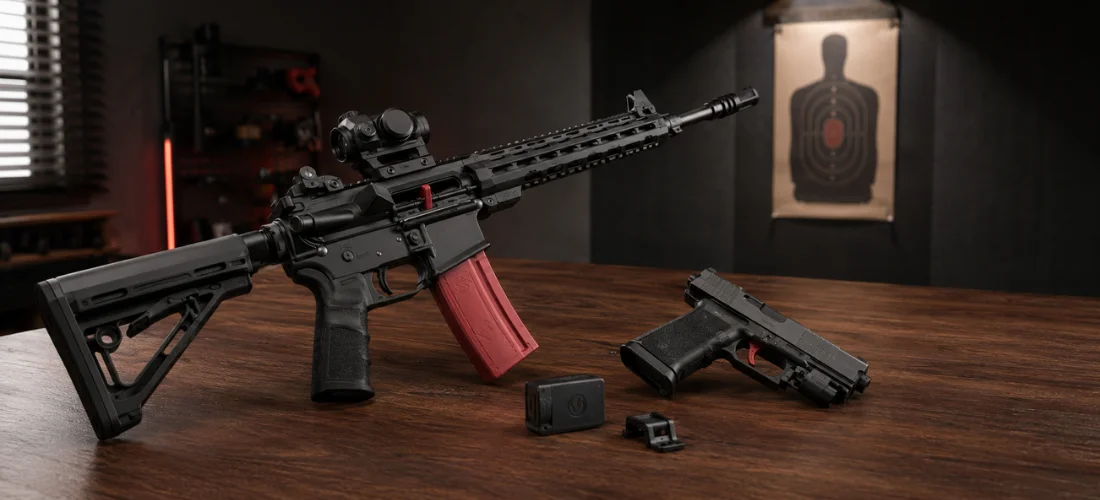
The X10 Elite is a universal movement sensor for pistols, rifles, shotguns, and bows, while Blackbeard replaces an AR-15’s bolt-carrier assembly and resets its trigger automatically. Buy the X10 for detailed shooting diagnostics across multiple platforms. Buy Blackbeard for uninterrupted AR repetitions. Many AR owners use both together.
A productive practice session needs more than pulling a trigger repeatedly. You need to know whether the sights moved, why the muzzle dipped, and whether your technique remains consistent as speed increases. With an AR-15, another problem appears: manually operating the charging handle after every press interrupts your position and rhythm. That is why the Mantis X10 Elite vs Blackbeard decision initially seems difficult.
Both improve at-home practice, but they address separate limitations. One diagnoses movement. The other keeps the rifle’s trigger operating. Understanding that distinction makes the buying decision far simpler. Dry fire training becomes smoother with the right system. In your shooting toolbag, the right tools can make a difference, and these two systems are definitely worth using.
What Is the Mantis X10 Elite?
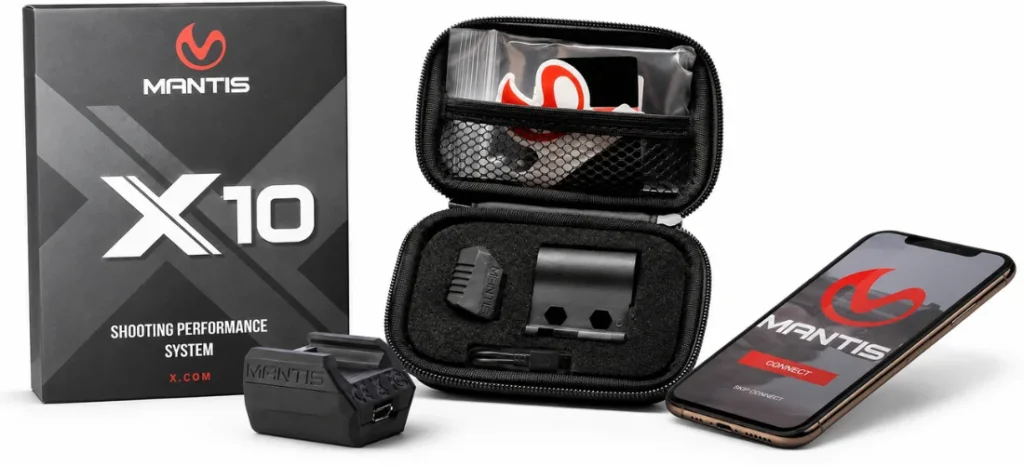
The Mantis X10 Elite is a small Bluetooth-connected sensor that attaches to a firearm or compatible adapter. It records the firearm’s orientation before, during, and after each shot, then sends the information to a mobile device for scoring and corrective feedback.
The unit does not project a laser or show an exact target impact. Its purpose is to diagnose firearm movement and the shooter’s mechanics. The system is designed for dry fire training at home and practice with live ammunition at the range. Its compact dimensions are approximately 1.3 × 1 × 0.75 inches, and the sensor weighs about 14 grams.
The X10 Elite offers a two-year warranty and a package containing the sensor, BR7 barrel-mounted rail, Universal MagRail adapter, charging cable, protective case, and quick-start guide.
How Does the IMU Sensor Track Trigger Press and Movement?
An internal IMU sensor measures orientation and acceleration continuously while the shooter aims and presses the trigger. Its accelerometer detects changes in movement and speed that are too brief or subtle for the shooter to identify consistently. The built-in gyroscope measures angular rotation, helping the software determine whether the muzzle twisted, dipped, rose, or drifted.
This data supports trigger press diagnosis by separating movement before the shot from movement during and immediately after the break. The application presents a muzzle trace that shows the firearm’s path around the aiming area. The trace is useful because a high or low score alone does not explain when the movement occurred.
Its shot-by-shot feedback assigns a score and suggests likely causes. Repeated patterns are more meaningful than one low-scoring press. The system can flag movement consistent with flinch detection, particularly when the muzzle drops sharply as the shot breaks. It may identify heeling when pressure from the heel of the hand pushes the pistol upward during the press.
A downward movement may be categorized as wrist break, especially when the pattern repeats across several shots. Lateral disturbance can sometimes indicate milking the grip, where the other fingers tighten as the trigger finger moves. Mantis groups these patterns into marksmanship error families. The suggestions are diagnostic starting points, not absolute proof of one specific mistake.
Dry Fire vs Live Fire Use
The X10 works without ammunition and can also record real range sessions. During unloaded practice, it focuses on sight stability, trigger mechanics, and follow-through. During live shooting, its live fire analytics allow users to compare their unloaded scores with their performance under noise and recoil.
The dedicated recoil analysis screen measures muzzle rise, recovery time, recoil direction, and the width of the recovery path. This can help compare grip techniques, firearms, or ammunition loads. The X10 also supports holster draw tracking, dividing a presentation into phases so users can identify where time is being lost.
Its usefulness for competition shooting comes from measuring consistency rather than merely counting repetitions. It can expose a rushed press or unstable presentation that a timer alone would miss.
Compatible Firearms: Pistol, Rifle, and Shotgun
The sensor connects directly to a suitable accessory rail. A Picatinny rail mount is usually the simplest option on a full-size pistol or modern rifle.
The included adapters expand compatibility to firearms without an available forward rail. Some models still require a separate magazine-floorplate or firearm-specific adapter.
The X10 works with pistols, rifles, shotguns, airsoft and CO2 trainers, and bows. It supports unloaded and live sessions on firearms, while archery use has its own application.
What Is the Mantis Blackbeard?
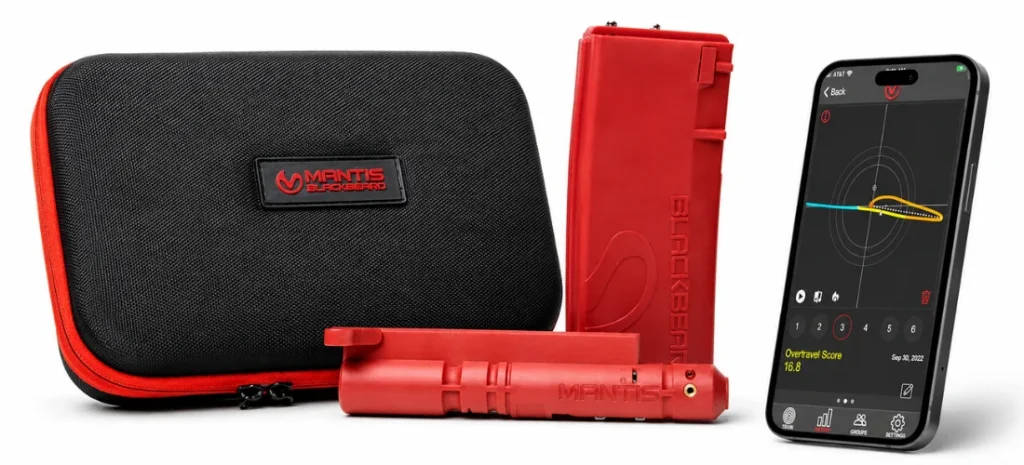
The Mantis Blackbeard is an AR-platform replacement assembly that automatically resets the hammer after each press. Installation involves removing the rifle’s original bolt and charging handle, inserting the Blackbeard assembly, and supplying power through its replacement magazine.
Its biggest benefit is that it lets the shooter retain a normal firing grip, sight picture, shoulder position, and stance between presses. The standard AR kit replaces the original bolt carrier group (BCG) with an inert electronic unit. Once installed, the rifle cannot chamber or fire live ammunition.
Power comes from a magazine-shaped battery pack inserted through the magazine well. Mantis rates it for 50,000 or more resets per charge, depending on the version and battery specifications.
How the Auto-Resetting Trigger Works
After the hammer falls, an electromechanical mechanism pushes it back into the cocked position. This creates an auto-resetting trigger without requiring permanent firearm modification. It is a drop-in trigger reset because the shooter replaces the original internal assemblies temporarily rather than changing the trigger itself.
The system can reset up to ten times per second. That is fast enough for realistic cadence practice without charging handle racking between repetitions. The shooter still uses the installed AR trigger, retaining its familiar weight, wall, break, and reset. However, the Blackbeard mechanism’s sound and mechanical impulse do not reproduce recoil or actual bolt movement.
Laser-equipped versions project a short 650nm laser pulse from the barrel whenever the trigger is pressed. Green and infrared configurations use different wavelengths.
Blackbeard vs BlackbeardX: Key Differences
The Blackbeard vs BlackbeardX distinction is built-in analysis. Standard Blackbeard resets the trigger and may provide a visible laser, depending on the configuration. BlackbeardX adds an integrated movement sensor inside the powered magazine.
The Mantis X10 Elite vs BlackbeardX comparison is closer than the standard Blackbeard comparison because both collect movement data. BlackbeardX, however, remains rifle-platform-specific and unlocks specialized transition measurements.
Those measurements include on-target delay, which shows how long the shooter remains settled on a target before breaking the shot. The system also measures over-travel, showing how far the muzzle passes a target before the shooter corrects back toward it. Its transition screen provides cadence data and movement-path information for fast strings across several aiming points.
Why AR-15 Owners Use It?
Traditional AR-15 dry fire requires the shooter to disturb their position and operate the charging handle after every trigger press. That interruption makes realistic rapid strings and transitions difficult.
With Blackbeard installed, shooters can practice ready-up presentations, target transitions, offset holds, reload sequences, positional work, and room-based movement without manually cocking the hammer.
For dedicated rifle owners, it is a strong candidate for the best AR-15 dry fire training system because it preserves the actual rifle, optic, grip, stock, sling, controls, and trigger.
It is particularly useful for 3-Gun training, where transitions, entries into position, and controlled multi-shot sequences matter as much as a single deliberate press.
Mantis X10 Elite vs Blackbeard: Full Spec and Price Comparison
| Product | Type | Compatible Firearms | Dry Fire | Live Fire | Core Feedback | Typical Price |
|---|---|---|---|---|---|---|
| Mantis X10 Elite | External movement sensor | Pistols, rifles, shotguns, airguns and bows | Yes | Yes | Movement, trigger, draw and recoil data | $249.99 |
| Blackbeard | Replacement AR trigger-reset assembly | Compatible AR-15 rifles; separate assemblies available for select platforms | Yes | No | Trigger reset and optional visible laser | $199–$249 |
| BlackbeardX | Reset assembly with integrated sensor | Model-specific AR and supported rifle variants | Yes | No | Trigger reset, movement, transitions, and delay | $299–$349 |
Prices vary by laser color, platform, bundle, and Amazon availability. Verify the exact selected configuration before ordering.
Which One Should You Buy First?
If You Shoot Mostly Pistol or Multiple Gun Types
Choose the X10 Elite first. It moves between pistols, rifles, shotguns, and supported training equipment, so it provides more value to someone who practices with several platforms.
If you are asking whether the Mantis X10 Elite is worth it, the answer is yes when you will use both home and range data. A pistol-only owner who never studies recoil or draws may be equally satisfied with the cheaper X3.
If Your Main Gun Is an AR-15
Buy Blackbeard first when the main obstacle is resetting the rifle after every press. It makes a larger immediate difference to AR practice because it preserves the firing position and allows uninterrupted strings.
The current Mantis Blackbeard price begins around $199 for the non-laser model. Red, green, and infrared versions increase the cost, while platform-specific options may be priced differently.
Blackbeard does not explain why the muzzle moved. It simply makes repetitions faster and more realistic. A standard model is therefore best for someone already capable of evaluating their own technique or using a separate diagnostic tool.
If You Want the Complete Setup: Both Together
The Mantis X10 Elite and Blackbeard combo provides automatic resets plus detailed movement feedback. Blackbeard operates the trigger, while the X10 records what happens around every press.
If you are asking Do I need Mantis X10 Elite and Blackbeard, the honest answer is no. One system can still deliver useful practice. The combination becomes worthwhile when AR training is frequent enough to justify continuous trigger operation and detailed analysis.
Using Mantis X10 Elite and Blackbeard Together
How the Two Systems Combine in the Mantis X App
Mount the X10 on the rifle’s handguard or another supported location. Install Blackbeard in place of the rifle’s original bolt assembly and charging handle, then insert the powered magazine.
Open the Mantis X app, select the appropriate rifle and detection mode, confirm the sensor orientation, and calibrate while holding the rifle still.
The X10 then scores each detected press while Blackbeard automatically recocks the hammer. This pairing works well for supported courses and training drills centered on stability, controlled cadence, positional transitions, and trigger mechanics.
BlackbeardX simplifies the hardware by integrating a sensor into the magazine. It also adds dynamic metrics that a rail-mounted X10 does not unlock, so a standard Blackbeard plus X10 is not completely identical to BlackbeardX.
Real-World Durability and Battery Life
Mantis rates Blackbeard’s powered magazine for up to 50,000 resets per charge. Treat 50,000 as the more conservative expectation. The X10 uses a rechargeable internal battery. It offers approximately eight to ten hours per charge. Session time, battery age, and connection behavior may affect the result.
Blackbeard’s moving reset mechanism experiences more mechanical work than the stationary X10 sensor. Keep the rifle clean, install the assembly correctly, and stop if the reset becomes inconsistent or the system produces unusual resistance. Both products carry Mantis’s two-year warranty for failure during normal use.
Where the Mantis X10 Elite Falls Short
The X10 does not reset a firearm’s trigger. A striker-fired pistol normally needs its slide cycled after every press unless another compatible reset solution is used. It does not display an exact simulated impact. Its score reflects measured firearm movement, not where a bullet or laser dot landed on a target.
Mounting can also complicate holster use. Some light-bearing holsters accommodate the sensor, but many standard holsters do not. The system can generate more data than a new shooter needs. Coaching suggestions should be validated against repeated patterns rather than treated as guaranteed diagnoses.
It is also expensive if the user only wants basic stability scores. The X3 provides much of the core pistol and rifle analysis for less.
Where the Blackbeard and BlackbeardX Fall Short
Standard Blackbeard is primarily AR-15-specific. Mantis sells separate assemblies for certain rifles, but one kit is not universally interchangeable across platforms.
Compatibility is not absolute. Current exclusions include .22 LR firearms, forced-reset triggers, super-safety systems, several specific aftermarket triggers, and lowers with pinned Colt sear blocks. Compatibility with some 80-percent lowers and TriggerTech units is not guaranteed.
It is limited to unloaded practice. The replacement assembly must be removed, and the rifle restored to its normal configuration before live ammunition is used. Standard Blackbeard provides little diagnostic information unless paired with another system. The laser shows approximate point of aim, but it does not explain the movement that produced it.
Mantis X10 Elite vs Blackbeard vs the Rest of the Lineup
The X2 is the least expensive Mantis movement sensor and supports unloaded pistol and rifle practice. It does not record live shots. The X3 adds range capability while retaining the core movement trace, scoring, courses, and coaching features.
The TitanX is an inert smart training pistol with automatic resetting and integrated laser functionality. It provides convenient high-volume practice but does not reproduce the exact grip and trigger of every owner’s firearm.
Laser Academy uses a chambered cartridge, smart targets, and a phone camera to record simulated impact position. It answers where the laser struck rather than why the firearm moved.
A CoolFire Trainer uses compressed gas to cycle supported pistols and produce physical movement, offering a different type of simulation from Mantis’s electronic sensors.
Final Verdict
The Mantis X10 Elite vs Blackbeard decision depends on the problem you need to solve. Buy the X10 Elite for diagnostic feedback across multiple firearms and live range sessions. Buy Blackbeard when your priority is realistic, uninterrupted AR-15 trigger practice. Buy both if the AR is a major training platform and you want automatic resets plus detailed movement data. Choose BlackbeardX instead when you want a simpler integrated AR setup and its specialized transition analytics.
FAQs
The X10 Elite is an external movement sensor that diagnoses shooting mechanics across several firearm types. Blackbeard is an inert replacement assembly that automatically resets a compatible AR trigger. The first analyzes performance, while the second removes the need to manually recock the rifle.
Yes. Install Blackbeard inside the compatible AR and mount the X10 Elite on an available rail or adapter. Blackbeard resets the hammer after each press, while the X10 records firearm movement and provides scoring and corrective feedback through the mobile application.
No. Standard Blackbeard provides automatic resets and may include a visible laser, depending on configuration. BlackbeardX adds an integrated movement sensor, application-based coaching, and specialized dynamic measurements for transitions, excess dwell, and movement beyond a target.
Yes. The X10 Elite supports unloaded practice and live range sessions with pistols, rifles, and shotguns. Its range features include recoil measurements and comparisons between shots. The sensor must be mounted securely and configured for the correct firearm and detection mode.
The X10 Elite works with most pistols, rifles, shotguns, airsoft or CO2 trainers, and supported bows. It mounts to a compatible accessory rail or adapter rather than entering the chamber, so it is not limited to one caliber. Some firearms require a separately purchased adapter.